
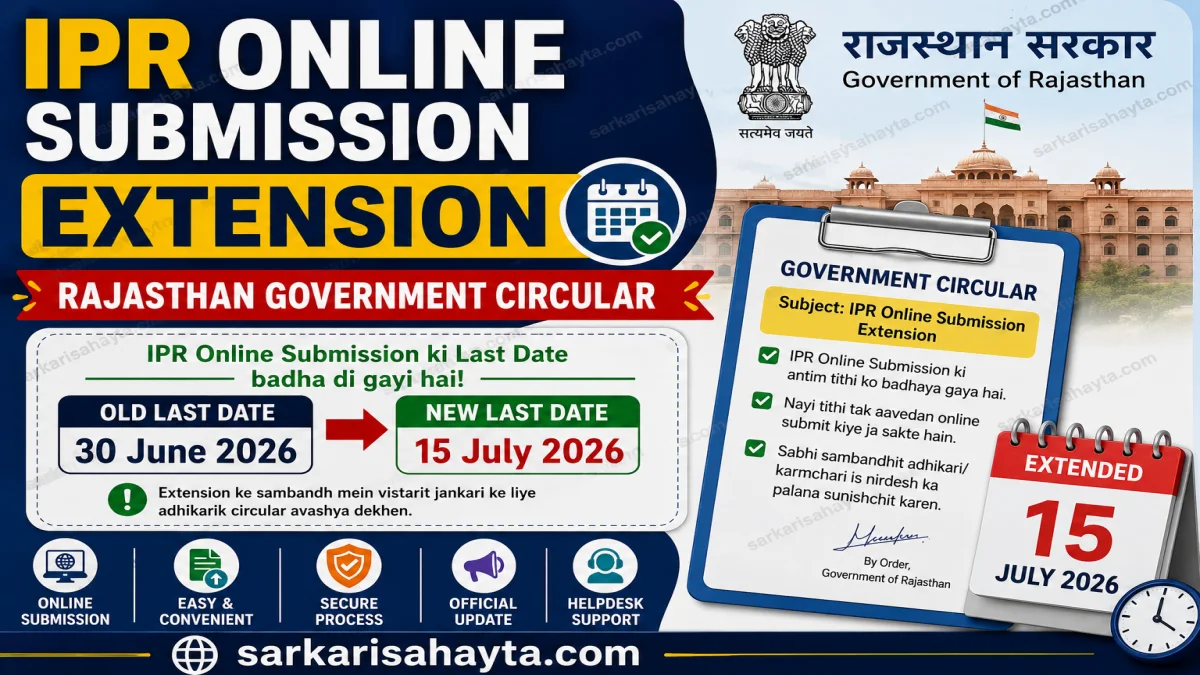
Part 1: Introduction and background of the Rajasthan Government’s circular regarding the extension of deadlines for submission of Immovable Property Returns (IPR) on the Rajkaj Portal.
On 31 July 2026, the Department of Personnel, Government of Rajasthan, issued a circular granting a final opportunity to state employees to submit their pending Immovable Property Returns (IPR) online through the Rajkaj Portal. This directive applies to all government servants, including those working under boards, corporations, autonomous institutions, and undertakings controlled by the state government. The extension period runs from 1 August 2026 to 15 August 2026, during which employees must ensure submission of their pending IPRs.
The requirement for online IPR submission was first introduced for gazetted officers from 1 January 2011, and later extended to all state employees from 1 January 2021. The government has emphasized that failure to submit IPRs will result in denial of vigilance clearance, non-consideration for promotion, and withholding of annual increments. Thus, compliance with this directive is directly linked to career progression and financial benefits of employees.
The circular highlights the responsibility of administrative heads, including Additional Chief Secretaries, Principal Secretaries, Secretaries, Heads of Departments, and District Collectors, to ensure that employees under their jurisdiction submit pending IPRs within the stipulated timeframe. This accountability mechanism ensures that compliance is monitored across all levels of government.
To assist employees, the Department of Personnel has provided detailed guidelines and links for submission. For the year 2025 (as on 1 January 2026), IPRs must be submitted through Rajkaj Version 2 software, while earlier years (2011–2024) must be submitted through Rajkaj Version 1. Employees can declare “NIL” if they do not own any immovable property, or upload scanned PDF files of filled IPR formats for respective years. The circular also provides IT support contact numbers for resolving technical difficulties.
In summary, Part 1 of this article introduces the background and significance of the Rajasthan Government’s circular on IPR submission. It underscores the importance of compliance, the extended deadline, and the accountability of administrative heads. In the next parts, we will expand on the detailed schedule, submission process, affidavit requirements, and preparation tips for employees to ensure smooth compliance.
Part 2: Step-by-Step Guide and Documentation Checklist – IPR Online Submission
A detailed explanation of the submission process for Immovable Property Returns (IPR) on the Rajkaj Portal, including timelines, procedures, and required documentation.
The Rajasthan Government’s circular dated 31 July 2026 provides employees with a final opportunity to submit pending Immovable Property Returns (IPR) online between 1 August 2026 and 15 August 2026. This extension applies to all state employees, including those working under boards, corporations, autonomous institutions, and undertakings. Compliance is mandatory, as failure to submit IPRs will result in denial of vigilance clearance, non-consideration for promotion, and withholding of annual increments.
📅 Day-Wise Timeline
Unlike medical examination notifications, the IPR circular does not assign individual dates to employees. Instead, it provides a uniform window (1–15 August 2026) for all employees to complete their pending submissions. This ensures flexibility while maintaining accountability.
📝 Documentation Checklist
Employees must prepare the following before submitting their IPR online:
- SSO ID credentials for login to the Rajkaj Portal.
- Details of immovable properties owned (land, house, flat, etc.).
- Supporting documents such as sale deeds, registration papers, or ownership certificates.
- Basic pay details and departmental information (appointing department, posted department, cadre, designation).
- Scanned PDF of filled IPR format (for legacy years 2011–2024).
- Affidavit or declaration in case of NIL property ownership.
⚙️ Submission Process
The circular outlines two distinct processes:
- For Year 2025 (as on 1 January 2026): Use Rajkaj Version 2 software via erajkaj.rajasthan.gov.in. Employees must log in with their SSO ID, verify their profile, add properties to the wallet, and submit the declaration. If no property exists, select “Declare IPR as NIL.”
- For Years 2011–2024: Use Rajkaj Version 1 (Legacy IPR). Employees must download the blank IPR format, fill in property details, sign, scan, and upload the PDF. Submitted IPRs can be updated by re-uploading revised PDFs, viewed through the “Submitted” button, or deleted if necessary.
📌 Important Notes
Employees must check the status of past IPR submissions using links provided in the circular. Administrative heads are responsible for ensuring compliance within their departments. IT support is available at helpline numbers listed in the circular for resolving technical difficulties.
In conclusion, Part 2 of this article has provided a step-by-step guide and documentation checklist for employees to complete their IPR submissions. By following these instructions, employees can ensure compliance with government directives and safeguard their career progression.
Part 3: Affidavit Requirements, Compliance Protocols, and Role of Administrative Heads – IPR Online Submission
A detailed explanation of affidavit requirements, compliance protocols, and the responsibilities of administrative heads in monitoring Immovable Property Return (IPR) submissions on the Rajkaj Portal.
The Rajasthan Government’s circular emphasizes that submission of Immovable Property Returns (IPR) is not merely a procedural formality but a mandatory compliance requirement for all state employees. To reinforce accountability, employees must submit a declaration or affidavit confirming the accuracy of their property details. This affidavit serves as a legal safeguard, ensuring that employees disclose all immovable assets honestly and transparently. In cases where no property is owned, employees must declare “NIL” ownership, which is equally binding.
The compliance protocols outlined in the circular are strict. Employees who fail to submit their IPRs within the extended deadline (1–15 August 2026) will face serious consequences, including denial of vigilance clearance, non-consideration for promotion, and withholding of annual increments. These measures underline the government’s commitment to integrity and transparency in public service. By linking compliance to career progression, the government ensures that employees treat IPR submission with the seriousness it deserves.
Administrative heads play a crucial role in monitoring compliance. The circular directs Additional Chief Secretaries, Principal Secretaries, Secretaries, Heads of Departments, and District Collectors to ensure that employees under their jurisdiction submit pending IPRs within the stipulated timeframe. This responsibility extends to boards, corporations, autonomous institutions, and undertakings controlled by the state government. By placing accountability on senior officials, the government ensures that compliance is enforced across all levels of administration.
To facilitate smooth compliance, the Department of Personnel has provided IT support and detailed manuals for employees. Technical officers are available at designated helpline numbers to resolve difficulties in online submission. Employees are encouraged to verify their profiles before submission, update incorrect details, and ensure that scanned affidavits or property documents are uploaded correctly. This structured support system minimizes errors and ensures that submissions are completed efficiently.
In summary, Part 3 of this article highlights the importance of affidavit submission, strict compliance protocols, and the role of administrative heads in monitoring IPR submissions. These measures collectively ensure transparency, accountability, and fairness in the management of immovable property disclosures by Rajasthan Government employees.
Part 4: Impact of Compliance, Transparency Measures, and Preparation Tips – IPR Online Submission
Final section of the article on Rajasthan Government’s circular regarding Immovable Property Return (IPR) submission, focusing on career impact, transparency initiatives, and preparation strategies for employees.
The Rajasthan Government’s circular dated 31 July 2026 makes it clear that compliance with Immovable Property Return (IPR) submission is directly tied to an employee’s career progression. Employees who fail to submit their IPRs within the extended deadline (1–15 August 2026) will face denial of vigilance clearance, non-consideration for promotion, and withholding of annual increments. This linkage ensures that property disclosures are treated as a serious responsibility rather than a routine formality.
Transparency is a key objective of the IPR system. By mandating online submission through the Rajkaj Portal, the government ensures uniformity, accessibility, and accountability. The availability of legacy formats (2011–2024) and updated modules (2025 onwards) allows employees to track their compliance history and rectify pending submissions. This digital approach minimizes paperwork, reduces errors, and strengthens the integrity of governance.
Administrative heads, including Secretaries, Heads of Departments, and District Collectors, are tasked with monitoring compliance within their jurisdictions. Their role is crucial in ensuring that employees under their supervision adhere to deadlines. This accountability framework reinforces discipline across all levels of administration and prevents lapses in reporting.
For employees, preparation is essential. They should:
- Verify their profile details (name, department, designation, basic pay) before submission.
- Organize property documents such as sale deeds, registration papers, and ownership certificates.
- Prepare scanned PDFs of filled IPR formats for legacy years.
- Use the “Declare IPR as NIL” option if no property is owned.
- Seek IT support promptly in case of technical difficulties.
Mental readiness and proactive planning are equally important. Employees should avoid last-minute submissions, as technical issues or incomplete documentation could lead to delays. By preparing early, verifying details, and ensuring accuracy, employees can safeguard their career progression and demonstrate integrity in public service.
In conclusion, Part 4 of this article highlights the impact of compliance on career advancement, the government’s transparency measures, and practical preparation tips for employees. The IPR submission process is not only a legal requirement but also a reflection of accountability and honesty in governance. By adhering to these guidelines, employees can ensure smooth compliance and contribute to a transparent administrative system in Rajasthan.