
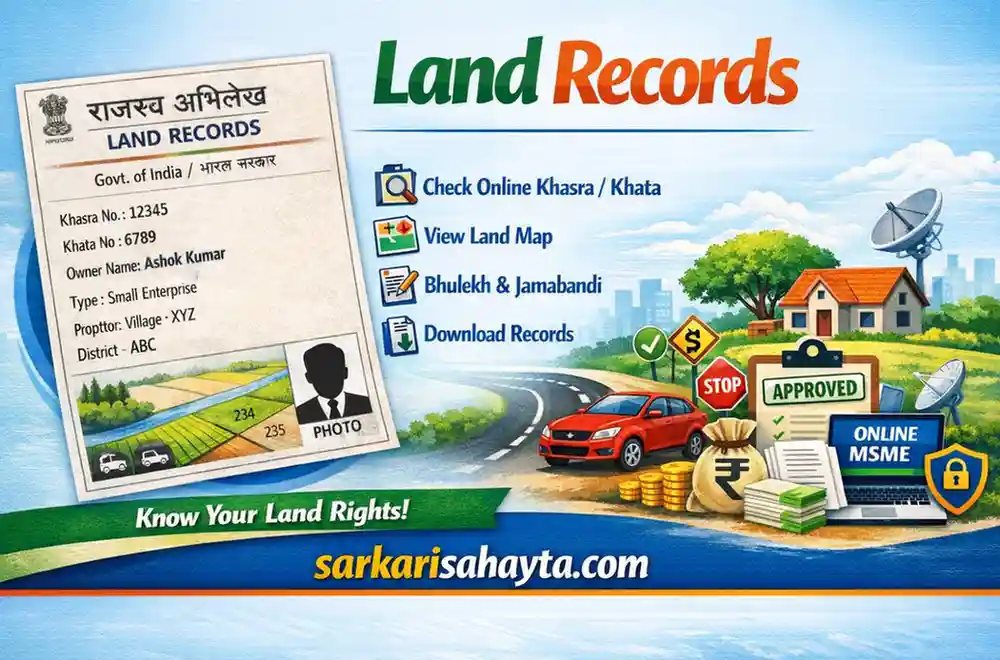
Q: What Are Land Records Services and Why Are They Important?
Answer: Land is one of the most valuable assets in India, and maintaining accurate records of ownership, usage, and transfer is essential for both citizens and the government.
This guide explains Land Records Services, their importance, digitization, online portals, benefits, challenges, and step-by-step procedures.
Whether you are a farmer, property owner, or investor, understanding land records is essential for protecting your rights.
Q: What Are Land Records?
Answer: Land records are official documents containing details about land ownership, boundaries, cultivation, and transactions.
Earlier, these records were maintained manually by revenue offices, but most states have now digitized them under the Digital India Land Records Modernization Programme (DILRMP).
- Khasra: Plot-level land details
- Khatauni: Record of land holdings
- Jamabandi: Register of rights and ownership
- Mutation: Change in ownership records
Q: Why Are Land Records Important?
Answer: Land records are important for legal, financial, and administrative purposes.
- Proof of Ownership: Establishes ownership rights
- Loan & Mortgage: Required by banks for loans
- Dispute Resolution: Helps resolve conflicts
- Government Planning: Supports taxation and schemes
- Transparency: Prevents fraud and encroachment
Q: How Have Land Records Evolved in India?
Answer: Historically, land records were maintained by village accountants in handwritten registers.
With digitization, the government introduced modern systems to improve transparency, efficiency, and accessibility.
This transformation led to the launch of the DILRMP.
Q: What is the Digital India Land Records Modernization Programme (DILRMP)?
Answer: DILRMP is a flagship government initiative to modernize land record management across India.
- Digitization of land records
- Integration with property registration
- GIS and satellite-based surveys
- Single-window citizen services
The goal is to reduce disputes, improve service delivery, and increase transparency.
Q: Which Are the Major State-Wise Online Land Record Portals?
Answer: Most Indian states now provide online land record portals.
| State | Portal Name | Website |
|---|---|---|
| Uttar Pradesh | Bhulekh UP | upbhulekh.gov.in |
| Karnataka | Bhoomi | landrecords.karnataka.gov.in |
| Maharashtra | Mahabhulekh | mahabhumi.gov.in |
| Bihar | Bihar Bhumi | biharbhumi.bihar.gov.in |
| Punjab | Jamabandi Punjab | jamabandi.punjab.gov.in |
Q: How Can You Access Land Records Online?
Answer: Citizens can easily access land records online through state portals.
- Visit official land records portal
- Select district, tehsil, and village
- Enter Khasra / Khata number or owner name
- View record of rights (ROR)
- Download or print records
Q: What Are the Benefits of Digitized Land Records?
Answer: Digitization has improved efficiency and transparency in land management.
- Convenience: Access from anywhere
- Time Saving: No office visits needed
- Accuracy: Reduced manual errors
- Security: Prevents tampering
- Transparency: Improves trust
Q: What Challenges Still Exist in Land Record Management?
Answer: Despite digitization, several challenges still affect land record management in India.
- Incomplete digitization in some states
- Mismatches between records and maps
- Resistance to digital adoption
- Legal disputes over ancestral property
- Continuous updating requirements
Q: What is the Future of Land Records in India?
Answer: The future of land record management depends heavily on advanced technologies.
- Blockchain: Tamper-proof records
- GIS Mapping: Accurate land mapping
- Artificial Intelligence: Fraud detection
- Mobile Apps: Easy citizen access
Q: Frequently Asked Questions About Land Records
Q: What is a Khasra Number?
Answer: It is a unique plot number assigned to agricultural land.
Q: Can I Download Land Records Online?
Answer: Yes, most state portals allow downloading and printing of land records.
Q: Is a Digital Land Record Legally Valid?
Answer: Yes, certified copies from official portals are legally valid.
Q: How Often Are Land Records Updated?
Answer: Records are updated after every transaction, mutation, or survey.
Q: What is ULPIN in Land Records?
Answer: ULPIN stands for Unique Land Parcel Identification Number.
It is often called the Aadhaar for land because every land parcel receives a unique 14-digit identification number.
This helps reduce fraud, illegal encroachment, and duplicate sale issues.
Q: What Key Land Record Terms Should You Know?
Answer: Understanding these terms is essential for property transactions.
- ROR (Record of Rights): Main ownership document
- Jamabandi / Khatauni: Regional names for ROR
- Bhu-Naksha: Digital cadastral map
- Mutation: Ownership transfer process
Q: How Do State-Specific Land Record Portals Work?
Answer: Every state has a dedicated portal for digital land record access.
Q: What is Karnataka Bhoomi Portal?
Answer: Karnatakas Bhoomi portal provides RTC (Record of Rights, Tenancy, and Crops), mutation status, and crop details.
Q: What is Bhulekh UP?
Answer: Bhulekh UP allows citizens to search land records using Gata/Khasra number and verify digital registry details.
Q: What is Mahabhulekh?
Answer: Maharashtras Mahabhulekh portal provides access to the digital 7/12 extract (Sat-Bara).
Q: How Can You Perform a Land Search Online?
Answer: Follow these steps to perform a land search online.
- Visit your state's land records portal
- Choose search method
- Search via Survey Number / Khasra / Owner Name
- Check digitally signed records
- Track mutation status if required
Q: What Real-Life Land Record Problems Do People Face?
Answer: These are common land-related issues faced by citizens.
- Encumbrance Issue: Land may already be mortgaged to a bank.
- Boundary Disputes: Plot dimension conflicts between neighbors.
- Ancestral Property Issues: Mutation not updated after inheritance.
Q: Why Are Land Records Important for Loans?
Answer: Banks rely heavily on digital land records during loan approval.
If land records are not digitized or contain incorrect details, loan applications may be flagged as high-risk or rejected.
Q: What Security Tips Should Landowners Follow?
Answer: Landowners should actively monitor their records.
- Periodic Checks: Review land status every 6 months
- Mobile Alerts: Register for mutation SMS alerts
- Verify Ownership: Check records regularly for unauthorized changes
Q: What is the Conclusion of Land Records Services?
Answer: Modern digital land record systems have transformed property management in India.
With ULPIN, online mutation tracking, digital maps, and state portals, citizens now have greater control and transparency over land ownership.
Using these digital tools properly can help safeguard one of your most valuable assetsyour land.