
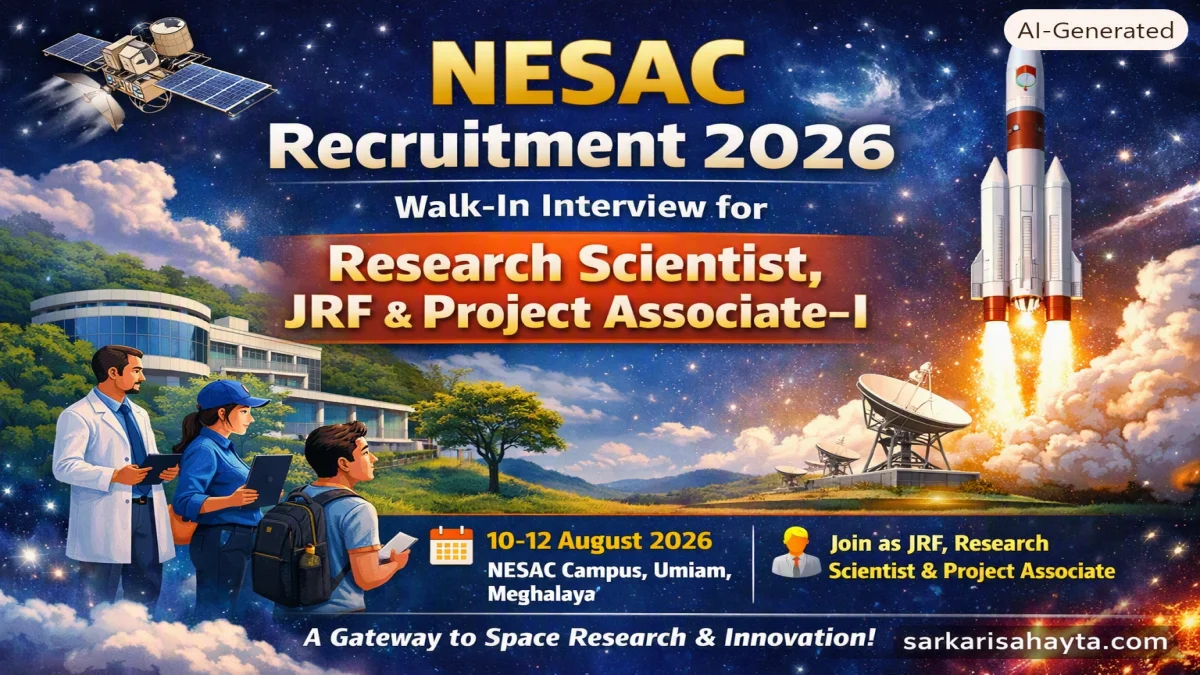
North¯Eastern¯Space¯Applications¯Centre¯(NESAC),¯Umiam,¯Meghalaya¯under¯the¯Department¯of¯Space,¯Government¯of¯India¯has¯announced¯walkin¯interviews¯for¯temporary¯positions¯of¯Research¯Scientist¯(RS),¯Junior¯Research¯Fellow¯(JRF)¯and¯Project¯Associate¯I.¯This¯is¯a¯great¯chance¯for¯students¯and¯young¯researchers¯to¯work¯in¯the¯field¯of¯space¯science¯and¯technology.¯¨
About¯NESAC
NESAC¯is¯an¯autonomous¯centre¯under¯the¯Department¯of¯Space.¯It¯helps¯the¯development¯of¯the¯NorthEastern¯Region¯using¯space¯science¯and¯technology.¯It¯works¯on¯projects¯related¯to¯remote¯sensing,¯GIS,¯satellite¯communication,¯and¯space¯atmospheric¯research.¯Its¯work¯supports¯natural¯resource¯management,¯town¯planning,¯health,¯education,¯and¯disaster¯management.¯¸
Important¯Dates
- ¸ Walkin¯Interview¯Dates:¯10¯¯12¯August¯2026
- Venue:¯NESAC¯Campus,¯Umiam,¯RiBhoi¯District,¯Meghalaya¯(85¯km¯from¯Guwahati¯and¯18¯km¯from¯Shillong)
- Reporting¯Time:¯09:30¯AM
Positions¯&¯Eligibility
🛠️ Essential Tools
¬ Research¯Scientist¯(RS)
- ©¬¯M.Sc./M.Tech¯in¯Geology,¯Applied¯Geology,¯Geophysics,¯Earth¯Science,¯Computer¯Science,¯Disaster¯Management,¯Forestry,¯Environmental¯Science,¯Physics,¯Meteorology¯or¯related¯fields¯with¯First¯Class.
- ¯Some¯posts¯require¯Ph.D¯or¯one¯year¯research¯experience¯in¯Geohazards,¯GIS,¯Remote¯Sensing,¯AI/ML,¯or¯Atmospheric¯Science.
- ¯¯Age¯Limit:¯As¯per¯NESAC¯rules¯(usually¯below¯35¯years).
ª Junior¯Research¯Fellow¯(JRF)
- ¯M.Sc./M.Tech¯in¯Forestry,¯Environmental¯Science,¯Physics,¯Chemistry,¯Earth¯System¯Science,¯Computer¯Science,¯Remote¯Sensing¯&¯GIS,¯Geoinformatics¯or¯related¯fields¯with¯First¯Class.
- ¯Valid¯NET/GATE¯qualification¯in¯the¯relevant¯field¯is¯required.
- ¯Desired¯skills:¯Python,¯R,¯MATLAB,¯Google¯Earth¯Engine,¯GIS¯analysis,¯and¯Remote¯Sensing¯data¯handling.
» Project¯Associate¯I
- ¯Bachelors¯or¯Masters¯Degree¯in¯Science/Engineering¯in¯relevant¯fields¯with¯experience¯in¯GIS,¯Remote¯Sensing,¯or¯Data¯Analysis.
- ¯Knowledge¯of¯programming¯languages¯like¯Python¯or¯JavaScript¯is¯preferred.
Salary¯&¯Benefits
- µ¯Research¯Scientist:¯As¯per¯NESAC¯project¯funds¯and¯Department¯of¯Space¯norms.
- µ¯JRF:¯Around¯INR¯37,000¯per¯month¯plus¯HRA¯(as¯per¯rules).
- µ¯Project¯Associate¯I:¯As¯per¯project¯funding¯and¯qualification.
How¯to¯Apply
Interested¯candidates¯should¯bring¯a¯filled¯application¯form¯along¯with¯original¯and¯attested¯copies¯of¯certificates,¯mark¯sheets,¯NET/GATE¯proof,¯experience¯certificates,¯and¯passportsize¯photographs¯to¯the¯interview¯venue.¯No¯TA/DA¯will¯be¯provided.¯
¸ Important¯Instructions
- ¯Electronic¯gadgets¯are¯not¯allowed¯inside¯the¯interview¯hall.
- ¯Candidates¯must¯report¯on¯time¯with¯complete¯documents.
- ¯No¯travel¯allowance¯will¯be¯paid.
- ¯Posts¯are¯temporary¯and¯projectbased.
Why¯Join¯NESAC?
Working¯at¯NESAC¯means¯being¯part¯of¯Indias¯space¯research¯family.¯You¯will¯learn¯from¯scientists,¯work¯on¯real¯projects,¯and¯help¯develop¯the¯NorthEastern¯region¯using¯space¯technology.¯Its¯a¯career¯that¯combines¯science¯and¯service¯to¯the¯nation.¯
Preparation¯Tips
- ¯Revise¯your¯subject¯basics¯and¯recent¯research¯topics.
- ¸¯Practice¯speaking¯clearly¯and¯confidently¯about¯your¯projects.
- ¯Dress¯formally¯and¯reach¯early¯at¯the¯venue.
- ¯Read¯about¯ISRO¯and¯NESACs¯recent¯missions¯and¯applications.
Day¯of¯Interview¯Checklist
- ¯Application¯form¯and¯documents¯file.
- ¸¯Passport¯photos¯(extra¯copies).
- ¯NET/GATE¯certificate¯and¯ID¯proof.
- ¯Reach¯before¯9:30¯AM.
- ¯Stay¯calm¯and¯confident.
¸ Common¯Mistakes¯to¯Avoid
- ¯Forgetting¯documents¯or¯arriving¯late.
- ¯Wearing¯casual¯clothes¯instead¯of¯formal.
- ±¯Carrying¯gadgets¯inside¯the¯premises.
- ¯Not¯revising¯basic¯concepts¯before¯interview.
Success¯Stories¯of¯Past¯Fellows
Many¯young¯researchers¯from¯NESAC¯have¯gone¯on¯to¯work¯in¯ISRO,¯universities,¯and¯international¯labs.¯Their¯journey¯started¯with¯a¯walkin¯interview¯just¯like¯this.¯Your¯story¯could¯be¯next!¯
Future Opportunities After JRF/RA
After completing your tenure at NESAC, many doors open for your career. You can pursue a Ph.D in space science, remote sensing, or atmospheric studies. Some fellows continue their journey with ISRO or other space research centres. Others move into teaching, industry R&D, or international research programs.
Working at NESAC gives you hands-on experience with satellite data, GIS tools, and real-world applications. This experience is highly valued in both government and private sectors. ¼ You can also collaborate with scientists across India and abroad, building a strong professional network.
Some fellows even start their own startups in geospatial technology, environmental monitoring, or AI-based mapping solutions. The skills learned at NESAC help them innovate and contribute to Indias technological growth.
Conclusion & Call to Action
¨ NESAC Recruitment¯2026 is a golden opportunity for young minds who love science and technology. If you have the passion to explore space applications and help the NorthEastern region grow through innovation, this is your moment. ¨
Mark the interview dates (10¯¯12¯August¯2026). Prepare your documents carefully. Revise your basics. Dress smartly. And most importantly, carry confidence and curiosity with you.
Remember, every scientist begins with a single step. This walkin interview could be the first step toward your dream career in space research. Dont miss it!
Action Point: Fill your application form, gather your certificates, and reach NESAC¯Umiam¯(Meghalaya)¯at¯9:30¯AM¯on¯your¯interview¯date. Your future in space science begins here.
Frequently Asked Questions (FAQs)
1¸ Who can apply for Research Scientist posts?
Candidates with First Class M.Sc./M.Tech in Geology, Computer Science, Disaster Management, Forestry, Environmental Science, Physics, Meteorology, or related fields. Some posts require Ph.D or one year research experience.
¸ Who can apply for JRF posts?
Students with First Class M.Sc./M.Tech in Forestry, Environmental Science, Physics, Chemistry, Earth System Science, Computer Science, Remote Sensing & GIS, Geoinformatics, or related fields. Valid NET/GATE qualification is mandatory.
¸ What is the stipend?
µ JRF: Around INR 37,000 per month plus HRA. µ Research Scientist and Project Associate salaries depend on project funds and Department of Space norms.
¸ Where will the interviews be held?
At NESAC Campus, Umiam, RiBhoi District, Meghalaya (85 km from Guwahati, 18 km from Shillong). Reporting time is 9:30 AM.
¸ What are the interview dates?
¸ Walkin interviews are scheduled on 10th, 11th, and 12th August 2026. Different posts have specific dates.
¸ Do I need to apply online?
No, this is a walkin interview. Bring your filled application form and documents directly to the venue.
¸ Will I get a permanent job at NESAC?
¸ No, these are temporary projectbased positions. They do not guarantee permanent jobs.
¸ What documents should I carry?
Application form, mark sheets, certificates, NET/GATE proof, experience certificates, publications (if any), passport photos, and ID proof.
¸ Is age relaxation available?
Yes, SC/ST/OBC candidates get relaxation as per Government of India rules.
Will NESAC provide travel allowance?
No, TA/DA will not be provided. Candidates must manage their own travel.
1¸1¸ Can I carry mobile phones inside?
No, electronic gadgets are not allowed inside the interview hall.
1¸¸ What if too many candidates come?
Screening tests may be conducted before interviews if the number of candidates is large.
Preparation Tips FAQs
1¸ How should I prepare for the interview?
Revise your basics in Remote Sensing, GIS, Physics, Environmental Science, or your subject area. Be ready to explain your project work in simple words.
¸ What kind of questions are asked?
¬ Mostly subject-related questions about your specialization (Geology, Computer Science, Disaster Management, Forestry, Atmospheric Science, etc.). Sometimes general questions about NESAC and space applications.
¸ Should I carry extra copies of documents?
Yes, always carry at least 23 sets of photocopies of your certificates and mark sheets. It shows you are well-prepared.
¸ How should I dress for the interview?
Wear neat formal clothes. For men, shirt and trousers with proper shoes. For women, formal dress or saree/salwar. Dressing smartly creates a good impression.
¸ How early should I reach the venue?
At least 30 minutes before reporting time. This gives you time to relax, find the hall, and settle down.
¸ What if I feel nervous?
Take a deep breath. Remember, the interviewers want to see your knowledge and confidence. Smile and stay positive.
¸ Should I prepare about NESAC projects?
Yes, read about NESACs recent work in remote sensing, disaster management, and space applications. It shows your interest in the organisation.
¸ How can I make a strong impression?
Be honest about what you know. Share your project experiences. Show enthusiasm for research and serving the nation.
¸ Any last-minute tips?
Keep your file neat. Revise formulas and definitions. Sleep well before the interview. Stay confident and polite.
Day of Interview Checklist
Things to Carry
- Neatly arranged file with all certificates and mark sheets
- Filled application form (Appendix A)
- ¸ Recent passport size photographs (extra copies)
- NET/GATE certificate (for JRF) or Ph.D proof (for RS)
- Experience certificates and publications (if any)
- No Objection Certificate (if working in Govt/PSU)
- ¸ Pens and a small notebook
Before Leaving Home
- Start early to avoid traffic delays
- Dress in formal clothes (neat and professional)
- Eat a light breakfast so you feel fresh
- Revise key formulas and concepts quickly
At the Venue
- Reach at least 30 minutes before reporting time
- Locate the auditorium and settle down calmly
- Keep your documents ready for verification
- Stay confident and polite with staff and interviewers
- Remember: No electronic gadgets are allowed inside
Mental Preparation
- Remind yourself: this is a learning opportunity
- Take deep breaths to stay relaxed
- Believe in your preparation and hard work
- Feel proud you are stepping into Indias space research world
¸ Common Mistakes to Avoid
Forgetting Important Documents
Many candidates arrive without all required certificates, mark sheets, or NET/GATE proof. Always doublecheck your file before leaving home.
Arriving Late
Reaching after 9:30 AM can create stress and may even disqualify you. Plan your travel and reach at least 30 minutes early.
Dressing Casually
Wearing jeans, Tshirts, or casual clothes shows lack of seriousness. Always wear neat formal attire to make a good impression.
± Carrying Gadgets
Mobile phones, smart watches, or other electronic gadgets are not allowed inside NESAC premises. Leave them at home or keep them outside.
¸ Speaking Nervously
Some candidates speak too softly or get nervous. Practice answering questions clearly and confidently before the interview.
Not Revising Basics
Interviewers often ask simple subject questions. If you forget basics, it shows poor preparation. Revise Remote Sensing, GIS, Physics, and Environmental Science fundamentals.
Untidy File
Carrying loose papers or a messy file looks unprofessional. Arrange your documents neatly in order.
Overconfidence
Confidence is good, but overconfidence can be harmful. Be polite, listen carefully, and answer honestly.
Not Knowing About NESAC
Some candidates dont read about NESAC projects. Interviewers expect you to know at least the basics of NESACs work. Read recent updates before the interview.
Poor Rest
Coming tired or sleepy reduces your performance. Sleep well the night before to stay fresh and alert.
Success Stories of Past Fellows
Story 1 From JRF to Scientist
Anita joined NESAC as a Junior Research Fellow in Environmental Science. She worked on satellite data for disaster management. Later, she cleared exams and became a Scientist in ISRO. Her journey shows how NESAC builds strong foundations.
Story 2 Computer Science Graduate to Innovator
Ramesh started as a JRF in Computer Science. He developed GIS applications and mobile tools for farmers. Today, he runs his own geospatial startup in Guwahati. His story proves that NESAC experience can lead to entrepreneurship.
Story 3 Physics Scholar to International Researcher
Priya joined as a Research Scientist in Atmospheric Science. She studied thunderstorms and lightning using satellite data. Later, she got a Ph.D fellowship abroad. Today, she works in a global climate research centre.
Story 4 Small Town Student to Professor
Rahul came from a small town in Meghalaya. He joined NESAC as JRF in Remote Sensing. After publishing papers, he became a professor in a central university. His journey shows that dedication can take you from local to national level.
Story 5 Serving the Nation
Meena joined as Project Associate I. She worked on flood mapping and disaster management. Later, she joined a government research lab and now contributes to national disaster response projects.
Future Opportunities After JRF/RA
Higher Studies (Ph.D & PostDoc)
Many JRF fellows continue their journey by enrolling in Ph.D programs in space science, remote sensing, GIS, or atmospheric studies. After Ph.D, some even go for postdoctoral research abroad.
¸ Permanent Roles in ISRO & NESAC
Though JRF/RA is temporary, it builds a strong foundation. Many fellows later clear exams and interviews for permanent scientist positions in ISRO, NESAC, or other space research centres.
Teaching & Academia
Some fellows choose to become professors or lecturers in universities. Their NESAC experience makes them excellent teachers who inspire the next generation of students.
Industry Research & Development
Private companies in geospatial technology, environment, and IT value NESAC experience. Fellows often get jobs in R&D departments of top industries. ¼
International Opportunities
With publications and NESAC experience, fellows can apply for research positions abroad. Many universities and labs welcome candidates with space research background. ¸
Entrepreneurship & Startups
Some fellows use their knowledge to start their own companies or research startups. They work on GIS apps, environmental monitoring, or AIbased mapping solutions.
Networking & Collaborations
During JRF/RA, fellows meet scientists, professors, and industry experts. These connections help in future collaborations, joint projects, and career growth.
Serving the Nation
Above all, the biggest opportunity is the pride of serving India. Whether fellows continue in ISRO, academia, or industry, their contribution strengthens the nations science and space technology.
Disclaimer: This article is written in simple English for easy understanding. For official details, candidates must refer to the original NESAC advertisement dated¯17¯July¯2026.