Comprehensive Guide to the Integrated Child Development Services Anganwadi Worker and Helper Recruitment 2026 in Dornapal Sukma Chhattisgarh
Introduction and Background of the Dornapal Project Recruitment Drive
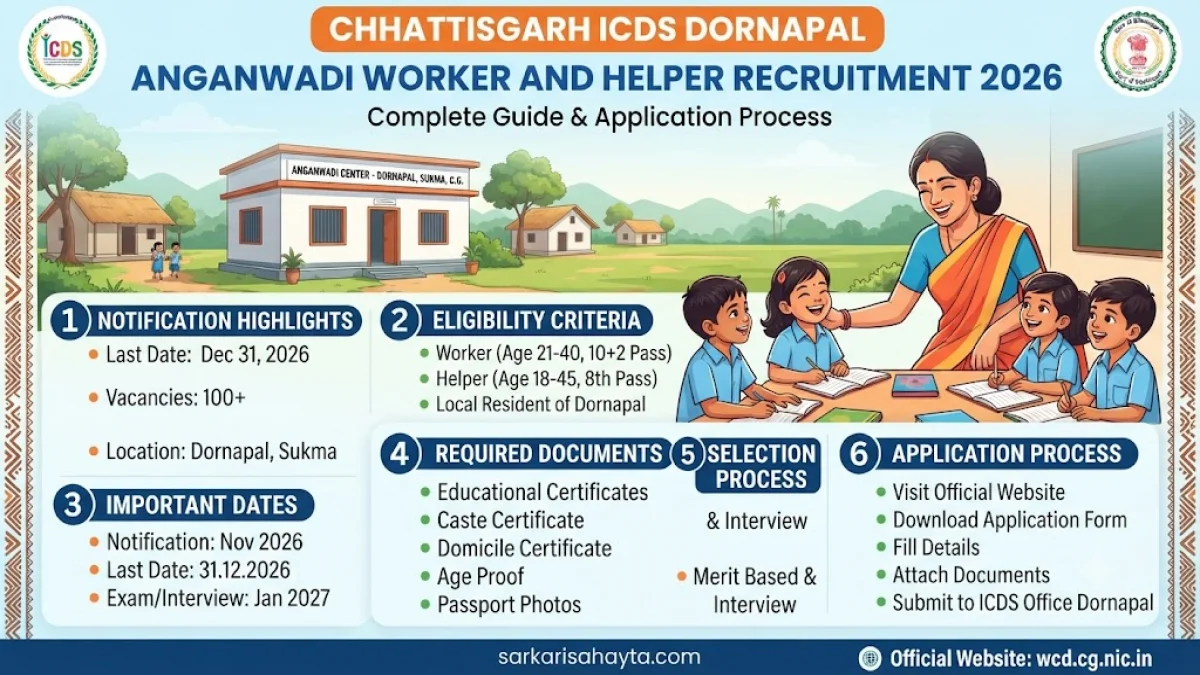
The office of the Project Officer for the Integrated Child Development Services project located in Dornapal within the Sukma district of Chhattisgarh has officially promulgated an extensive recruitment notification inviting online applications for vacant positions of Anganwadi Workers and Anganwadi Helpers . This comprehensive guide provides an exhaustive analytical breakdown of the official notification issued on 25 August 2026 under administrative reference number 2026-27, detailing the regulatory frameworks, eligibility parameters, online submission protocols via the digital portal available at https://aww.e-bharti.in, and the crucial socioeconomic significance of grassroots child welfare employment in tribal regions .
Legal Authority and Statutory Government Directives Governing the Selection Process
The recruitment notification derives absolute legal validity and administrative compliance from a sequence of foundational state-level orders and circulars issued by the Women and Child Development Department of the Government of Chhattisgarh . Specifically, the notification incorporates procedural guidelines originating from the D.K.S. Bhavan Raipur memorandum bearing reference number 728/1098/2008/M.Ba.Vi./50 dated 02 April 2008 . These legislative provisions ensure that every sequential phase of candidate selection is executed with absolute transparency, procedural uniformity, and strict alignment with state administrative regulations .
Exhaustive Breakdown of Vacant Positions Across Designated Sectors and Gram Panchayats
The current recruitment notification specifically targets twelve localized vacancies distributed across multiple operational sectors within the Dornapal project jurisdiction to guarantee precise community representation and localized service delivery . The detailed sectoral allocation encompasses the following positions:
- Sector Chimlipenta: Panchayat Pentachimli, Village Tugalpad, Center Tugalpad, position of Anganwadi Worker .
- Sector Kunded: Panchayat Ursangal, Village Ursangal, Center Ursangal 02, position of Anganwadi Worker .
- Sector Kunded: Panchayat Gondpalli, Village Gandhimarka, Center Gandhimarka 02, position of Anganwadi Worker .
- Sector Kunded: Panchayat Gondpalli, Village Gandhimarka, Center Gandhimarka 03, position of Anganwadi Worker .
- Sector Jagargunda: Panchayat Kondasanvli, Village Kondasanvli, Center Kondasanvli 01, position of Anganwadi Worker .
- Sector Dornapal: Panchayat Medwahi, Village Medwahi, Center Medwahi 03, position of Anganwadi Worker .
- Sector Kunded: Panchayat Taralaguda, Village Bainpalli, Center Bainpalli, position of Anganwadi Worker .
- Sector Chimlipenta: Panchayat Pentachimli, Village Michiguda, Center Michiguda, position of Anganwadi Helper .
- Sector Chimlipenta: Panchayat Pentachimli, Village Tekelguda, Center Tekelguda, position of Anganwadi Helper .
- Sector Chimlipenta: Panchayat Taralaguda, Village Kalaiguda, Center Kalaiguda, position of Anganwadi Helper .
- Sector Chimlipenta: Panchayat Silger, Village Silger, Center Silger 02, position of Anganwadi Helper .
- Sector Chintagufa: Panchayat Tadmmetla, Village Tadmmetla, Center Tadmmetla 02, position of Anganwadi Helper .
Honorary Nature of Appointments and Operational Financial Structures
Positions within the Anganwadi ecosystem operate strictly as honorary and non-governmental community service roles rather than regular civil service cadres . Selected candidates are entitled to receive a standardized monthly honorarium disbursed directly by the state government in accordance with prevailing policy schedules . While serving as a dedicated community-level position, this framework provides a reliable source of financial empowerment and supplementary income for rural women, assisting them in achieving economic stability while making vital contributions to grassroots developmental goals .
Mandatory Eligibility Criteria Regarding Gender Demographics and Age Boundaries
Adhering strictly to the social welfare mandate of the Integrated Child Development Services program, eligibility for both Anganwadi Worker and Helper positions is restricted exclusively to female candidates . Applicants must satisfy precise demographic boundaries, requiring their age to fall strictly between 18 and 44 years as of the date of issuance of the recruitment notification . Furthermore, the operational upper age limit for continued service within the institutional framework is capped at 65 years, ensuring a balanced integration of energetic workforce participation and experienced maturity .
Special Age Relaxations and Disqualification Clauses for Experienced Personnel
To honor and incentivize prior institutional contribution, experienced candidates who have accumulated a service tenure of one year or more as an Anganwadi Worker, Helper, Co-Helper, or Organizer are granted a special upper age relaxation of up to three years beyond the standard threshold . However, applicants possessing less than one year of documented experience are not eligible for this age relaxation benefit . The guidelines explicitly stipulate that any former worker previously dismissed from service due to administrative irregularities or misconduct remains permanently disqualified from re-entry . For validation purposes, experience certificates must be officially issued exclusively by the respective Project Officer or the District Women and Child Development Officer for urban nutrition programs .
Strict Local Residency Prerequisites and Acceptable Documentation Proofs
A fundamental prerequisite for candidacy is that the applicant must be a permanent resident of the exact revenue village where the Anganwadi center is operated . To substantiate local residency, candidates must link their application to mandatory documentation: either citing their valid entry number within the updated electoral voter roll of the respective village and uploading its copy, or furnishing an official certificate jointly signed by the village Sarpanch and Secretary . In the event of formal complaints regarding residency, validation is restricted solely to domicile certificates issued by designated competent revenue authorities .
Educational Qualification Standards for Anganwadi Worker Positions
The prescribed baseline educational qualification for the Anganwadi Worker position requires candidates to have successfully passed the 12th or preceding 11th standard board examination . To prevent administrative bottlenecks in remote tribal areas where qualified applicants may be scarce, progressive relaxation protocols are embedded within the framework . If zero applications are received from candidates meeting the primary educational benchmark, the requirement can be systematically relaxed by the evaluation committee in accordance with official government directives . For evaluation purposes, self-attested photocopies of academic marksheets are mandatory attachments .
Educational Qualification Standards and Progressive Relaxations for Anganwadi Helpers
The prescribed baseline educational qualification for the Anganwadi Helper position mandates passing the 8th standard examination . In the event that no applications are received from candidates holding an 8th standard pass certificate, the qualification criteria can be relaxed by the committee to lower educational tiers as permitted by administrative rules . For evaluation purposes, submitting self-attested copies of 8th and 5th standard marksheets is compulsory, and applications lacking proper numerical marks or total aggregate details will face outright rejection .
Mandatory Verification Rules for Grade-Based Academic Marksheets
A critical technical requirement for candidates possessing grade-based academic records rather than numerical scores (such as Grades A, B, C, or D) is that their marksheets must be officially verified and endorsed by the issuing authority . The verifying authority must explicitly record the cumulative maximum total marks, the aggregate marks obtained, and the precise percentage directly on the document before digital upload . If an applicant fails to submit a properly verified grade sheet containing these explicit numerical metrics, the evaluation committee will exercise its discretion regarding application acceptance .
Mandatory Upload Protocols for Scheduled Caste and Scheduled Tribe Certificates
Candidates applying under reservation quotas for Scheduled Castes or Scheduled Tribes must upload valid caste certificates issued by competent administrative authorities to claim entitled evaluation points . All uploaded certificates must be thoroughly self-attested by the applicant prior to digital submission . These verification steps protect the integrity of tribal welfare allocations and ensure transparent distribution of developmental opportunities .
Comprehensive Evaluation Matrix and Scoring Distribution Mechanics
The selection methodology is governed by a transparent 100-point evaluation matrix administered by the local committee . The scoring breakdown is structured as follows:
- Educational Qualification: Maximum 60 marks, calculated based on the percentage of total marks secured in the 12th board examination for Workers, or the 8th board examination for Helpers, or the relaxed equivalent qualification .
- Widowed, Deserted, or Divorced Status: Maximum 15 marks awarded to eligible women experiencing continuous separation exceeding two years or legal dissolution .
- Scheduled Caste or Scheduled Tribe Category: Maximum 10 marks awarded to applicants belonging to recognized tribal or scheduled communities .
- Prior Operational Experience: Maximum 6 marks awarded at a rate of 6 marks for possessing one year or more of documented service experience as a worker, helper, or co-helper .
- Poverty Line Status: Maximum 6 marks awarded to applicants belonging to families listed in active Below Poverty Line survey registers .
- Residential Ashram Educational Background: Maximum 3 marks awarded for successful prior study within residential girls' ashrams operated by the Scheduled Caste and Scheduled Tribe Department .
Compassionate Provisions and Verification Standards for Widows and Abandoned Women
Demonstrating profound social sensitivity, the administrative framework incorporates compassionate provisions granting additional evaluation score weightage to widows, divorcees, and deserted or abandoned women . To claim these designated points, applicants must upload explicit supporting documentation that satisfies rigorous verification standards . For abandoned women, acceptance requires either a joint certificate issued by the village Sarpanch and Secretary and verified by the sector supervisor, or a formal legal order issued by a competent court of law, provided that the separation period has endured for a continuous duration exceeding two years . Divorcees must furnish official court decree documentation, while widows must submit the death certificate of their deceased spouse .
Socioeconomic Upliftment Prioritization Through Poverty Line Documentation
Aligning directly with the foundational welfare objectives of the Integrated Child Development Services initiative, the recruitment process actively prioritizes households experiencing severe economic hardship . Applicants belonging to families officially enumerated below the poverty line must submit verified certification issued by competent local authorities, utilizing active beneficiary lists maintained by Chief Executive Officers in rural jurisdictions . Submission of this authentic poverty line documentation ensures eligibility for designated evaluation weighting .
Strict Compliance Rules Governing Document Verification and Objection Timelines
The administrative guidelines enforce an uncompromising policy regarding document submission, stating that all certificates must be self-attested and successfully uploaded alongside the digital application form . No offline applications are entertained under any circumstances by the project office . Furthermore, during the subsequent provisional merit list review and objection window, candidates are strictly prohibited from introducing novel documents, fresh certificates, or supplementary credentials that were not originally submitted during the initial application phase .
Step-by-Step Online Application Procedure via the Designated E-Bharti Portal
Modernizing the administrative workflow entirely, the submission of applications must be executed strictly through the official digital portal accessible via https://aww.e-bharti.in . Candidates are required to navigate the online interface carefully, input personal, educational, and sectoral details with absolute precision, and complete digital submissions within the active window extending from 25 August 2026 to 09 September 2026 . Applicants must submit separate online forms for each distinct post if applying across multiple categories .
Post-Application Evaluation and Provisional Merit List Publication Workflow
Upon the conclusion of the application window, the evaluation committee will systematically review all timely submissions received through the digital portal . Following this rigorous scoring assessment based on the established 100-point matrix, a provisional or draft merit list will be published directly on the official web portal . This digital publication enables candidates to examine scores and file formal objections supported by documentary evidence strictly within the stipulated time limit, ensuring democratic oversight before final selections are finalized .
Grassroots Information Dissemination and Multi-Level Administrative Oversight
To guarantee that no eligible rural woman remains uninformed about the recruitment drive, official notifications are distributed across multiple administrative channels, including the Director of Women and Child Development in Raipur, the District Collector of Sukma, the Chief Executive Officer of Janpad Panchayat Konta, the Sub-Divisional Officer of Revenue, the National Informatics Centre for portal publication, local panchayat offices, and sector supervisors . Local panchayats are mandated to display the advertisement prominently on public notice boards, while village messengers execute public announcements to maximize rural outreach . This multi-tiered oversight mechanism guarantees absolute transparency and eliminates discretionary bias across the administrative machinery .
Critical Operational Role of Anganwadi Workers and Helpers in Rural Child Development
Anganwadi Workers and Helpers serve as the indispensable operational bedrock of rural healthcare delivery, assisting in preparing nutritious supplementary meals, maintaining strict center sanitation, tracking vulnerable infants, and mobilizing local communities for immunization drives . Their ground-level involvement bridges the vital gap between state welfare policy implementation and positive nutritional outcomes for women and children in remote tribal sectors .
Socioeconomic Empowerment of Rural and Tribal Women Through Grassroots Employment
Beyond its primary child welfare objectives, this recruitment initiative functions as a powerful instrument of women's empowerment, granting rural women financial autonomy, societal respect, and leadership platforms . Securing an institutional position transforms marginalized homemakers into active contributors to local economic development and community progress .
Conclusion and Future Outlook for Community Welfare in Dornapal Sukma District
The Anganwadi Worker and Helper recruitment drive in Dornapal for 2026 exemplifies a balanced synthesis of digital administrative transformation, rigorous transparency, and profound social welfare sensitivity . By meticulously establishing local residency mandates, honoring experienced personnel, and protecting vulnerable demographics, the state government continues to fortify the grassroots infrastructure necessary for sustainable tribal growth and inclusive national prosperity .