Comprehensive Guide to the Integrated Child Development Services Anganwadi Helper Recruitment 2026 in Narharpur Chhattisgarh
Introduction and Overview of the Narharpur Anganwadi Recruitment Drive for 2026
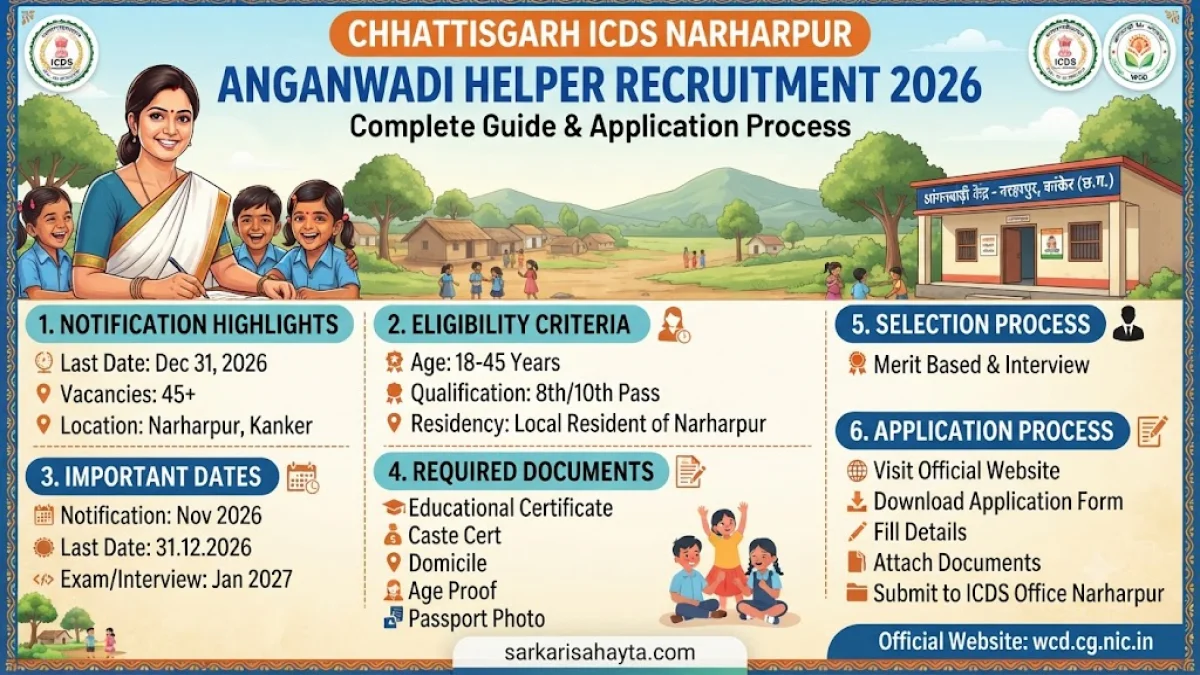
The Integrated Child Development Services project office located in Narharpur within the North Bastar Kanker district of Chhattisgarh has officially released a detailed recruitment notification for the position of Anganwadi Helper. This comprehensive article aims to explore every single aspect of this recruitment drive, providing aspirants with complete clarity regarding the procedural guidelines, eligibility frameworks, documentation requirements, and the broader social impact of grassroots child development programs in rural India.
Legal Authority and Government Directives Governing the Recruitment Process
The official recruitment advertisement carries substantial legal and administrative weight, having been issued under the direct supervision of the Project Officer of ICDS Narharpur in alignment with multiple state-level circulars and guidelines. The legal framework incorporates directives from the Directorate of Women and Child Development, Government of Chhattisgarh, including foundational memorandums dating back to April 2008, subsequent amendments in November 2019, April 2023, September 2023, and modern IT integration frameworks issued in January 2026. These sequential orders ensure that every stage of selection is conducted transparently, objectively, and strictly in accordance with state administrative protocols.
Detailed Breakdown of Vacant Positions Across Specific Gram Panchayats
The current recruitment notification specifically targets localized vacancies within designated village panchayats of the Narharpur block to ensure absolute community representation. Specifically, there is one vacant post of Anganwadi Helper allocated to Dudumbahra village within the Dabbena Panchayat, and another single vacancy designated for Rampur 2 under the jurisdiction of the Junwani Panchayat. This precise allocation ensures that administrative outreach directly reaches underserved rural pockets, fulfilling localized requirements for supplementary nutrition and early childhood care.
Mandatory Educational Qualifications and Academic Evaluation Standards
To ensure widespread inclusivity and accessibility for rural women, the minimum educational qualification required for the Anganwadi Helper post has been established as a successful pass in the 8th standard. Furthermore, the notification outlines strict guidelines for academic evaluation, noting that if an applicant's marksheet reflects grades instead of absolute numerical marks, it is legally mandatory for the candidate to procure and submit an official grading conversion certificate issued by the respective educational institution. This eliminates ambiguity during the merit preparation phase and guarantees a fair assessment of all competing candidates.
Financial Structure and Honorarium Details for Anganwadi Helpers
Recognizing the dedicated service rendered at the grassroots level, the selected candidates for the Anganwadi Helper position will receive a structured financial package comprising a base honorarium of 2,250 rupees alongside an additional administrative allowance of 2,750 rupees, culminating in a total monthly remuneration of 5,000 rupees. In addition to this baseline amount, recipients are entitled to periodic revisions and enhancements sanctioned by the state government over time, ensuring financial adaptation to shifting economic realities and providing sustained livelihood support to rural families.
Age Limit Criteria and Specific Relaxations for Experienced Personnel
The recruitment guidelines establish a clear demographic bracket, requiring applicants to be at least 18 years of age while not exceeding 44 years as of the qualifying date. To honor prior institutional contribution, experienced candidates who have previously served as Anganwadi Workers or Helpers are granted a special upper age relaxation of up to three years. This policy successfully balances the induction of energetic young participants with the retention of seasoned operational wisdom within the child development ecosystem.
Compassionate Provisions and Special Categories for Vulnerable Women
Demonstrating deep social sensitivity, the administrative framework incorporates dedicated provisions for windows, divorcees, and abandoned women seeking socioeconomic rehabilitation. Widows are required to present an official death certificate of their deceased spouse along with a verified panchayat-issued document. Meanwhile, divorcees and legally separated or abandoned women must furnish a formal court decree or a recognized societal certificate accompanied by a panchayat attestation confirming that the separation period has spanned a minimum of two years.
Socioeconomic Prioritization Through Poverty Line Documentation
In strict alignment with the welfare objectives of the Integrated Child Development Services initiative, the recruitment process prioritizes households facing economic hardships. Applicants belonging to families officially enumerated in the 2011 Below Poverty Line survey must submit a valid, verified certificate issued by a competent government authority. This mandatory requirement ensures that employment opportunities systematically uplift marginalized economic strata and directly benefit households requiring financial support.
Rigorous Verification Standards for Residence and Caste Certificates
To preserve local integrity and ensure that positions are filled exclusively by deserving native inhabitants, candidates must submit authentic residence and caste certificates issued by competent revenue or administrative authorities. In specific scenarios where traditional government residential documentation is unavailable, a joint residence certificate bearing the official signatures of both the village Sarpanch and Panchayat Secretary is accepted. For candidates applying under Scheduled Caste and Scheduled Tribe reservations, validation is strictly restricted to certificates sanctioned by designated competent authorities.
Evaluation Weightage and Experience Incentives for Former Workers
A notable highlight of the Narharpur recruitment notification is the integration of an experience reward mechanism designed to honor past service within the department. Women who possess documented prior experience working as Anganwadi Workers or Helpers are awarded distinct scoring advantages during evaluation. This strategic incentive not only validates years of dedicated community labor but also elevates the operational efficiency of local centers by incorporating trained personnel who understand programmatic nuances.
Mandatory Requirement of Local Village Residency for Applicants
The administrative notification enforces a strict geographical prerequisite stating that every applicant must be a permanent resident of the exact village where the vacancy exists. This localization rule is designed to eliminate commuting barriers, guarantee immediate availability during emergencies, and foster profound community trust between the Anganwadi center and local families, as the helper shares the cultural and social environment of the beneficiaries she serves.
Step-by-Step Online Application Procedure via the Designated Portal
Modernizing the administrative workflow, the submission of applications must be executed strictly through the official web portal https://aww.e-bharti.in. Applicants are required to navigate the digital interface carefully, input personal, academic, and category details accurately, and complete the digital submission process within the stipulated timeframe extending from 25 August 2026 to 9 September 2026.
Crucial Mandate for Offline Hard Copy Submission and Document Verification
Completing solely the digital registration on the web portal is insufficient for candidacy validation; applicants are legally bound to compile self-attested photocopies of all supporting academic certificates, category proofs, and residential documents for physical submission directly to the project office. The notification explicitly warns that failure to submit these hard copies will result in the outright rejection of the application, rendering digital data void.
Strict Timelines and Deadlines Governing the Entire Recruitment Schedule
Time management forms a cornerstone of this recruitment drive, with the active online application window opening on 25 August 2026 and culminating strictly on 9 September 2026. The project office has maintained a firm stance that any applications, physical files, or representations received after the final deadline will face summary dismissal without any administrative review or consideration, urging applicants to execute their submissions well before closure dates.
Grassroots Information Dissemination Through Panchayats and Village Messengers
To guarantee that no eligible woman remains uninformed about the active vacancies, official copies of the advertisement have been distributed across multiple administrative desks, including the District Program Officer and the Chief Executive Officer of the Janpad Panchayat. Furthermore, local panchayats are instructed to display the notice prominently on public notice boards while village messengers, known locally as Kotwars, execute public drum announcements to maximize rural reach.
Multi-Level Administrative Oversight and Accountability Mechanisms
Transparency is rigorously maintained through a multi-tiered oversight structure involving district-level supervisors, block development officers, and panchayat executive functionaries. Copies of administrative orders are dispatched to relevant sector supervisors in Narharpur to monitor local compliance, eliminate discretionary bias, and ensure that merit remains the singular benchmark for final candidate selection.
Critical Role of Anganwadi Helpers in Supporting Child and Maternal Health
Anganwadi Helpers serve as the foundational bedrock of rural healthcare delivery, assisting accredited Anganwadi Workers in preparing nutritious supplementary meals, maintaining strict center sanitation, tracking pregnant and lactating mothers, and mobilizing local communities for immunization drives. Their ground-level involvement bridges the gap between state welfare policy implementation and grassroots health outcomes.
Historical Evolution and National Significance of the ICDS Framework
Launched initially in 1975, the Integrated Child Development Services program represents one of the most expansive public welfare initiatives globally, designed to combat malnutrition, morbidity, and impaired educational development among children under six years of age. By systematically organizing health check-ups, preschool non-formal education, and nutritional distribution, the overarching program safeguards the foundational human capital of the nation.
Empowering Rural Women Through Grassroots Employment Opportunities
Beyond its primary child welfare objectives, the recruitment initiative functions as a powerful instrument of women's empowerment, granting rural women financial autonomy, societal respect, and leadership platforms. Securing an institutional position transforms marginalized homemakers into active contributors to local economic development and community progress.
Conclusion and Future Outlook for Community Development in Narharpur
The Anganwadi Helper recruitment drive in Narharpur for 2026 exemplifies a balanced synthesis of digital transformation, administrative transparency, and profound social welfare sensitivity. By meticulously establishing local residency mandates, honoring experienced personnel, and protecting vulnerable demographics, the state government continues to fortify the grassroots infrastructure necessary for sustainable rural growth and inclusive national prosperity.