Welcome to the Complete Guide on UPPSC Civil Judge (Junior Division) Examination 2026: Notification, 365 Vacancies, Eligibility, Age Limit, Syllabus and Online Application Process
The Uttar Pradesh Public Service Commission (UPPSC) has officially released the notification for the Uttar Pradesh Judicial Service Civil Judge (Junior Division) Examination 2026. This highly prestigious recruitment offers aspiring legal professionals an opportunity to enter the state's judicial system and serve as Civil Judges in Uttar Pradesh.
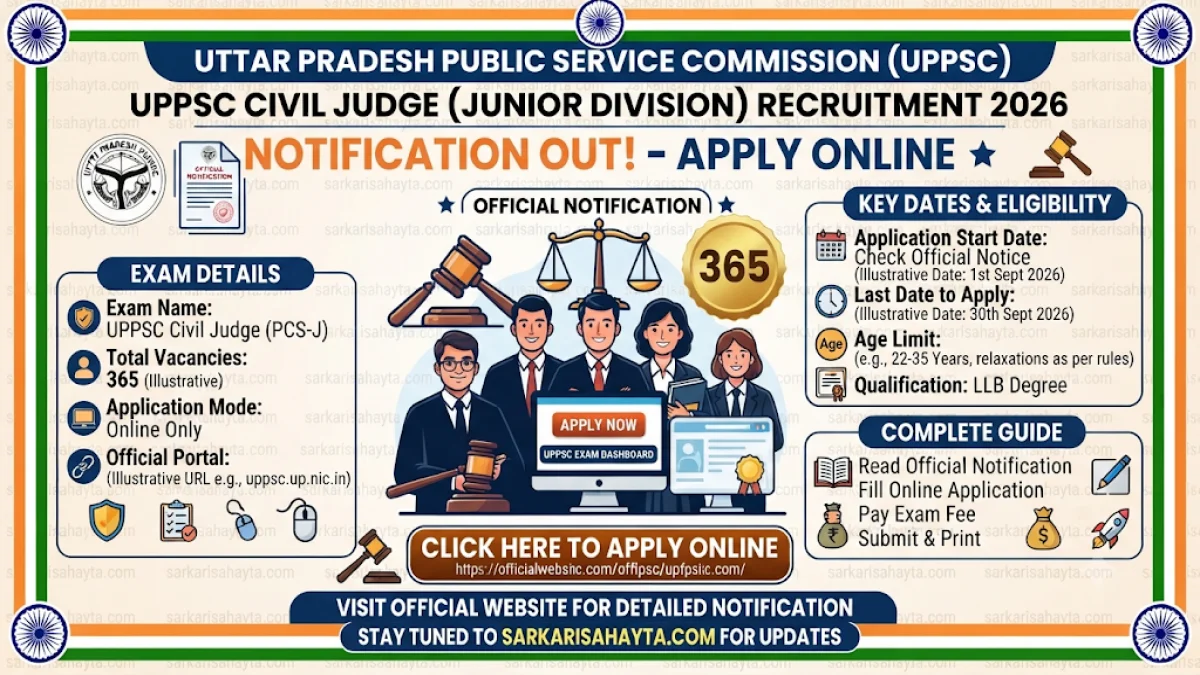
The latest notification has generated significant interest among law graduates and practicing advocates because it introduces important eligibility provisions, updated legal requirements, examination details, and a structured selection process. A total of 365 vacancies have been notified, making this one of the most important judicial recruitment drives in recent years.
Candidates aiming for a respected judicial career should carefully understand the eligibility criteria, age requirements, application procedure, reservation rules, syllabus, examination pattern, and selection methodology before applying. This comprehensive guide has been prepared to provide a detailed understanding of every major aspect of the recruitment process while helping aspirants strategically plan their preparation.
Table of Contents
- UPPSC Civil Judge 2026 Overview
- Essential Full Forms
- Important Dates
- Vacancy Details
- Eligibility Criteria
- Age Limit
- Educational Qualification
- One Time Registration (OTR)
- How to Apply Online
- Application Fee
- Selection Process
- Exam Pattern
- Detailed Syllabus
- Salary and Career Growth
- Preparation Strategy
- Expert Analysis
- Frequently Asked Questions
UPPSC Civil Judge (Junior Division) 2026 Overview
The Uttar Pradesh Judicial Service Civil Judge (Junior Division) Examination is conducted by UPPSC for recruitment to the state judicial services. The examination is considered one of the most prestigious opportunities available for legal professionals seeking a judicial career.
| Particulars | Details |
|---|---|
| Recruitment Authority | Uttar Pradesh Public Service Commission (UPPSC) |
| Post Name | Civil Judge (Junior Division) |
| Advertisement Number | A-6/E-1/2026 |
| Total Vacancies | 365 |
| Job Category | State Judicial Service |
| Pay Level | Level-10 |
| Selection Method | Preliminary Exam, Main Exam and Interview |
Essential Full Forms
| Abbreviation | Full Form |
|---|---|
| UPPSC | Uttar Pradesh Public Service Commission |
| OTR | One Time Registration |
| EWS | Economically Weaker Sections |
| OBC | Other Backward Classes |
| SC | Scheduled Caste |
| ST | Scheduled Tribe |
| PWD | Persons with Disabilities |
| LL.B. | Bachelor of Laws |
| OMR | Optical Mark Recognition |
Important Dates
| Event | Date |
|---|---|
| Notification Release | 20 November 2026 |
| Start of Online Application | 20 November 2026 |
| Last Date for Fee Payment & Application Submission | 21 December 2026 |
| Application Correction / Modification Last Date | 28 December 2026 |
UPPSC Civil Judge Vacancy 2026
The commission has notified 365 vacancies for the Civil Judge (Junior Division) post. The final number may increase or decrease depending on administrative requirements.
| Category | Vacancies |
|---|---|
| Unreserved | 148 |
| Scheduled Caste | 76 |
| Scheduled Tribe | 07 |
| Other Backward Classes | 98 |
| Economically Weaker Sections | 36 |
| Total | 365 |
Eligibility Criteria
Candidates applying for the UP Judicial Service Examination must satisfy all eligibility conditions prescribed in the notification. Since this recruitment aims to appoint judicial officers, educational qualifications and legal experience play a decisive role in determining eligibility.
Age Limit
Applicants must have attained 22 years of age and should not have attained more than 35 years of age as on 01 July 2027. This means candidates must not have been born before 02 July 1992 and after 01 July 2005. Age relaxations are applicable as per notification provisions.
An important provision in the notification states that candidates who were age-eligible in the examinations of 2023, 2024 and 2025 shall also be considered age eligible under specified conditions.
Educational Qualification
The candidate must possess a Bachelor of Laws (LL.B.) degree from a recognized university and must be enrolled as an advocate under the Advocates Act, 1961. The candidate should also be entitled to practice before courts subordinate to the High Court.
The notification further specifies that the candidate must have completed at least one year of legal practice as on the date of advertisement publication, subject to the transitional provisions mentioned in the notification and the Supreme Court directions cited therein.
A thorough knowledge of Hindi in Devanagari script is mandatory.
One Time Registration (OTR) Requirement
UPPSC has made One Time Registration (OTR) mandatory for all applicants. Candidates must obtain their OTR number before submitting the online application form. Those who have not completed OTR are required to obtain it before proceeding with the application process.
The Commission has specifically advised candidates to obtain the OTR number at least 72 hours before the submission of the online application.
How to Apply Online
- Complete OTR registration.
- Visit the UPPSC online application portal.
- Authenticate using the OTR number.
- Fill educational and eligibility details.
- Verify personal information.
- Deposit application fee.
- Preview the application form.
- Submit the final application.
- Take a printout for future reference.
Candidates should preserve every stage of the application process, including registration details, fee receipt, application form, and submission confirmation.
Application Fee
| Category | Total Fee |
|---|---|
| General / EWS / OBC | ₹125 |
| SC / ST | ₹65 |
| PWD | ₹25 |
| Ex-Servicemen | ₹65 |
Selection Process
The selection process consists of three stages:
- Preliminary Examination
- Main (Written) Examination
- Interview / Viva-Voce
Candidates successful in the Preliminary Examination are shortlisted for the Main Examination. Thereafter, candidates qualifying the Main Examination are called for Interview. Final selection is based on combined performance in the Main Examination and Interview.
Examination Pattern
Preliminary Examination
- Paper-I: General Knowledge (150 Marks)
- Paper-II: Law (300 Marks)
The Preliminary Examination is objective in nature. There is negative marking of one-third (0.33) marks for every incorrect answer.
Main Examination
- General Knowledge – 200 Marks
- English Language – 100 Marks
- Hindi Language – 100 Marks
- Law-I (Substantive Law) – 200 Marks
- Law-II (Procedure & Evidence) – 200 Marks
- Law-III (Penal, Revenue & Local Laws) – 200 Marks
Interview
The Interview carries 100 marks and evaluates the candidate's suitability for judicial service, including merit, character, personality, and overall aptitude.
Detailed Syllabus Highlights
General Knowledge includes Indian History, Geography, Polity, Economy, Current Affairs, Science & Technology, Social Issues, and legislation relating to women, children, senior citizens, and persons with disabilities.
Law papers cover Constitutional Law, Jurisprudence, Transfer of Property Act, Contract Act, Evidence Law, Civil Procedure Code, Criminal Procedure, Bharatiya Nyaya Sanhita, Bharatiya Nagarik Suraksha Sanhita, Bharatiya Sakshya Adhiniyam, U.P. Revenue Code, Municipal Laws and other important legal subjects.
Salary and Career Growth
Selected candidates will receive pay under Level-10 with a revised pay scale of ₹77,840 to ₹1,36,520. Judicial officers also receive various admissible allowances and benefits according to applicable service rules.
The Civil Judge (Junior Division) position serves as the foundation of a long-term judicial career. Officers may earn promotions to Senior Civil Judge, District Judge and other higher judicial positions through service progression and performance.
Smart Preparation Strategy
- Master Constitutional Law and Procedural Laws.
- Focus on recent legal developments.
- Practice previous years' judiciary papers.
- Strengthen Hindi and English drafting skills.
- Maintain updated notes for current affairs.
- Study landmark Supreme Court decisions.
- Develop analytical answer-writing skills.
- Prepare systematically for viva-voce.
Successful judiciary aspirants generally maintain a balanced preparation strategy that combines conceptual understanding, statutory interpretation, writing skills, and current legal awareness.
Expert Analysis
The 2026 Civil Judge notification represents a significant opportunity for law graduates and advocates. With 365 vacancies and a structured recruitment process, competition is expected to remain very high.
One notable feature of the notification is the emphasis on legal practice eligibility and compliance with recent judicial directions. Candidates should not merely prepare for examinations but also ensure complete compliance with eligibility requirements and document verification standards.
Applicants who begin their preparation early and maintain a disciplined study plan focused on law subjects, answer writing, and current legal developments are likely to have a meaningful advantage in this highly competitive judicial service examination.
Frequently Asked Questions (FAQs)
- How many vacancies are available in UPPSC Civil Judge 2026?
- The notification has announced 365 vacancies for the post of Civil Judge (Junior Division).
- What is the last date to apply online?
- The last date for payment of fee and submission of the online application is 21 December 2026.
- Is OTR mandatory for applying?
- Yes, One Time Registration (OTR) is mandatory before submitting the application form.
- What is the minimum educational qualification required?
- Candidates must possess an LL.B. degree and be enrolled as an advocate as prescribed in the notification.
- What is the age limit for the examination?
- Candidates must be between 22 and 35 years of age subject to applicable relaxations.
- Is there negative marking in the Preliminary Examination?
- Yes, one-third (0.33) mark is deducted for every incorrect answer.
- What is the salary of Civil Judge (Junior Division)?
- The post carries Level-10 pay with a revised scale of ₹77,840 to ₹1,36,520.
- How many stages are there in the selection process?
- There are three stages: Preliminary Examination, Main Examination and Interview.
- Is knowledge of Hindi compulsory?
- Yes, thorough knowledge of Hindi in Devanagari script is mandatory.
- Can law graduates without enrollment apply?
- Candidates must fulfill the enrollment and legal practice requirements specified in the notification before applying.
Conclusion
The UPPSC Civil Judge (Junior Division) Examination 2026 provides an outstanding opportunity for advocates and law graduates seeking a prestigious career in the judicial system. With attractive pay, substantial vacancies, and long-term growth prospects, the recruitment is expected to draw applications from some of the most dedicated legal professionals in the country.
Candidates should carefully review the eligibility conditions, complete OTR registration on time, prepare systematically according to the official syllabus, and maintain all required documentation. A well-planned preparation strategy combined with strong legal fundamentals can significantly improve the chances of securing success in this highly competitive judicial examination.