
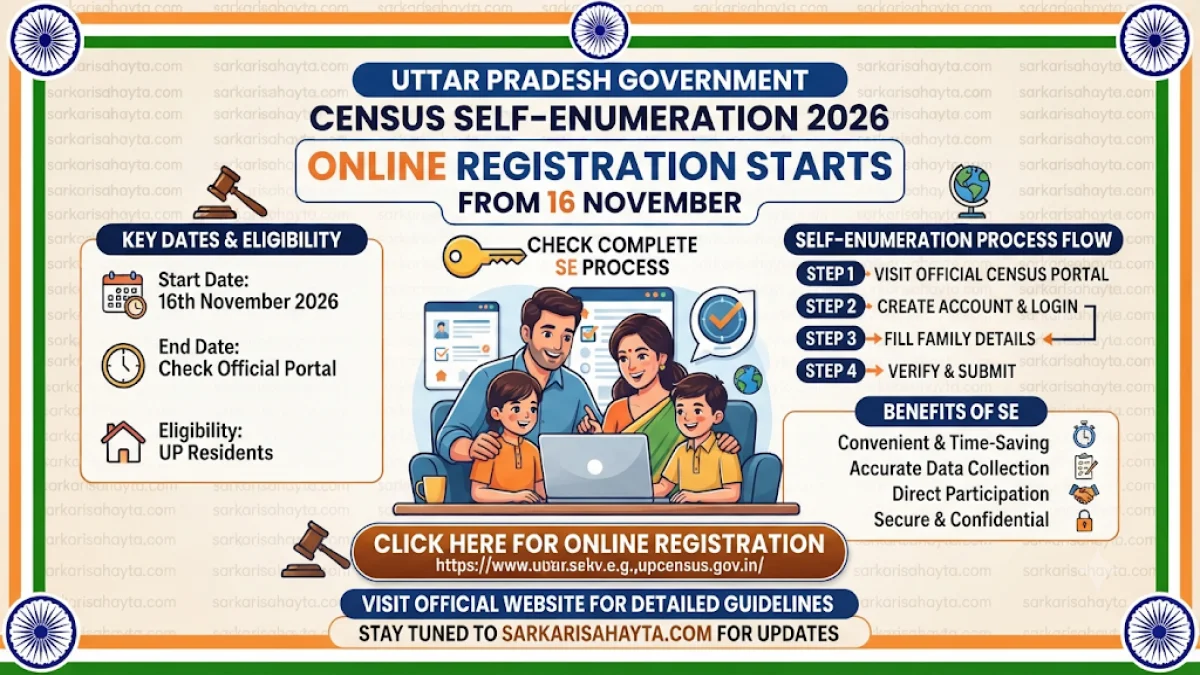
UP Census Self-Enumeration (SE): Complete Guide to Online Self Enumeration, Registration Process, Benefits, Documents and Important Information
India is moving towards a more technology-driven and citizen-friendly census system, and Self-Enumeration (SE) is one of the most significant innovations in this direction. The Uttar Pradesh Census Self-Enumeration facility allows residents to provide household and demographic information digitally, enabling faster, more accurate, and more efficient data collection.
The Self-Enumeration process empowers citizens to submit family details themselves instead of relying solely on traditional door-to-door data collection. This digital approach not only improves accuracy but also reduces errors, saves time, and supports effective planning and policy formulation by government authorities.
For residents of Uttar Pradesh, understanding the Self-Enumeration process is crucial because census data influences government planning, welfare schemes, infrastructure development, educational facilities, healthcare expansion, employment initiatives, and resource allocation for future generations.
What is UP Census Self-Enumeration (SE)?
Self-Enumeration (SE) is a digital facility through which individuals can enter census-related information about themselves and their household members through an online system. Instead of waiting for an enumerator to record the information manually, citizens can voluntarily provide accurate details about their family and residence through the official census platform.
The objective is to increase participation, reduce data collection errors, improve efficiency, and enable citizens to actively contribute to the national census process.
UP Census Self-Enumeration (SE) Important Dates
The Uttar Pradesh Self-Enumeration (SE) process has been introduced to enable residents to submit census-related household information online within the prescribed timeline. Citizens should complete the self-enumeration process before the deadline to ensure their details are included accurately in the census records.
| Event | Date |
|---|---|
| Self-Enumeration Start Date | 16 November |
| Self-Enumeration Last Date | 30 November |
| Mode of Submission | Online Self-Enumeration (SE) |
| Applicable Region | Uttar Pradesh |
Residents are advised to complete the Self-Enumeration process during the registration window and verify all family details carefully before final submission. Accurate information helps ensure reliable census records and supports effective government planning and welfare program implementation.
Why is Census Important?
A census is much more than a population count. It serves as the foundation for planning and policy decisions at national, state, district, and local levels. Governments use census information to understand demographic trends and prepare development strategies.
- Planning educational institutions.
- Healthcare infrastructure development.
- Road and transport planning.
- Employment and skill development programs.
- Urban and rural development projects.
- Social welfare policies.
- Housing and public utility planning.
- Resource allocation and budgeting.
Objectives of Self-Enumeration
The introduction of Self-Enumeration is intended to modernize data collection and enhance public participation.
- Improve accuracy of population data.
- Reduce dependency on physical visits.
- Enable citizens to verify information before submission.
- Speed up census operations.
- Promote digital governance.
- Increase transparency in data collection.
- Reduce human errors in recording information.
Who Can Use Self-Enumeration?
Self-Enumeration is intended for households that have access to digital devices and internet connectivity. An eligible household representative can enter details for all family members residing in the household.
Generally, the head of the family or an authorized adult household member can complete the process on behalf of the entire family.
Benefits of Self-Enumeration
Convenience
Residents can complete the process from their homes without waiting for a field visit by an enumerator.
Greater Accuracy
Household members know their personal details better than anyone else, which reduces the possibility of incorrect entries.
Time Saving
The digital process minimizes paperwork and speeds up data collection.
Data Verification
Users can review information before final submission, helping improve the quality of census records.
Digital Integration
The initiative supports India's broader digital governance transformation and strengthens modern public administration systems.
Information Typically Required During Self-Enumeration
To ensure accurate census records, households may be required to provide various demographic and residential details.
- Name of family members.
- Age and date of birth.
- Gender.
- Marital status.
- Educational qualifications.
- Occupation details.
- Relationship with the head of the family.
- Residential status.
- Migration information.
- Housing details.
- Language information.
- Other census-relevant demographic information.
Documents That May Be Helpful
Although requirements may vary depending on census guidelines, keeping the following documents handy can simplify the process:
- Aadhaar Card.
- Voter ID.
- Birth Certificates.
- Educational Certificates.
- Ration Card.
- Electricity Bill.
- Address Proof.
- Family Member Details.
- Mobile Number.
- Email Address.
Step-by-Step Self-Enumeration Process
- Access the official census self-enumeration platform.
- Create a user account if required.
- Verify your mobile number through OTP.
- Enter household details.
- Add information for all family members.
- Fill residential and demographic information.
- Review all entries carefully.
- Correct any mistakes before submission.
- Submit the completed self-enumeration form.
- Save the acknowledgement or reference number.
How Self-Enumeration Improves Data Accuracy
Traditional census methods depend heavily on field-level data collection. While highly effective, manual recording may sometimes result in spelling errors or incomplete information. Self-Enumeration allows households to enter details directly, significantly reducing such issues.
Since family members can review their own information before submission, the overall quality and reliability of census records improves considerably.
Role of Census Data in Development
Government agencies depend heavily on census statistics while planning welfare and development programs. Accurate census information helps authorities identify the needs of different regions and communities.
Benefits of accurate census data include:
- Better healthcare planning.
- Improved educational infrastructure.
- Enhanced social welfare targeting.
- Smarter urban development projects.
- Efficient transportation planning.
- Evidence-based policymaking.
- Balanced resource distribution.
Common Mistakes to Avoid
- Entering incorrect names.
- Providing wrong date of birth details.
- Missing family members.
- Incorrect relationship information.
- Using outdated address records.
- Submitting incomplete forms.
- Skipping mandatory fields.
Why Every Household Should Participate
The census is one of the largest administrative exercises conducted by the government. Every household's participation directly contributes to better governance and more effective developmental planning. Missing or inaccurate information may affect the quality of statistical insights used by policymakers and administrators.
Participation in Self-Enumeration ensures that your household's demographic information is accurately represented in official records.
Digital India and Self-Enumeration
Self-Enumeration aligns with the broader vision of Digital India by encouraging online citizen participation in governance initiatives. It promotes paperless administration, efficient record management, and citizen-centric public services.
The transition towards digital census operations demonstrates how technology can improve large-scale government programs while making them more accessible and transparent.
Future of Census Data Collection
Digital census platforms represent the future of population data collection. As internet penetration and digital literacy continue to increase, Self-Enumeration is expected to become an important component of modern census operations.
This evolution will help governments gather more accurate information quickly while improving convenience for citizens and reducing operational challenges.
Conclusion
UP Census Self-Enumeration (SE) is a significant step toward modernizing census operations and encouraging citizen participation in data collection. By allowing households to submit their information digitally, the process becomes faster, more transparent, and more accurate. Accurate census data is essential for effective governance, public welfare programs, infrastructure development, healthcare planning, and educational expansion. Citizens should complete the Self-Enumeration process carefully and ensure all household information is submitted accurately to contribute to the state's development planning.
Frequently Asked Questions (FAQs)
- What is UP Census Self-Enumeration (SE)?
- Self-Enumeration is a digital process that allows residents to provide census-related household and demographic information online.
- Who can complete the Self-Enumeration process?
- An adult household member or head of the family can generally complete the process on behalf of all family members.
- Why is Self-Enumeration important?
- It improves data accuracy, reduces errors, saves time, and allows citizens to participate directly in census data collection.
- What information is usually required for Self-Enumeration?
- Details such as family member names, age, education, occupation, housing information, and demographic data are generally required.
- Can information be reviewed before final submission?
- Yes, users are typically able to review entered details before submitting the final self-enumeration form.
- How does census data help governments?
- Census data supports planning related to healthcare, education, infrastructure, employment, welfare programs, and resource allocation.
- What documents may be useful during Self-Enumeration?
- Aadhaar, voter ID, address proof, birth certificates, and family information records can be helpful.
- Does every household need to participate in the census?
- Yes, participation helps ensure accurate population statistics and better planning for public services.
- What are the main advantages of digital census registration?
- Convenience, speed, transparency, and improved accuracy are among the key advantages.
- How can citizens avoid mistakes during Self-Enumeration?
- By carefully reviewing names, dates of birth, addresses, family details, and other information before submission.