
Welcome to the Complete Guide on BSSC Stenographer & Stenotypist Grade-III Exam 2026 Normalization Process, Debarred Candidates Notice and Important Updates
The Bihar Staff Selection Commission (BSSC) has released important notices regarding Advertisement No. 07/25 for the recruitment of Stenographer and Stenotypist Grade-III posts. These updates are significant for candidates preparing for the Computer Based Test (CBT), as they provide clarity about the normalization methodology, examination structure, and compliance requirements that may directly influence the final result preparation process.
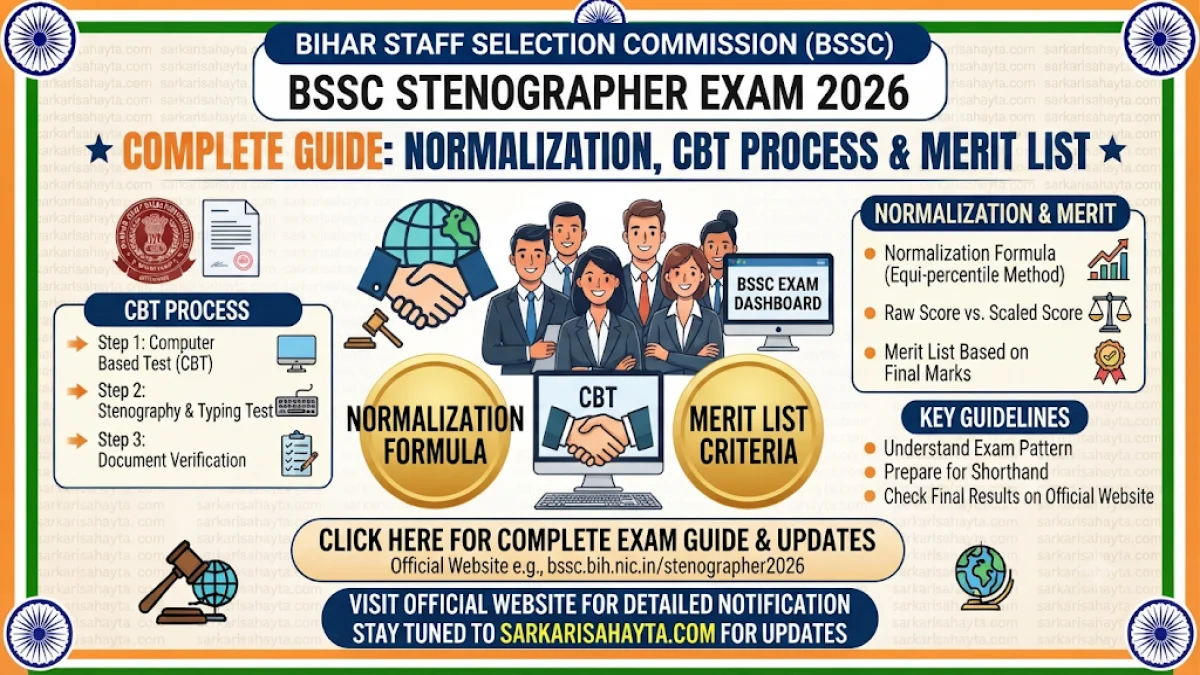
Unlike routine recruitment notices, this update contains crucial information regarding score normalization in multi-shift examinations and verification of candidates who may have previously faced debarment from competitive examinations. Aspirants should carefully understand these developments because they can impact both eligibility verification and the final merit determination process.
For candidates appearing in the upcoming BSSC Stenographer & Stenotypist Grade-III Examination, understanding how normalization works is just as important as exam preparation itself. This guide explains every major aspect of the latest notification in a simple and comprehensive manner while also offering expert insights that can help candidates stay ahead of the competition.
Table of Contents
- BSSC Recruitment Update Overview
- Essential Full Forms
- Latest BSSC Notice Explained
- Important Dates
- What is Normalization?
- SSC-Based Normalization Methodology
- Normalization Process Step-by-Step
- Why Normalization Matters
- Debarred Candidates Verification Notice
- What Candidates Should Do?
- Smart Preparation Strategy
- Expert Analysis
- Frequently Asked Questions
BSSC Recruitment Update Overview
BSSC is conducting the written examination for Stenographer and Stenotypist Grade-III through a Computer Based Test format. According to the latest official communication, the examination is scheduled to be held in multiple shifts, making score normalization an essential component of the result preparation process.
The Commission has clearly stated that whenever examinations are conducted in more than one phase or shift, a normalization methodology becomes necessary to ensure fairness among candidates appearing on different sessions with varying difficulty levels.
| Particular | Details |
|---|---|
| Recruiting Authority | Bihar Staff Selection Commission (BSSC) |
| Advertisement Number | 07/25 |
| Post Name | Stenographer / Stenotypist Grade-III |
| Exam Mode | Computer Based Test (CBT) |
| Exam Date | 01 December 2026 |
| Normalization Applicable | Yes |
| Methodology Reference | SSC Normalization Procedure |
Essential Full Forms
| Abbreviation | Full Form |
|---|---|
| BSSC | Bihar Staff Selection Commission |
| CBT | Computer Based Test |
| SSC | Staff Selection Commission |
| CGO | Central Government Offices |
| PO | Percentile Output |
| NTA | National Testing Agency |
| IT | Information Technology |
| HR | Human Resources |
Latest BSSC Notice Explained
The Commission has informed candidates that the written examination under Advertisement No. 07/25 will be conducted in two shifts. Due to the multi-shift structure, BSSC will adopt a normalization process similar to the methodology introduced by the Staff Selection Commission from June 2025 onwards.
The purpose of this decision is to ensure that no candidate gains an unfair advantage or disadvantage because of variations in question-paper difficulty levels across examination shifts.
The Commission has specifically referred candidates to the SSC normalization framework for understanding how raw examination scores are converted into normalized scores before final merit preparation.
Important Dates
| Event | Date |
|---|---|
| BSSC Stenographer CBT Examination | 01 December 2026 |
| Normalization Notice Release | 20 November 2026 |
| Debarred Candidates Clarification Deadline | 22 November 2026 (11:59 PM) |
What is Normalization?
Normalization is a statistical process used when examinations are conducted in multiple sessions. Since different shifts may contain question papers of slightly different difficulty levels, simply comparing raw scores may not provide a fair evaluation.
Under normalization, candidate performance is adjusted mathematically so that the evaluation remains equitable across all sessions. This approach is widely used in national-level examinations where multiple examination shifts are unavoidable.
SSC-Based Normalization Methodology
According to the normalization framework referenced by BSSC, the conversion process follows three major stages:
- Conversion of raw marks into percentile scores.
- Mapping percentile values back onto the marks scale.
- Calculation of a final normalized score through averaging and comparison methods.
This procedure is designed to create a common scale for all candidates irrespective of the session in which they appeared.
Normalization Process Step-by-Step
Step 1: Percentile Calculation
The first stage calculates percentile scores separately for every examination shift. Candidate performance is evaluated relative to other candidates appearing in the same session.
Step 2: Session-Wise Data Integration
Percentile data from all examination sessions is combined into a common framework. Interpolation techniques are then applied wherever required to ensure accurate alignment across different sessions.
Step 3: Final Normalized Score
After percentile mapping and interpolation, normalized scores are generated. These normalized marks become the basis for merit preparation instead of relying solely on raw scores.
Why Normalization Matters for Candidates?
- Ensures fairness across multiple shifts.
- Protects candidates from shift-wise difficulty variations.
- Creates an equitable merit list.
- Enhances recruitment transparency.
- Minimizes controversy regarding session advantage.
- Provides statistically balanced evaluation.
Candidates should therefore focus on maximizing performance rather than worrying about the relative difficulty of examination shifts.
Debarred Candidates Verification Notice
Another important communication issued by the Commission concerns candidates who indicated prior debarment history during the application process.
The Commission identified certain applicants who selected the option indicating previous debarment from a competitive examination but allegedly did not provide complete details regarding the duration and circumstances of such debarment.
These candidates have been directed to submit supporting information and documentary evidence within the specified deadline. Failure to provide the required clarification may result in cancellation of candidature as per recruitment provisions.
This step highlights the importance of accuracy and transparency while filling recruitment applications. Even minor discrepancies in application details can result in verification complications during later stages.
What Candidates Should Do Now?
- Review all recent BSSC notifications carefully.
- Understand how normalization may affect final scores.
- Avoid relying on unofficial score predictions.
- Keep application details and supporting documents ready.
- Regularly check official updates.
- Focus on accuracy and speed during CBT preparation.
- Strengthen stenography-related skills and typing practice.
Smart Preparation Strategy for BSSC Stenographer Examination
Candidates often focus entirely on theoretical preparation and overlook practical examination dynamics. Since this examination is being conducted through CBT mode, digital familiarity becomes equally important.
- Practice computer-based mock tests.
- Improve typing consistency.
- Revise Hindi and English grammar fundamentals.
- Strengthen current affairs preparation.
- Focus on accuracy before speed.
- Develop time management strategies.
- Analyze previous recruitment trends.
Candidates should also remember that normalization does not reduce the value of strong performance. Higher raw scores remain beneficial because normalized results are ultimately derived from actual candidate performance.
Expert Analysis
The adoption of SSC's post-June 2025 normalization methodology reflects a significant effort by BSSC to align examination evaluation practices with nationally recognized standards. Such a move enhances credibility, transparency, and consistency across recruitment examinations.
The debarred candidate verification notice further demonstrates the Commission's focus on maintaining the integrity of the recruitment process. Together, these measures indicate a strong emphasis on fairness, compliance, and accurate merit determination.
Candidates who thoroughly understand the normalization process are often able to approach examinations with greater confidence because they recognize that final scores are adjusted scientifically rather than arbitrarily.
Frequently Asked Questions (FAQs)
- What is the BSSC Advertisement No. 07/25 recruitment about?
- The recruitment is being conducted for Stenographer and Stenotypist Grade-III positions through a Computer Based Test examination.
- When will the BSSC Stenographer examination be conducted?
- The written CBT examination is scheduled for 01 December 2026.
- Will normalization be applied in the examination?
- Yes, normalization will be applied because the examination is being conducted in multiple shifts.
- Why does BSSC use normalization?
- Normalization ensures fairness when candidates appear in different examination sessions having varying difficulty levels.
- Which normalization model will be followed?
- BSSC has indicated that it will use the SSC normalization methodology introduced from June 2025.
- What is a percentile score?
- A percentile score reflects a candidate's relative performance compared with other candidates appearing in the same examination shift.
- Can normalization increase or decrease marks?
- Normalization adjusts examination scores based on statistical evaluation and shift-wise comparison mechanisms.
- What happens if a candidate fails to provide required debarment details?
- The Commission may consider candidature-related action according to recruitment rules and verification requirements.
- Does normalization affect the merit list?
- Yes, normalized scores are generally used for preparing fair and balanced merit rankings across multiple sessions.
- How should candidates prepare at this stage?
- Candidates should focus on CBT practice, accuracy, typing skills, current affairs, and consistent revision while monitoring official updates.
Final Thoughts
The latest BSSC announcements provide valuable clarity regarding examination evaluation and candidate verification procedures. Both normalization and eligibility verification are essential components of a transparent recruitment system. Aspirants should understand the process thoroughly, maintain complete documentation, and continue preparation with confidence.
With the examination approaching rapidly, candidates who combine strong subject preparation with a clear understanding of the normalization framework are likely to gain a significant competitive advantage during the final selection process.