
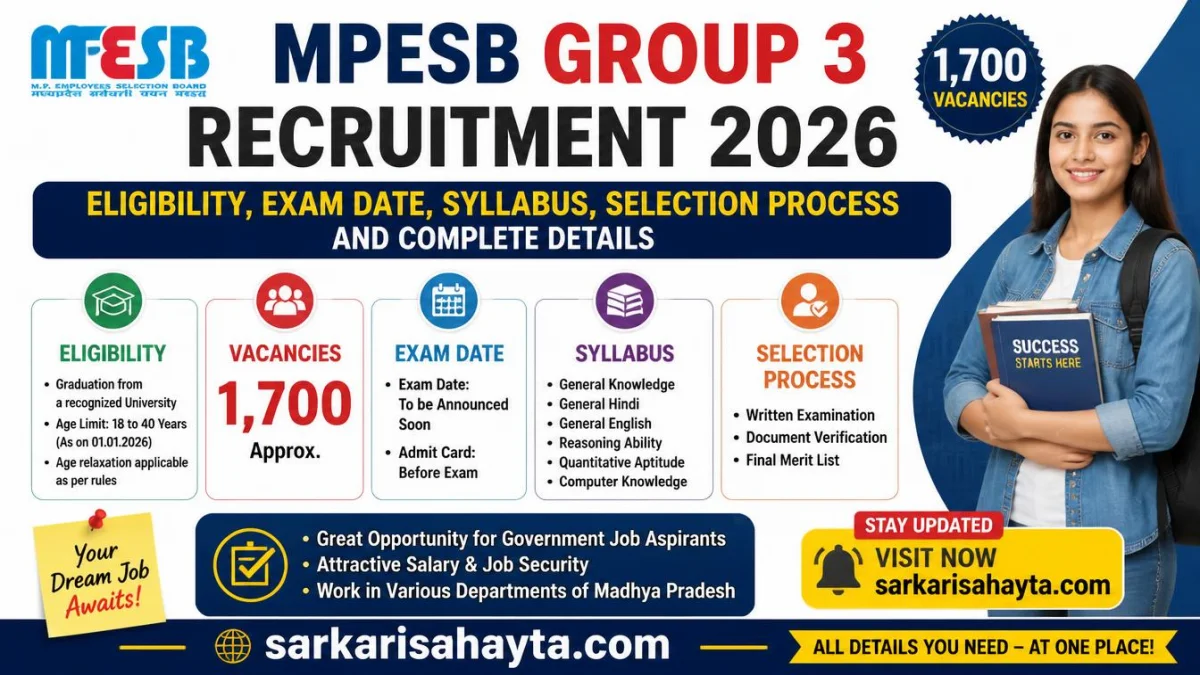
MPESB Group 3 Recruitment 2026: 1,700 Vacancies, Eligibility, Exam Pattern, Application Dates, Syllabus and Complete Details
MPESB Group 3 Recruitment 2026 has been announced for recruitment to various Sub Engineer, Cartographer, Laboratory Technician and other equivalent technical posts under different departments and institutions of Madhya Pradesh. The Madhya Pradesh Employees Selection Board (MPESB), Bhopal has issued the examination and recruitment rulebook for the Group-03 Combined Recruitment Examination-2026 (Second). According to the official rulebook, the online application process begins on 29 August 2026, applications can be submitted up to 12 September 2026, corrections are permitted up to 17 September 2026, and the computer-based examination is scheduled to begin from 7 October 2026.
This recruitment is particularly important for candidates holding diplomas, degrees, ITI qualifications and other technical credentials because the vacancies are distributed across engineering, surveying, laboratory, drafting, computer, agriculture engineering and several other specialised areas. The recruitment rulebook also contains department-wise vacancy tables, category-wise reservation details, post-wise educational qualifications, examination rules and the technical subject mapping required for the computer-based examination.
MPESB Group 3 Recruitment 2026 brings together technical vacancies from multiple Madhya Pradesh departments under one competitive examination
The Group 3 examination is designed as a common recruitment examination for third-category technical posts that fall outside the regular jurisdiction of the Madhya Pradesh Public Service Commission. The rulebook identifies Group 03 as covering Sub Engineer, Cartographer, Laboratory Technician and other equivalent posts, with recruitment conducted against vacancies reported by different departments and institutions.
The department-wise vacancy statement contains 1,700 vacancies in the main consolidated vacancy table. These vacancies are spread across numerous post codes and include both executive and non-executive positions. The vacancy structure includes posts such as Mineral Surveyor, Surveyor, Laboratory Technician, Sub Engineer, Technical Assistant, Computer Operator, Junior Instructor, Demonstrator, Assistant Town Planning-related posts and Cartographer, along with specialised engineering positions.
The vacancy distribution also includes positions under major technical and infrastructure-related departments such as the Public Works Department, Water Resources Department, Rural Engineering Service, Urban Development authorities, Agriculture Engineering Directorate, Pollution Control Board, State Agricultural Marketing Board, engineering colleges, polytechnic colleges and other government institutions. For example, the vacancy table includes 225 Sub Engineer posts under the Public Works Department, 290 Sub Engineer posts under the Rural Engineering Service and 379 Civil Sub Engineer posts under the Water Resources Department.
The recruitment calendar gives candidates a clear window for submitting applications, making corrections and preparing for the October examination
| Recruitment Activity | Date |
|---|---|
| Online Application Start Date | 29 August 2026 |
| Last Date to Submit Application | 12 September 2026 |
| Application Correction Start Date | 29 August 2026 |
| Last Date for Application Correction | 17 September 2026 |
| Examination Start Date | 7 October 2026 |
Candidates should treat the correction deadline as a separate and important deadline rather than assuming that application editing will remain available until the examination. The rulebook specifically provides 17 September 2026 as the last date for making corrections.
The examination is scheduled from 7 October 2026, with the first shift scheduled from 9:00 AM to 12:00 PM and the second shift scheduled from 2:30 PM to 5:30 PM. Candidates have a reporting window before each shift, followed by a designated period for reading important instructions before the three-hour examination begins.
The 1,700 vacancies cover engineering, surveying, laboratory and several other technical profiles rather than a single job designation
One of the most useful aspects of this recruitment is its broad technical coverage. Candidates should not consider Group 3 as a single-post recruitment because eligibility depends heavily on the individual post code and the qualification prescribed for that particular vacancy.
The official vacancy table begins with posts such as Mineral Surveyor and Surveyor and subsequently includes Laboratory Technician positions in different engineering disciplines, Sub Engineer positions, Technical Assistant, Computer Operator, Junior Instructor, Cartographer, Demonstrator and other technical designations.
Engineering candidates will find several specialised opportunities. For example, the vacancy schedule contains Civil, Electrical, Mechanical and Agriculture Engineering-related positions. Post Code 019 is an Electrical Sub Engineer position carrying 3 vacancies and requiring a diploma in Electrical Engineering, while Post Code 045 includes 12 Mechanical Assistant or Sub Engineer positions for candidates with Agriculture Engineering graduation.
There are also substantial opportunities for Civil Engineering diploma holders. Post Code 020 alone contains 225 Civil Sub Engineer vacancies under the Public Works Department, while Post Code 120 contains 290 Sub Engineer vacancies under the Rural Engineering Service. The Water Resources Department includes 379 Civil Sub Engineer vacancies under Post Code 124, along with separate vacancies reserved for specified categories of persons with disabilities under subsequent post codes.
The recruitment also includes Cartographer opportunities, including Post Code 132 with 35 vacancies under the office of the Principal Chief Conservator of Forests and Head of Forest Force, Madhya Pradesh. The qualification provisions for this profile include higher secondary-level education along with specified drawing, cartography, architecture or related technical credentials.
Educational qualification requirements change from one post code to another, so candidates must verify the exact technical qualification before applying
There is no single educational qualification applicable to every Group 3 vacancy. The rulebook states that the candidate must possess the educational, technical or vocational qualification prescribed under the relevant departmental recruitment rules on the date of submitting the application.
For Group 3 posts, the general framework permits candidates with the required diploma or higher qualification in the relevant subject, but the precise requirement is determined by the post and department. This distinction is important because a diploma that makes a candidate eligible for one technical post may not automatically qualify the candidate for another post with a different technical discipline.
For example, the Mineral Surveyor position requires a diploma in Mining Engineering or Civil Engineering from a recognised institution, whereas the Surveyor position accepts an ITI certificate in Surveying or a diploma in Civil Engineering.
Similarly, the Electrical Sub Engineer vacancy under Post Code 019 requires a diploma in Electrical Engineering. For certain Sub Engineer posts involving GIS-related work, the prescribed qualification can additionally include a three-year Diploma or Degree in Civil Engineering together with at least a one-year diploma in GIS Application and Remote Sensing or Geoinformatics/Geomatics from a recognised institution.
Therefore, candidates should identify their preferred post code first and then compare their exact qualification, specialisation and any additional certificate requirement with the relevant entry in the official rulebook.
The age criteria generally start at 18 years, while the applicable upper-age limit depends on category and government rules
The recruitment rules prescribe a minimum age of 18 years. For the applicable Group 3 posts, the general maximum age is 40 years, while the upper age limit can extend to 45 years for specified categories including eligible Scheduled Caste, Scheduled Tribe, Other Backward Class candidates, women, certain government or government-associated employees and other categories covered by the applicable rules.
The age is calculated with reference to 1 January 2026. The rulebook also states that the maximum age, after considering applicable relaxations, ordinarily cannot exceed 45 years except for categories specifically covered by the relevant provisions.
Eligible Madhya Pradesh candidates should also keep their valid category and other supporting certificates ready because reservation and age relaxation benefits depend upon valid documentation issued by the competent authority. The recruitment rules specifically require candidates to have valid registration with the Madhya Pradesh employment office for the applicable posts.
The application fee depends on category, while MPOnline portal charges are payable separately according to the selected application method
For direct recruitment and contractual recruitment posts covered by the examination, the examination fee for an unreserved candidate is ₹500 per question paper. Eligible Madhya Pradesh domicile candidates belonging to Scheduled Caste, Scheduled Tribe, Other Backward Class, EWS and persons with disabilities categories are charged ₹250 per question paper. No examination fee is prescribed for backlog vacancies under direct recruitment.
In addition to the examination fee, the rulebook specifies an MPOnline portal charge of ₹60 for candidates submitting the application through an MPOnline kiosk and ₹20 for registered citizen users who log in and complete the application through the prescribed online facility.
Applicants should therefore calculate the final payable amount according to their category and the mode through which they submit the application instead of considering the examination fee alone.
The Group 3 examination consists of one 200-mark paper divided equally between general subjects and the relevant technical trade
The examination structure is straightforward but requires preparation across two distinct areas. The Group 3 examination contains one question paper carrying 200 marks. The first section carries 100 marks and covers General Knowledge, General Hindi, General English, General Mathematics, General Logical Ability, General Science and General Computer Knowledge. The second section carries another 100 marks and is based on the relevant technical subject.
| Section | Subjects | Marks |
|---|---|---|
| Question Section A | General Knowledge, General Hindi, General English, General Mathematics, General Logical Ability, General Science and General Computer Knowledge | 100 |
| Question Section B | Technical trade or subject related to the applied post | 100 |
| Total | One Question Paper | 200 |
The technical paper is not identical for every candidate. The rulebook maps post codes to different technical papers, including Electrical Engineering, Mechanical Engineering, Civil Engineering, Computer Science and Engineering, Electronics and Telecommunication Engineering, Fashion Technology, Architecture, Modern Office Management, Hotel Management, Agriculture Engineering, Textile Design, Automobile Engineering, Refrigeration and Air Conditioning and ITI Draftsman Civil.
The technical paper is determined by the post code, which makes post selection an important part of examination preparation
Candidates should pay close attention to the technical paper mapping because a candidate's preparation should be aligned with the subject associated with the selected post code. Civil Engineering covers a large group of post codes, while Electrical and Mechanical Engineering are separately mapped to their respective technical vacancies.
Some post codes have special arrangements. Candidates applying for Post Code 088 can appear in either the Civil or Architecture paper according to the applicable provision, and the result is prepared by combining the relevant percentile scores as prescribed. Likewise, candidates applying for Post Codes 128 and 131 may appear in either the Electrical or Mechanical paper according to their relevant subject, with the result methodology specified separately in the rulebook.
This makes it advisable to finalise the preferred post and associated technical paper before beginning intensive subject preparation. Preparing randomly across several unrelated technical disciplines would be inefficient when the examination provides a clearly defined subject structure.
The qualifying standard requires candidates to understand the difference between minimum qualifying marks and final selection merit
The recruitment rules prescribe minimum qualifying marks for the examination. For unreserved candidates, the minimum qualifying standard is 50 percent, while candidates belonging to Scheduled Caste, Scheduled Tribe, Other Backward Class and eligible persons with disabilities receive relaxation of up to 10 percentage points, resulting in a 40 percent minimum qualifying standard. The rulebook also records a 10 percent relaxation for eligible EWS candidates under the applicable government provision, with selection from the EWS merit list.
However, merely achieving the minimum qualifying score does not create an automatic right to appointment. The rules explain that a candidate's name can be included in the qualifying list while appointment remains dependent upon a department requisition, forwarding of the candidate's name, fulfilment of all prescribed appointment conditions and issuance of an appointment order by the concerned department.
For this reason, candidates should treat the qualifying percentage as the minimum threshold rather than a safe selection score. Actual selection depends upon merit, available vacancies, category, post preference and the subsequent recruitment process.
Multiple examination shifts may be normalised through the prescribed percentile methodology when candidates take the examination in different shifts
The rulebook provides a detailed methodology for preparing examination results where examinations are conducted in multiple shifts. The MPESB rules refer to the Normalised Equi-Percentile (NEP) scaling technique and explain that percentile scores may be combined for examinations conducted in multiple shifts or where more than one subject is involved.
The methodology is designed to make scores comparable where candidates face different question sets or shifts. The rules further explain the use of proportionate scores, percentile scores, Z-values and T-scores in applicable multi-stage examination situations.
Candidates should therefore not assume that a raw score from one shift can always be compared directly with a raw score from another shift without considering the prescribed normalisation methodology.
The examination-day instructions make identity verification, Aadhaar-related requirements and timely reporting especially important
Candidates must carry an original valid photo identity document to the examination centre. The rulebook lists options such as Voter ID, PAN Card, Aadhaar Card, Driving Licence and Passport. An e-Aadhaar is accepted only after the required UIDAI verification. A candidate without the prescribed original photo identity document may be denied entry to the examination.
In addition to the prescribed identity document, candidates are required to carry the relevant Aadhaar information or Aadhaar-related document as specified in the rules because multi-level biometric verification is mandatory. Aadhaar must be unlocked at the time of biometric verification.
Reporting time should be taken seriously because the board states that candidates are allowed entry only up to the prescribed reporting time. Candidates arriving after the reporting deadline are not eligible for entry to the examination.
Electronic devices including mobile phones, calculators, digital watches, log tables, sunglasses and material intended for copying are prohibited inside the examination environment. Candidates should therefore avoid carrying unnecessary electronic or restricted items to the examination centre.
The candidate must also carry the downloaded admit card and a black ball-point pen. Once the examination begins, candidates are not permitted to leave the examination room until the examination has concluded.
The admit card will be made available online and candidates should not expect a physical admit card through the post
The Test Admit Card, or TAC, will be made available through the MPESB website for valid online applications. The admit card contains important details including the candidate's information, examination name, roll number and examination centre. Additional identity-related information is also incorporated into the admit card.
The board does not send the admit card separately through postal mail. Candidates should therefore monitor the official examination portal and download the TAC when it becomes available.
The application number should also be preserved carefully because the rules specify that candidates use their online application number for obtaining the examination admit card. Losing application details can therefore create avoidable difficulties later in the recruitment process.
The recruitment includes category-wise reservation and vacancies marked as provisional should be read carefully before interpreting the final category distribution
The vacancy tables are divided across categories including UR, EWS, SC, ST and OBC, with additional horizontal provisions for persons with disabilities, women, ex-servicemen and other applicable categories. Some vacancy tables also distinguish between main reservation figures and provisional or hypothetical figures that remain subject to court decisions or applicable government instructions.
For example, the Water Resources Department vacancy table contains separate entries for certain disability categories and also shows a division between the main reservation table and the provisional 13 percent reservation table.
This distinction matters because candidates should not automatically add every provisional or category-specific figure to the overall vacancy count. The consolidated vacancy statement already provides the principal total of 1,700 posts, while the detailed tables explain how those vacancies are distributed and classified.
The employment registration requirement makes Madhya Pradesh employment-office registration an important eligibility checkpoint
The recruitment instructions state that candidates applying for the covered posts must have a live registration with the Madhya Pradesh State Employment Office. This requirement is therefore separate from educational qualification and should be checked before completing the application.
Candidates claiming reservation or age-relaxation benefits should also ensure that their supporting certificates are valid and issued by the competent authority. The recruitment rules make it clear that the validity of eligibility documents is ultimately examined during the appointment process rather than being conclusively verified at the initial application stage.
The online application should be completed with careful attention to post preference, qualification details and the correction deadline
Before starting the application, candidates should identify the post codes for which they are actually eligible. Since the recruitment combines numerous technical positions with different qualifications and technical papers, selecting a post merely because its name appears attractive can create an eligibility problem later.
The application should contain accurate personal information, educational details, category information and post preference in accordance with the recruitment rules. The rulebook specifically requires candidates to indicate preference for the posts for which they apply.
After submitting the application, candidates should download or preserve the application details and payment confirmation. The correction facility remains available until 17 September 2026, but candidates should not postpone necessary corrections until the final hours because errors that remain uncorrected within the permitted period may subsequently become difficult or impossible to rectify.
A practical preparation strategy should divide study time between the 100-mark general section and the 100-mark technical section
Because both halves of the examination carry equal weight, candidates should avoid concentrating exclusively on their technical subject. A technically strong candidate can lose a substantial number of marks by neglecting General Knowledge, Hindi, English, Mathematics, Logical Ability, Science and Computer Knowledge.
The general section should be prepared through regular revision and timed practice. Mathematics and reasoning benefit from repeated problem-solving, while language and general knowledge require consistent exposure and revision. Computer awareness should also be included in the weekly study schedule because it forms part of the 100-mark general section.
The technical section should be prepared according to the exact paper associated with the selected post code. A Civil Engineering candidate should not prepare from a generic technical syllabus without checking whether the selected post is mapped to Civil Engineering or another technical paper. The official paper mapping provides the appropriate framework for this decision.
A useful preparation cycle is to first complete the technical fundamentals, then revise the general subjects in parallel, and finally spend substantial time on full-length 200-mark mock tests. Since the examination duration is three hours, candidates should also practise maintaining accuracy while working under a fixed time limit.
Candidates should preserve every recruitment document because the application-stage eligibility is provisional rather than a final appointment guarantee
The board makes an important distinction between submitting an application and receiving an appointment. Educational and other certificates are not treated as finally verified merely because an application has been accepted. The concerned department verifies the relevant credentials during the recruitment or appointment process.
This means candidates should retain original educational certificates, marksheets, category certificates, employment registration details, identity documents and any post-specific technical certificates. Where a post requires an additional qualification such as GIS, surveying, drafting or a specialised engineering credential, the candidate should be able to produce documentary evidence when required.
The most important points candidates should verify before submitting the MPESB Group 3 application are eligibility, post code, technical paper, category and application fee
- Recruitment: MPESB Group 3 Combined Recruitment Examination 2026, Second.
- Total vacancies: 1,700 posts in the consolidated vacancy statement.
- Application start: 29 August 2026.
- Application last date: 12 September 2026.
- Correction last date: 17 September 2026.
- Examination: From 7 October 2026.
- Examination mode: Online computer-based examination.
- Total marks: 200.
- General section: 100 marks.
- Technical section: 100 marks.
- General qualifying standard: 50 percent for UR candidates, with applicable relaxation for specified categories.
- Minimum age: 18 years.
- General maximum age: 40 years, subject to applicable relaxations and rules.
- Unreserved examination fee: ₹500 per question paper.
- Eligible reserved-category fee: ₹250 per question paper.
- MPOnline portal charge: ₹60 through kiosk or ₹20 through registered citizen user, as applicable.
The dates, fee structure and examination framework above are taken from the recruitment rulebook issued for the Group 3 Combined Recruitment Examination 2026 (Second).
Why MPESB Group 3 Recruitment 2026 deserves serious attention from diploma and technical graduates across Madhya Pradesh
The scale and diversity of this recruitment make it significantly different from a conventional single-department vacancy. Candidates from Civil Engineering, Electrical Engineering, Mechanical Engineering, Agriculture Engineering, surveying, laboratory technology, computer-related disciplines, architecture, drafting and other technical backgrounds can find relevant opportunities within the same examination framework, subject to the individual post requirements.
The vacancy table demonstrates that several departments are participating, while the technical paper mapping provides a structured route for candidates to prepare according to their selected field. The combination of a 100-mark general section and a 100-mark technical section also means that candidates can build a balanced preparation plan instead of depending entirely on one subject area.
At the same time, the recruitment requires careful reading. A candidate should not rely solely on the job title because educational qualifications, technical papers, category requirements, post preferences and salary levels can differ considerably from one post code to another. The official rulebook extends from the general examination instructions to detailed department-wise vacancy and qualification tables, making post-wise verification essential.
Final assessment of MPESB Group 3 Recruitment 2026 shows that preparation and eligibility verification should proceed together rather than separately
MPESB Group 3 Recruitment 2026 provides a substantial opportunity for technically qualified candidates, with 1,700 vacancies distributed among a wide range of government departments and institutions. The recruitment is not limited to one engineering branch or one designation; instead, it brings together Sub Engineers, Cartographers, Laboratory Technicians and numerous other technical profiles under a common competitive examination.
The most important practical takeaway is that candidates should first establish their eligibility for a specific post code, then identify the corresponding technical question paper, and finally prepare for the 200-mark examination by giving equal importance to the general and technical sections. At the same time, candidates must complete the application within the prescribed dates, maintain accurate records, satisfy the Madhya Pradesh employment-registration requirement where applicable and prepare the required original identity documents for the examination day.
Since the examination begins on 7 October 2026, candidates who are eligible should use the application period to complete the formalities without delay and use the remaining preparation period for systematic revision, technical practice, general-section preparation and full-length mock examinations.
Official website: MPESB Official Website
Frequently Asked Questions about MPESB Group 3 Recruitment 2026 can help candidates resolve the most important application and examination doubts
How many vacancies are available in MPESB Group 3 Recruitment 2026?
The consolidated vacancy table in the recruitment rulebook shows 1,700 vacancies across the Group 3 recruitment. The vacancies are distributed among multiple departments, institutions and technical post codes.
When does the MPESB Group 3 application process start?
The online application process starts on 29 August 2026, while the last date for submitting the application is 12 September 2026.
What is the last date for correcting the Group 3 application?
The application correction facility is available up to 17 September 2026. Candidates should verify their information carefully before the correction window closes.
When will the MPESB Group 3 examination begin?
The computer-based examination is scheduled to begin from 7 October 2026. The prescribed schedule provides morning and afternoon shifts.
How many marks is the Group 3 examination?
The examination carries 200 marks through one question paper, with 100 marks allocated to general subjects and 100 marks allocated to the relevant technical subject.
Is the technical syllabus the same for every Group 3 candidate?
No. The technical paper depends on the post code. The rulebook maps different post codes to Civil, Electrical, Mechanical, Computer Science, Electronics and Telecommunication, Agriculture Engineering and other specialised technical papers.
What is the minimum qualifying percentage?
The general minimum qualifying standard is 50 percent, while specified reserved and other eligible categories receive the relaxation provided under the recruitment rules. The rulebook states a 40 percent minimum qualifying standard for the categories covered by the applicable 10 percentage-point relaxation.
Can qualifying the examination guarantee appointment?
No. The rules specifically state that inclusion in the qualifying list does not itself create a right to appointment. Appointment depends upon departmental requisition, recommendation or forwarding of the candidate, fulfilment of appointment conditions and issuance of the appointment order by the concerned department.
What identity documents are accepted at the examination centre?
The rulebook lists original photo identity documents such as Voter ID, PAN Card, Aadhaar Card, Driving Licence and Passport, subject to the prescribed verification requirements. Candidates should also follow the Aadhaar and biometric verification instructions applicable to the examination.
Will the admit card be sent by post?
No. The Test Admit Card is made available online through the board's website and is not separately dispatched through post. Candidates should download it when released and carry the required printed admit card to the examination centre.
What should candidates carry to the examination centre?
Candidates should carry the prescribed admit card, an original valid photo identity document and a black ball-point pen, while also complying with the Aadhaar and biometric verification requirements. Electronic devices and prohibited examination materials should not be carried into the examination environment.
Source note: This article has been prepared from the MPESB Group-03 Combined Recruitment Examination-2026 (Second) examination and recruitment rulebook dated for the current recruitment cycle, including its vacancy tables, eligibility provisions, examination pattern, syllabus and examination instructions.