GSSSB Staff Nurse Class-3 Gujarati Language Paper-2 Detailed Syllabus 2026 - Overview
Welcome to SarkariSahayta.com! Candidates preparing for the Gujarat Subordinate Service Selection Board (GSSSB) Staff Nurse Class-3 competitive examination can now review the detailed syllabus of Paper-2 (Gujarati Language) as officially specified in the examination syllabus notification. The Gujarat Subordinate Service Selection Board has published the subject-wise syllabus and marks distribution for the MCQ-based Gujarati Language Paper-2, providing candidates with a clear roadmap for their preparation.
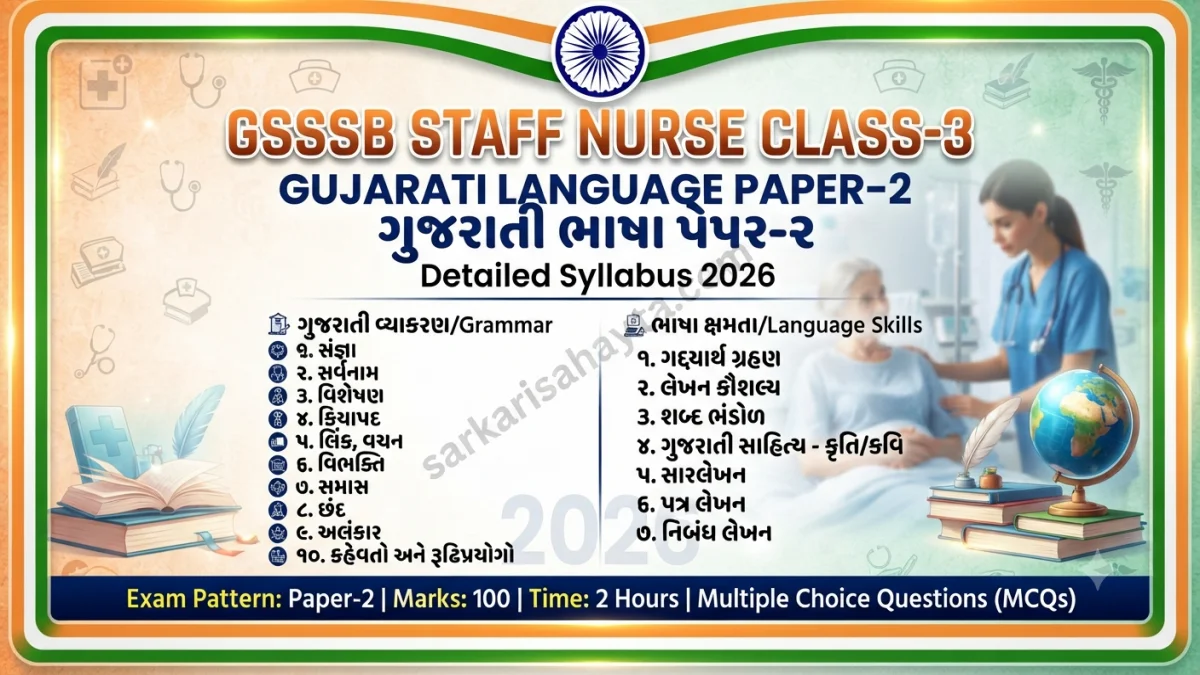
According to the detailed syllabus notification issued under Advertisement Nos. 458/2026-27 and 462/2026-27, Paper-2 is designed to evaluate candidates' understanding of Gujarati language, grammar, literary knowledge, comprehension, sentence structure and related language skills. The paper carries a total of 100 marks and is divided into three major sections: Language, Grammar and Literature.
This detailed guide explains the complete syllabus, section-wise marks distribution, important topics, preparation strategy, essential full forms and practical study recommendations to help candidates prepare systematically instead of studying Gujarati language topics without a structured plan.
GSSSB Staff Nurse Gujarati Language Paper-2 Examination Overview
| Particulars | Details |
|---|---|
| Recruitment Board | Gujarat Subordinate Service Selection Board (GSSSB) |
| Post | Staff Nurse, Class-3 |
| Advertisement Numbers | 458/2026-27 and 462/2026-27 |
| Paper | Paper-2 |
| Subject | Gujarati Language |
| Examination Type | MCQ-Based Competitive Examination |
| Total Marks | 100 Marks |
| Language Section | 30 Marks |
| Grammar Section | 40 Marks |
| Literature Section | 30 Marks |
| Official Syllabus Date | 26 November 2026 |
| Official Location | Gandhinagar, Gujarat |
Table of Contents
- Examination Overview
- Paper-2 Marks Distribution
- Language Section – 30 Marks
- Grammar Section – 40 Marks
- Literature Section – 30 Marks
- Essential Full Forms
- Preparation Strategy
- Recommended Study Sources
- Common Preparation Mistakes
- Important Instructions Mentioned in the Notification
- Frequently Asked Questions
GSSSB Staff Nurse Paper-2 Marks Distribution: Understanding the 100-Mark Structure
The Gujarati Language Paper-2 syllabus is divided into three sections with different weightages. Grammar carries the highest marks, making it an important area for candidates seeking to improve their score. However, the Language and Literature sections should not be neglected because together they account for 60 marks.
| Section | Total Marks | Percentage of Paper |
|---|---|---|
| Language | 30 | 30% |
| Grammar | 40 | 40% |
| Literature | 30 | 30% |
| Total | 100 | 100% |
From a preparation perspective, Grammar accounts for 40% of the total paper. Language and Literature each contribute 30%. A balanced preparation plan should therefore allocate sufficient time to grammar practice while regularly revising comprehension, literary authors, their works, awards and institutions.
Language Section – 30 Marks: Complete Gujarati Language Topics
The Language section tests reading comprehension, poetry understanding, sentence transformation, translation and picture-based interpretation. Candidates should practise interpreting meaning rather than relying exclusively on memorisation.
1. Prose Comprehension – 10 Marks
The syllabus includes two prose passages, with each passage carrying 5 marks. Candidates may be required to read a passage and answer questions based on its central idea, supporting details, vocabulary, context, interpretation or conclusions.
To prepare effectively, candidates should regularly read Gujarati prose passages from textbooks, newspapers, editorials and educational materials. While practising, focus on identifying the main idea, understanding the author's perspective, locating factual information and interpreting the meaning of words within sentences.
2. Poetry Comprehension – 5 Marks
The poetry section includes one poetry passage worth 5 marks. Questions may test the meaning of verses, the central theme, poetic expressions, emotional tone and the interpretation of the presented poem.
Candidates should practise reading Gujarati poetry carefully and understanding the meaning of each line. Familiarity with poetic expressions, vocabulary and the overall message can help improve accuracy in poetry-based questions.
3. Sentence Transformation – 5 Marks
Sentence transformation is an important language skill that involves changing sentence structures without incorrectly altering their meaning or following the prescribed grammatical transformation.
The official syllabus specifically mentions the following areas:
- Simple, complex and compound sentences.
- Active voice and passive voice.
- Affirmative and negative sentences.
- Interrogative sentences.
- Imperative sentences.
Practising sentence transformation in Gujarati can help candidates understand sentence construction, grammatical relationships and the proper use of language in different forms.
4. Translation from English to Gujarati – 5 Marks
The syllabus includes sentences translated from English into Gujarati. Candidates should focus on sentence meaning, grammatical structure, vocabulary, tense, appropriate Gujarati expressions and sentence formation.
Literal word-by-word translation may not always produce a grammatically correct Gujarati sentence. Candidates should practise translating short English sentences into natural and grammatically accurate Gujarati.
5. Picture-Based Questions – 5 Marks
Picture-based questions carry 5 marks. Candidates may be required to interpret an image, identify relevant information, understand a depicted situation or answer questions based on visual context.
Practice describing pictures in Gujarati, identifying the important elements shown in an image and understanding relationships between objects, activities and situations. This can help develop observation and interpretation skills required for visual comprehension questions.
Grammar Section – 40 Marks: Complete Topic-Wise Syllabus
Grammar is the highest-weightage section in Gujarati Language Paper-2, carrying 40 marks. The notification lists 21 grammatical topics, with most topics carrying 2 marks and selected topics carrying 1 mark.
| No. | Grammar Topic | Marks |
|---|---|---|
| 1 | Idioms (Rudhiprayog) | 2 |
| 2 | Proverbs (Kahevat) | 2 |
| 3 | Identification and Analysis of Compound Words (Samas) | 2 |
| 4 | Figures of Speech (Alankar) | 2 |
| 5 | Poetic Metres (Chhand) | 2 |
| 6 | One Word for a Group of Words | 2 |
| 7 | Synonyms (Samanarthi Shabd) | 2 |
| 8 | Antonyms (Viruddharthi Shabd) | 2 |
| 9 | Vibhakti | 2 |
| 10 | Joining Sandhi (Sandhi Jodo) | 2 |
| 11 | Separating Sandhi (Sandhi Chhodo) | 2 |
| 12 | Punctuation Marks | 1 |
| 13 | Correct Spelling (Jodani Shuddhi) | 2 |
| 14 | Word Classification (Shabd Bhed) | 2 |
| 15 | Sounds (Dhvani) | 1 |
| 16 | Forming Words Using Consonant-Vowel Combinations | 2 |
| 17 | Arrange Words in Dictionary Order | 2 |
| 18 | Language and Writing Correction | 2 |
| 19 | Krdant and Nipaat | 2 |
| 20 | Noun, Pronoun and Adjective | 2 |
| 21 | Verb, Adverb, Gender and Number Usage | 2 |
Idioms and Proverbs
Gujarati idioms and proverbs are commonly used expressions that convey meanings beyond their literal interpretation. Candidates should understand the meaning, appropriate usage and context of commonly encountered expressions. Learning idioms through example sentences can be more effective than memorising isolated meanings.
Samas, Alankar and Chhand
These topics require understanding of Gujarati grammatical and literary structures. Candidates should study the identification, definitions, examples and distinctions between different types of compound words, figures of speech and poetic metres. Practice questions can help distinguish similar concepts.
Synonyms, Antonyms and One-Word Substitutions
Vocabulary-based questions can be prepared through structured revision. Candidates should maintain a notebook containing frequently used Gujarati synonyms, antonyms, one-word expressions and their meanings. Revising these words repeatedly may help improve recall during the examination.
Sandhi, Vibhakti and Word Classification
Sandhi joining and separation, Vibhakti, word classification and related grammatical concepts require familiarity with Gujarati language rules. Candidates should study the rules and practise applying them to different words and sentences instead of memorising only definitions.
Spelling, Punctuation and Language Correction
Jodani Shuddhi, punctuation, language correction and writing correction require attention to accurate Gujarati usage. Candidates should regularly practise identifying incorrectly written words, incorrect sentence structures, punctuation errors and inappropriate word usage.
Gender, Number, Verb and Adverb
The syllabus also includes grammatical usage involving verbs, adverbs, gender and number. Candidates should understand how grammatical forms change according to sentence context and how words function within Gujarati sentences.
Literature Section – 30 Marks: Gujarati Literature Syllabus
The Literature section carries 30 marks and focuses on literary knowledge derived primarily from Gujarati textbooks published or included in the GCERT curriculum for Standards 8 to 12. The official syllabus also includes literary institutions and awards.
1. Gujarati Prose Literature – 10 Marks
Candidates should study the prose sections included in Gujarati textbooks from GCERT Standards 8 to 12. The syllabus specifically requires knowledge of literary authors, their biographies, literary works, pen names and contributions to Gujarati literature.
Important preparation areas include:
- Names and biographies of prose writers.
- Major literary works and publications.
- Pen names and literary identities.
- Contribution to Gujarati literature.
- Literary background and important facts about writers.
2. Gujarati Poetry Literature – 10 Marks
The poetry portion covers poets included in Gujarati textbooks from GCERT Standards 8 to 12. Candidates should study the poets, their biographies, literary works, pen names and contributions to Gujarati poetry and literature.
For effective revision, prepare a comparative table containing the poet's name, major works, pen name, literary period and notable contribution. This format can help candidates quickly revise facts and avoid confusion between writers.
3. Gujarati Literary Institutions – 5 Marks
The syllabus includes the following literary institutions and organisations:
- Gujarat Vernacular Society.
- Gujarati Sahitya Parishad.
- Gujarat Sahitya Akademi.
- Gujarat Vishwakosh Trust.
Candidates should study the founders, establishment years, headquarters, published magazines or books and important programmes or activities associated with these institutions.
Institution-based questions may require factual knowledge. Therefore, candidates should prepare a dedicated table for each institution covering its establishment, founder, headquarters, publications and major activities.
4. Gujarati Literary Awards – 5 Marks
Literary awards are another important part of the syllabus. The notification specifically identifies the following awards:
- Jnanpith Award.
- Sahitya Akademi Award.
- Saraswati Samman.
- Gujarati Sahitya Parishad Awards.
- Gujarat Sahitya Akademi Awards.
- Ranjitram Suvarna Chandrak.
- Narmad Suvarna Chandrak.
Candidates should prepare the establishment or history of the awards, first recipients, first Gujarati recipients where applicable, recent awardees and other relevant literary facts. Since award winners may change over time, candidates should verify the latest information from reliable official sources before the examination.
Essential Full Forms and Abbreviations
| Abbreviation | Full Form |
|---|---|
| GSSSB | Gujarat Subordinate Service Selection Board |
| GCERT | Gujarat Council of Educational Research and Training |
| MCQ | Multiple Choice Question |
| Class-3 | Class III / Third-Class Government Service Category |
| Paper-2 | Second Examination Paper |
How to Prepare for GSSSB Staff Nurse Gujarati Language Paper-2
Step 1: Begin with the Official Syllabus
Print or save the official syllabus and divide your preparation into Language, Grammar and Literature. Track each topic as you complete it. This prevents unnecessary study of unrelated subjects and helps maintain focus on the prescribed examination structure.
Step 2: Give Grammar a Consistent Daily Slot
Grammar accounts for 40 marks. Dedicate regular time to idioms, proverbs, Sandhi, Samas, synonyms, antonyms, Vibhakti, word classification, sentence correction and other prescribed topics. Practise MCQs after studying each topic.
Step 3: Use GCERT Gujarati Textbooks from Standards 8 to 12
For the Literature section, use the Gujarati textbooks prescribed or included in the GCERT curriculum for Standards 8 to 12. Create author-wise and poet-wise notes containing biographies, literary works, pen names and contributions. The official syllabus specifically identifies these textbooks as the basis of literary preparation.
Step 4: Prepare Literature Institutions and Awards Separately
Do not leave literary institutions and awards until the final week. These topics require factual revision. Prepare concise notes on establishment years, founders, headquarters, publications, award histories and relevant recipients.
Step 5: Practise Comprehension and Translation
Regularly solve prose passages, poetry comprehension, English-to-Gujarati translation and picture-based exercises. These topics require application and interpretation, which improves through practice rather than passive reading.
Step 6: Build a Revision Notebook
Maintain a notebook containing difficult Gujarati words, idioms, proverbs, grammar rules, literary authors, awards and institutional facts. Revise this notebook periodically to improve retention.
Step 7: Attempt Timed Practice Tests
Once you have completed the syllabus, attempt Gujarati language practice tests under timed conditions. Analyse mistakes and identify weak topics. Practice tests should be used to assess preparation, not merely to record scores.
Recommended Study Sources for Gujarati Paper-2
- GCERT Gujarati textbooks from Standards 8 to 12 for prose and poetry literature.
- Gujarati grammar books covering the prescribed syllabus.
- Gujarati language comprehension and translation practice materials.
- Previous competitive examination question papers, wherever available.
- Official websites and verified sources for literary institutions and award information.
- Gujarati vocabulary and idiom revision materials.
Before purchasing additional books, compare their contents with the official syllabus. A resource covering the prescribed topics comprehensively is generally more useful than collecting multiple books with overlapping content.
Common Mistakes Candidates Should Avoid During Gujarati Language Preparation
- Ignoring Grammar because it appears to be a familiar subject.
- Studying literary authors without revising their works and pen names.
- Preparing only vocabulary while neglecting sentence transformation.
- Ignoring English-to-Gujarati translation practice.
- Studying literary awards without checking recent developments.
- Using unrelated study materials that do not match the prescribed syllabus.
- Leaving picture-based questions and comprehension practice until the last moment.
- Memorising definitions without practising MCQs.
Important Instructions and Disclaimer Mentioned in the Official Syllabus
The official notification states that the syllabus and topics have been provided to facilitate candidates' examination preparation. The board may make general modifications to the syllabus or marks distribution when circumstances require. The board is not obligated to provide reasons for such changes, and its decision regarding relevant matters is final.
The notification also states that if an interpretation-related issue arises in an examination question, the board may consider the particular question and consult subject experts. The decision taken by the board in such circumstances will be final.
Accordingly, candidates should periodically check the official GSSSB website for any subsequent updates, clarifications or modifications.
Frequently Asked Questions (FAQs)
- 1. How many marks are allotted to GSSSB Staff Nurse Gujarati Language Paper-2?
- The Gujarati Language Paper-2 carries a total of 100 marks. It is divided into Language (30 marks), Grammar (40 marks) and Literature (30 marks).
- 2. How many marks are allotted to the Grammar section?
- The Grammar section carries 40 marks and includes 21 topics mentioned in the official syllabus.
- 3. Which GCERT textbooks should candidates study for Gujarati Literature?
- The official syllabus refers to Gujarati textbooks from GCERT Standards 8 to 12, covering the prose and poetry sections and their literary authors.
- 4. What topics are included in the Language section?
- The Language section includes two prose passages, one poetry passage, sentence transformation, English-to-Gujarati translation and picture-based questions.
- 5. How many marks are allotted to Gujarati prose comprehension?
- Prose comprehension carries 10 marks and includes two passages worth 5 marks each.
- 6. How many marks are allotted to poetry comprehension?
- Poetry comprehension carries 5 marks and includes one poetry passage.
- 7. Which literary institutions are mentioned in the syllabus?
- The syllabus mentions Gujarat Vernacular Society, Gujarati Sahitya Parishad, Gujarat Sahitya Akademi and Gujarat Vishwakosh Trust.
- 8. Which literary awards should candidates prepare?
- Candidates should prepare Jnanpith Award, Sahitya Akademi Award, Saraswati Samman, Gujarati Sahitya Parishad Awards, Gujarat Sahitya Akademi Awards, Ranjitram Suvarna Chandrak and Narmad Suvarna Chandrak.
- 9. Does the syllabus include translation questions?
- Yes. The Language section includes English-to-Gujarati sentence translation, which carries 5 marks.
- 10. Can GSSSB change the syllabus or marks distribution?
- According to the official notification, the board may make general changes to the syllabus or marks distribution when necessary, and its decision regarding such matters is final.
- 11. What is the best way to prepare for Gujarati Grammar?
- Candidates should study the prescribed grammatical rules, prepare topic-wise notes, practise MCQs and regularly revise topics such as Sandhi, Samas, idioms, proverbs, synonyms, antonyms, sentence correction and word classification.
- 12. Where should candidates check official updates?
- Candidates should refer to the official Gujarat Subordinate Service Selection Board website and the relevant recruitment notifications for verified updates.
Final Preparation Advice for GSSSB Staff Nurse Paper-2
The GSSSB Staff Nurse Class-3 Gujarati Language Paper-2 syllabus offers a structured approach to preparing for the 100-mark examination. With 40 marks assigned to Grammar, 30 marks to Language and 30 marks to Literature, candidates should focus on all three sections rather than relying on a single area of preparation.
Using GCERT Gujarati textbooks from Standards 8 to 12, practising grammar regularly, revising literary authors and awards, and solving comprehension and translation questions can help candidates build a stronger preparation foundation. A topic-wise study plan, consistent revision and practice tests can make preparation more organised and productive.
Keep checking official notifications for the latest information and prepare according to the syllabus prescribed by the Gujarat Subordinate Service Selection Board.