
🌌 Introduction
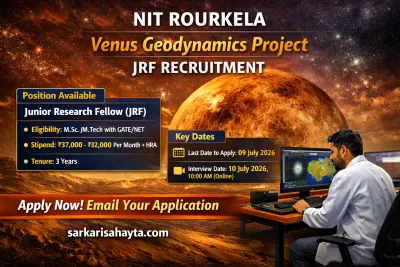
The National Institute of Technology (NIT) Rourkela, an Institute of National Importance under the Ministry of Education, Government of India, has announced a recruitment advertisement for the position of Junior Research Fellow (JRF) under the project titled “Deciphering Venus’s Geodynamics: A Comprehensive Investigation of Corona‑driven Geodynamics, Ongoing Plume‑Tectonic Activity, and the Stagnant Lid Enigma.” 🪐
🎯 Purpose of the Project
This project aims to unravel the mysteries of Venus’s internal and surface dynamics by studying its coronae, plume‑tectonic processes, and the stagnant‑lid phenomenon. It seeks to advance planetary science through data‑driven modeling and comparative geophysical analysis. 🌍
🏢 Institutional Context
NIT Rourkela, located in Odisha, is one of India’s premier technical institutions known for excellence in research and innovation. The Department of Earth and Atmospheric Sciences leads this project, supported by the Indian Space Research Organisation (ISRO) under the Department of Space. 🚀
🛠️ Essential Tools
👨🏫 Project Leadership
- Principal Investigator (PI): Prof. Bhaskar Kundu – kundub@nitrkl.ac.in | 0661‑246‑2936
- Alternate Email: drilbhaskar@gmail.com | Phone: 7681812407
📅 Key Dates
- Advertisement Date: 12 June 2026
- Last Date for Application: 09 July 2026
- Interview Date: 10 July 2026 at 10:00 AM (Online)
✨ Significance of the Notification
This advertisement opens a gateway for researchers passionate about planetary science and space exploration. It reflects NIT Rourkela’s commitment to advancing India’s scientific capabilities in collaboration with ISRO, focusing on Venus’s geodynamics and planetary evolution. 🌠
🪐 About the Project
The project titled “Deciphering Venus’s Geodynamics” is a groundbreaking research initiative funded by the Indian Space Research Organisation (ISRO) under the Department of Space. It aims to explore the complex geological and geophysical processes shaping Venus, one of Earth’s closest planetary neighbors. 🌍
🛠️ Essential Tools
🎯 Project Objective
The primary goal is to investigate the corona‑driven geodynamics of Venus, analyze ongoing plume‑tectonic activity, and understand the stagnant‑lid enigma that differentiates Venus from Earth. Through advanced data analysis and numerical modeling, the project seeks to decode how Venus’s internal processes influence its surface evolution. 🔬
🏢 Department and Funding Details
- Department: Earth and Atmospheric Sciences, NIT Rourkela
- Project Code: SR/26/ER/031
- Funding Agency: ISRO – Department of Space
- Project Duration: Till 02 June 2029
👨🏫 Project Leadership
- Principal Investigator (PI): Prof. Bhaskar Kundu (Department of Earth and Atmospheric Sciences)
- Email: kundub@nitrkl.ac.in | drilbhaskar@gmail.com
- Phone: 0661‑246‑2936 | 7681812407
🔬 Research Focus Areas
- Analysis of Synthetic Aperture Radar (SAR) data for surface deformation mapping.
- Numerical modeling of Venusian coronae and plume‑tectonic interactions.
- Integration of remote sensing, geodesy, and planetary geology datasets.
- Development of computational models using Python, MATLAB, and GIS tools.
📈 Significance of the Project
This project contributes to India’s expanding planetary research portfolio. By combining remote sensing, geophysical modeling, and data analytics, it strengthens India’s scientific collaboration with ISRO and global space research communities. 🌠
🛠️ Essential Tools
✨ Final Note on the Project
The “Deciphering Venus’s Geodynamics” project embodies scientific curiosity and technological innovation. It offers researchers a chance to explore the mysteries of Venus and contribute to humanity’s understanding of planetary evolution beyond Earth. 🚀
📑 Post Details and Eligibility Criteria
The recruitment notification invites applications for the position of Junior Research Fellow (JRF) under the Venus Geodynamics Project. The engagement will be purely temporary and co‑terminus with the project duration. 🪐
👨💻 Post Details
- Name of Post: Junior Research Fellow (JRF)
- No. of Posts: 01 (One)
- Tenure: 3 Years
- Stipend:
- Year 1 & 2: INR 37,000/- per month (+ HRA as per norms)
- Year 3: INR 42,000/- per month (+ HRA as per norms)
- Job Description:
- Conduct research on Venus’s geodynamic processes.
- Perform global data analysis, compositional mapping, and numerical modeling of coronae.
- Work with SAR datasets, planetary geology, and geophysics.
🎓 Essential Qualifications
- M.Sc./M.Tech in Earth Sciences, Geophysics, Geodesy, Physics, or related field.
- Minimum 60% marks or 6.5 CGPA on a 10‑point scale.
- Valid GATE/NET (UGC/CSIR) or equivalent national‑level exam qualification.
- Experience in Remote Sensing and SAR data analysis.
- Understanding of planetary geology/geophysics.
- Proficiency in programming (Python, MATLAB, or similar) for data analysis and modeling.
📌 Desirable Qualifications
- Experience in handling SAR data.
- Familiarity with geodetic software and planetary data processing tools.
- Experience with GIS software for mapping and spatial analysis.
- Prior exposure to planetary datasets and numerical modeling.
🎂 Age Limit
- Upper Age Limit: 28 years (as on last date of application).
- Relaxation:
- +5 years for SC/ST/PwD/Female candidates.
- +3 years for OBC (Non‑Creamy Layer) candidates.
⚠️ Important Notes
- Mere possession of minimum qualification does not guarantee selection.
- Candidates will be shortlisted based on merit and project requirements.
- Suppression of information or false documents will lead to cancellation of selection/joining.
- Reservation guidelines will be followed as per ISRO norms.
✨ Final Note on Eligibility
The eligibility criteria ensure that only academically strong and technically skilled candidates are considered. With emphasis on planetary science, remote sensing, and computational modeling, this position is ideal for young researchers aiming to contribute to India’s space exploration mission. 🚀
📝 Application Process
The application process for the Junior Research Fellow (JRF) position under the Venus Geodynamics project at NIT Rourkela is conducted entirely online. Candidates must carefully follow the steps below to ensure successful submission. ⚡
🌐 How to Apply
- Visit the NIT Rourkela Homepage → Faculty & Staff → SRICCE → Career → Notices section.
- Download and fill the application form completely with accurate details.
- Prepare a single PDF file containing:
- Filled and signed application form.
- Educational qualification documents (mark sheets, certificates).
- Research papers (if any).
- Work experience certificates (if any).
- Send the PDF file via email to the PI’s email ID mentioned in the advertisement.
- Ensure the subject line of the email contains the Advertisement No. (26ER031).
📅 Important Dates
- Last Date for Application: 09 July 2026
- Interview Date: 10 July 2026, 10:00 AM (Online)
📌 Key Instructions
- No hard copies of applications are required; only soft copies via email will be accepted.
- Incomplete or incorrectly filled applications will be rejected.
- Applications received after the deadline will not be considered.
- Shortlisted candidates will be informed via email for the online interview.
⚠️ Advisory
Candidates must ensure that all documents are authentic and complete. Suppression of information or submission of false documents will lead to cancellation of selection. 🚫
✨ Final Note on Application
The application process is straightforward but requires attention to detail. Timely submission, accurate documentation, and adherence to guidelines are essential for securing this research opportunity at NIT Rourkela. 🌟
🎯 Selection Procedure
The selection process for the Junior Research Fellow (JRF) position under the Venus Geodynamics project at NIT Rourkela is designed to ensure transparency, merit‑based recruitment, and alignment with project requirements. ⚖️
📊 Shortlisting of Candidates
- Applications received via email will be scrutinized by the PI and SRICCE office.
- Only candidates fulfilling the essential qualifications (M.Sc./M.Tech in Earth Sciences/Geophysics/Geodesy/Physics with 60% marks or 6.5 CGPA and valid GATE/NET) will be shortlisted.
- Preference will be given to candidates with experience in SAR data analysis, planetary geology, and programming skills.
📝 Merit‑Based Evaluation
- Selection is primarily based on academic performance and suitability for the project.
- Research aptitude in remote sensing, geodesy, GIS, and numerical modeling will be considered.
- Mere possession of minimum qualification does not guarantee selection.
📑 Interview Process
- Shortlisted candidates will be informed via email for the online interview.
- The interview is scheduled for 10 July 2026 at 10:00 AM in the Department of Earth and Atmospheric Sciences.
- Performance in the interview will determine final selection.
📄 Document Verification
Selected candidates must produce original documents during verification:
- Educational certificates and mark sheets.
- Proof of age and identity.
- Category certificates (SC/ST/OBC/PwD) if applicable.
- Research papers or work experience certificates (if any).
⚠️ Important Notes
- Suppression of information or submission of false documents will lead to cancellation of selection/joining.
- NIT Rourkela reserves the right to fix higher criteria for shortlisting.
- The decision of the institute will be final and binding.
✨ Final Note on Selection
The selection procedure emphasizes fairness and merit. By focusing on academic excellence, research aptitude, and project relevance, NIT Rourkela ensures that only deserving candidates are chosen to contribute to this prestigious planetary science project. 🚀
👩🔬 Life as a Junior Research Fellow at NIT Rourkela
Being selected as a Junior Research Fellow (JRF) under the Venus Geodynamics Project at NIT Rourkela offers a unique opportunity to contribute to planetary science and space research. This role blends academic growth, technical skill development, and professional exposure. 🌟
⚙️ Daily Research Activities
- Analyzing SAR (Synthetic Aperture Radar) data for Venus’s surface deformation studies.
- Conducting numerical modeling of corona‑driven geodynamics and plume‑tectonic activity.
- Working with planetary geology datasets and geodesy tools.
- Programming in Python/MATLAB for data analysis and simulation.
🏢 Work Environment
The Department of Earth and Atmospheric Sciences provides a collaborative and resource‑rich environment. JRFs work under the guidance of Prof. Bhaskar Kundu, gaining exposure to interdisciplinary research in planetary science, geophysics, and remote sensing. ⚡
💰 Stipend & Benefits
- Year 1 & 2: INR 37,000/- per month (+ HRA as per norms).
- Year 3: INR 42,000/- per month (+ HRA as per norms).
- Access to advanced computational facilities and research labs.
🌍 Broader Impact
JRFs contribute to India’s planetary exploration mission by supporting ISRO’s research on Venus. Their work enhances global understanding of planetary geodynamics and strengthens India’s role in space science. 🚀
📈 Career Growth
- Hands‑on experience in planetary science and geophysics enhances employability.
- Opportunities to publish research papers and present at conferences.
- Potential to pursue doctoral studies or secure positions in academia and research institutions.
✨ Final Note on JRF Life
Life as a JRF at NIT Rourkela is intellectually stimulating and professionally rewarding. It offers young researchers a platform to innovate, learn, and contribute meaningfully to space exploration and planetary science. 🌠
📚 Preparation Strategy
To maximize the chances of selection as a Junior Research Fellow (JRF) under the Venus Geodynamics project at NIT Rourkela, candidates must prepare strategically. Since the process involves merit‑based shortlisting and an online interview, readiness in academics, documentation, and technical skills is essential. 🏆
🎓 Academic Preparation
- Revise core subjects in Earth Sciences, Geophysics, Geodesy, and Planetary Physics thoroughly.
- Strengthen fundamentals in planetary geology and geodynamics, especially corona‑driven processes and plume‑tectonics.
- Brush up on remote sensing techniques, SAR data analysis, and GIS applications.
- Review recent research papers on Venus’s geodynamics and planetary evolution.
📑 Documentation Readiness
- Ensure all educational certificates and mark sheets are updated and scanned clearly.
- Prepare proof of age, identity, and category certificates (SC/ST/OBC/PwD) if applicable.
- Compile research papers, project reports, or work experience certificates into a single PDF.
- Keep the application form filled, signed, and ready for submission via email before the deadline.
🖥️ Technical Familiarity
- Practice programming in Python and MATLAB for data analysis and numerical modeling.
- Gain exposure to geodetic software and planetary data processing tools.
- Be prepared to discuss practical applications of SAR data and GIS mapping during the interview.
💪 Personal Readiness
- Maintain discipline and punctuality in preparation.
- Stay updated with latest trends in planetary science and ISRO’s research initiatives.
- Develop confidence in explaining technical concepts clearly and concisely.
🌟 Smart Tips
- Prepare a checklist of required documents before the deadline.
- Network with seniors or peers who have worked on planetary science projects for guidance.
- Rehearse mock interviews focusing on technical and project‑related questions.
- Keep track of updates on the NIT Rourkela website and email notifications.
✨ Final Note on Preparation
Preparation for the JRF role at NIT Rourkela is not just about academics — it is about readiness, documentation, and confidence. By combining strong technical fundamentals with proper organization and interview skills, candidates can significantly improve their chances of selection. 🚀
🎁 Benefits of the Fellowship
Joining as a Junior Research Fellow (JRF) under the Venus Geodynamics project at NIT Rourkela offers multiple academic, professional, and personal benefits. This fellowship is not only financially supportive but also career‑defining. 🌟
💰 Financial Support
- Year 1 & 2: INR 37,000/- per month (+ HRA as per norms).
- Year 3: INR 42,000/- per month (+ HRA as per norms).
- Stable financial assistance during the three‑year fellowship period.
🎓 Academic Growth
- Opportunity to work on cutting‑edge planetary science research funded by ISRO.
- Access to advanced computational tools, geodetic software, and GIS applications.
- Chance to publish research papers and present findings at national and international conferences.
📈 Career Opportunities
- Hands‑on experience in planetary geophysics, remote sensing, and numerical modeling.
- Enhanced employability in academia, research institutions, and space science organizations.
- Potential pathway to doctoral studies or advanced research positions in India and abroad.
🏢 Professional Exposure
- Work under the mentorship of Prof. Bhaskar Kundu and collaborate with peers in planetary science.
- Develop skills in project management, teamwork, and technical communication.
- Exposure to interdisciplinary research combining Earth sciences, physics, and planetary geology.
🌍 Contribution to National Mission
- Contribute to India’s planetary exploration mission in collaboration with ISRO.
- Support global understanding of Venus’s geodynamics and planetary evolution.
- Be part of a government‑funded initiative with national and international importance. 🇮🇳
✨ Final Note on Benefits
The JRF fellowship at NIT Rourkela is more than a temporary engagement — it is a stepping stone to a brighter academic and professional future. With financial support, research exposure, and national impact, fellows gain the skills and confidence needed to excel in the competitive world of planetary science and space exploration. 🚀
🌐 Important Websites & References
For the Junior Research Fellow (JRF) recruitment under the Venus Geodynamics Project, candidates must rely only on official sources for accurate information and application submission. 🖥️
🔗 NIT Rourkela Official Website
- Primary source for recruitment notices under SRICCE (Sponsored Research & Industrial Consultancy).
- Contains detailed advertisement, corrigendum, and updates.
- Application link available under Faculty & Staff → SRICCE → Career → Notices.
📑 Advertisement Reference
- Advertisement No.: NITR/SR/2026/Advt.-26ER031/L/041
- Date of Notification: 12 June 2026
- Last Date for Application: 09 July 2026
- Interview Date: 10 July 2026, 10:00 AM (Online)
📧 Contact Information
- PI: Prof. Bhaskar Kundu – kundub@nitrkl.ac.in | Phone: 0661‑246‑2936
- Alternate Email: drilbhaskar@gmail.com | Phone: 7681812407
⚠️ Advisory
Candidates should avoid relying on unofficial websites, agents, or third‑party portals. All valid information and applications are available only through the NIT Rourkela official website. 🚫
✨ Final Note on References
Staying updated through official portals ensures accuracy and transparency. Aspirants must regularly check nitrkl.ac.in for notifications, corrigenda, and interview updates. 🌟
❓ Frequently Asked Questions (FAQ)
Here are answers to the most common queries regarding the Junior Research Fellow (JRF) recruitment under the Venus Geodynamics Project. These FAQs will help candidates avoid confusion and ensure smooth participation. 📋
1️⃣ Who can apply for this fellowship?
Candidates with M.Sc./M.Tech in Earth Sciences, Geophysics, Geodesy, Physics, or related fields with minimum 60% marks or 6.5 CGPA and valid GATE/NET qualification are eligible.
2️⃣ How many positions are available?
There is 01 Junior Research Fellow (JRF) position available under this project.
3️⃣ What is the duration of the fellowship?
The tenure of the fellowship is 3 years, co‑terminus with the project.
4️⃣ What is the stipend?
Year 1 & 2: INR 37,000/- per month (+ HRA as per norms). Year 3: INR 42,000/- per month (+ HRA as per norms).
5️⃣ How do I apply?
Applications must be submitted online by sending a single PDF (application form + documents) via email to the PI’s email ID. The subject line must contain the advertisement number.
6️⃣ What is the last date of application?
The last date for submission is 09 July 2026.
7️⃣ When will the interview be conducted?
The online interview is scheduled for 10 July 2026 at 10:00 AM in the Department of Earth and Atmospheric Sciences.
8️⃣ Is there any application fee?
No application fee is required.
9️⃣ What is the age limit?
Upper age limit is 28 years (as on last date of application). Relaxation: +5 years for SC/ST/PwD/Female candidates, +3 years for OBC (Non‑Creamy Layer).
🔟 What is the nature of the appointment?
The appointment is purely temporary/contractual and co‑terminus with the project duration.
✨ Final Note on FAQs
These FAQs cover the most important aspects of the fellowship program. Candidates should regularly check nitrkl.ac.in for updates, corrigenda, and interview notifications. Staying informed ensures a smooth and successful application journey. 🚀
🏁 Conclusion
The Venus Geodynamics Project at NIT Rourkela represents a pioneering initiative in planetary science, supported by the Indian Space Research Organisation (ISRO). By recruiting a Junior Research Fellow (JRF), the institute is offering young researchers a chance to contribute to cutting‑edge innovations that explore Venus’s corona‑driven geodynamics, plume‑tectonic activity, and stagnant‑lid enigma. 🪐
📌 Key Takeaways
- Position: Junior Research Fellow (JRF) – 01 Post.
- Stipend: INR 37,000/- per month (Year 1 & 2), INR 42,000/- per month (Year 3) + HRA.
- Tenure: 3 Years, co‑terminus with the project.
- Application Deadline: 09 July 2026.
- Interview Date: 10 July 2026, 10:00 AM (Online).
🌟 Broader Impact
This fellowship is not just about academic growth; it is about contributing to a larger vision of planetary exploration and advancing India’s role in global space research. The outcomes of this project will enhance understanding of Venus’s geodynamics and strengthen India’s scientific footprint in planetary science. 🚀
✨ Final Words
For aspiring candidates, this opportunity is a gateway to advanced research, professional development, and meaningful contribution to space science. By applying diligently and preparing thoroughly, candidates can secure a role that blends personal growth with national service. 🌠
🔔 Stay updated through nitrkl.ac.in for notifications, corrigenda, and interview details. Your dedication today can shape a sustainable and innovative tomorrow. 🌱