🎓 CBSE Online Training Programme 2026 on Understanding 5Ds – Complete Guide for Teachers, Schools, Registration, Benefits, Certification & Inclusive Education
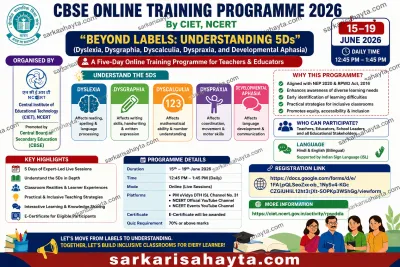
📢 The Central Board of Secondary Education (CBSE) has issued an important circular regarding a specialized online training programme titled “Beyond Labels: Understanding 5Ds (Dyslexia, Dysgraphia, Dyscalculia, Dyspraxia, and Developmental Aphasia)”. The programme is being organized by the Central Institute of Educational Technology (CIET), NCERT and aims to strengthen awareness regarding learning disabilities and inclusive education practices among teachers, school leaders, and educational stakeholders.
🏫 In today's rapidly evolving educational landscape, understanding diverse learning needs has become more important than ever before. Every child learns differently, and some students face unique learning challenges that often remain unidentified in traditional classroom settings. Through this five-day online training programme, educators will gain valuable knowledge about recognizing, understanding, and supporting children with specific learning difficulties.
🌟 The initiative aligns with the vision of the National Education Policy (NEP) 2020 and the objectives of the Rights of Persons with Disabilities (RPWD) Act, 2016. The programme seeks to create awareness, encourage inclusive teaching practices, and equip teachers with practical classroom strategies that can make education more accessible and effective for all learners.
📚 This comprehensive guide explains every important aspect of the CBSE Online Training Programme 2026, including eligibility, objectives, schedule, registration process, certification criteria, significance of the 5Ds, benefits for teachers, and much more.
📌 CBSE Training Programme 2026 Overview
| Organization | Central Board of Secondary Education (CBSE) |
| Training Conducted By | Central Institute of Educational Technology (CIET), NCERT |
| Programme Name | Beyond Labels: Understanding 5Ds |
| Mode | Online (Live Sessions) |
| Duration | 15 June 2026 to 19 June 2026 |
| Daily Timing | 12:45 PM to 1:45 PM |
| Target Audience | Teachers, Educators, School Leaders and Educational Stakeholders |
| Certificate | E-Certificate Available |
| Certificate Requirement | 70% or Above in Quiz |
| Language | Hindi and English |
| Accessibility Support | Indian Sign Language (ISL) |
| Registration Link | Register Here |
| More Information | Official Details |
🌈 What Does “Beyond Labels” Mean?
🧠 The title “Beyond Labels” carries a powerful educational message. Traditionally, children with learning difficulties are often categorized using labels that focus only on their challenges. Such labels sometimes create stereotypes and may negatively affect a child’s confidence, academic growth, and social development.
✨ The purpose of this programme is to encourage educators to look beyond diagnostic labels and understand the individual strengths, abilities, learning styles, and potential of every student.
👩🏫 Instead of viewing a child as “a dyslexic student” or “a child with a learning disability,” teachers are encouraged to understand the learner holistically and adopt supportive strategies that help students succeed.
🎯 This approach promotes empathy, inclusion, and learner-centered teaching practices.
📖 Understanding the Concept of 5Ds
The training programme focuses on five important developmental and learning-related conditions commonly referred to as the 5Ds.
- 📚 Dyslexia
- ✍️ Dysgraphia
- 🔢 Dyscalculia
- 🤸 Dyspraxia
- 🗣 Developmental Aphasia
Each of these conditions affects learning in different ways and requires specific understanding and educational support.
📚 Dyslexia – Understanding Reading Difficulties
📖 Dyslexia is one of the most common learning difficulties affecting reading and language processing skills. Students with dyslexia may experience challenges in recognizing words, decoding text, spelling, and reading fluently.
❗ Dyslexia does not indicate low intelligence. Many highly intelligent and successful individuals have dyslexia. The difficulty lies in processing written language rather than understanding concepts.
🔍 Common Signs of Dyslexia
- 📖 Slow reading speed
- 🔤 Difficulty identifying letters and sounds
- ✍️ Frequent spelling mistakes
- 📚 Trouble understanding written instructions
- 📝 Reversing letters or words
- 📄 Difficulty reading aloud
🎯 How Teachers Can Help
- ✅ Use multi-sensory teaching methods
- ✅ Provide visual learning aids
- ✅ Allow additional reading time
- ✅ Encourage audio-based learning
- ✅ Offer positive reinforcement
- ✅ Use structured reading interventions
✍️ Dysgraphia – Understanding Writing Difficulties
🖊 Dysgraphia affects a student's writing abilities. Learners with dysgraphia may struggle with handwriting, spelling, organizing thoughts on paper, and producing written work efficiently.
📄 Even when students understand concepts clearly, they may find it difficult to express their knowledge through writing.
🔍 Signs of Dysgraphia
- ✍️ Poor handwriting
- 📝 Inconsistent letter formation
- 📄 Difficulty organizing written work
- ⏳ Slow writing speed
- 📚 Trouble taking notes
- 🔤 Frequent spelling errors
🎯 Classroom Support Strategies
- 💻 Allow use of computers
- 📝 Provide printed notes
- 📚 Reduce excessive copying tasks
- 🎤 Encourage oral responses
- 📋 Use structured writing templates
- ⭐ Focus on content rather than handwriting alone
🔢 Dyscalculia – Understanding Mathematical Learning Difficulties
➕ Dyscalculia is a learning difficulty related to mathematical concepts and number understanding. Students with dyscalculia often face challenges in understanding numbers, calculations, measurements, time, and mathematical reasoning.
📊 These learners may perform well in other subjects while experiencing significant difficulties in mathematics.
🔍 Common Symptoms
- 🔢 Difficulty recognizing numbers
- ➗ Problems with calculations
- 📏 Trouble understanding measurements
- ⏰ Difficulty telling time
- 📉 Challenges in mathematical reasoning
- 🧮 Confusion with number sequences
🎯 Effective Teaching Techniques
- 🧩 Use concrete learning materials
- 📊 Introduce visual representations
- 🔢 Break concepts into smaller steps
- 🎮 Use educational games
- 📚 Provide repeated practice opportunities
- 🤝 Offer individualized support
🤸 Dyspraxia – Understanding Coordination Difficulties
🏃 Dyspraxia affects motor coordination, movement planning, and physical task execution. Students with dyspraxia may struggle with activities that require coordination, balance, and fine motor skills.
✏️ Tasks such as writing, cutting, drawing, tying shoelaces, or participating in sports may become difficult.
🔍 Common Characteristics
- 🤸 Poor coordination
- ✏️ Difficulty with handwriting
- 🏃 Frequent tripping or bumping into objects
- 🧩 Challenges in organizing activities
- 🖐 Difficulty using tools and equipment
- 📚 Problems completing practical tasks
🎯 Classroom Support
- 🪑 Provide suitable seating arrangements
- 📝 Allow extra time for tasks
- 📚 Simplify instructions
- 🎯 Break activities into manageable steps
- 🤝 Encourage peer support
- 🌟 Recognize individual strengths
🗣 Developmental Aphasia – Understanding Language Difficulties
🧠 Developmental Aphasia refers to significant difficulties in language development and communication. Children affected by this condition may struggle to understand spoken language, express thoughts, or participate effectively in verbal interactions.
📢 Early identification and supportive communication strategies are crucial for improving outcomes.
🔍 Common Signs
- 🗣 Delayed speech development
- 📚 Difficulty understanding language
- 💬 Limited vocabulary
- ❓ Challenges following instructions
- 🧠 Difficulty forming sentences
- 🤝 Communication-related social difficulties
🎯 Teaching Strategies
- 🖼 Use visual supports
- 📢 Speak clearly and slowly
- 📝 Use simple language
- 🤝 Encourage communication opportunities
- 🎯 Provide repeated instructions
- 🌟 Celebrate communication efforts
🏫 Why Inclusive Education Matters in Modern Schools
🌍 Inclusive education ensures that every child receives equal opportunities to learn, participate, and grow regardless of learning differences, disabilities, language barriers, or developmental challenges.
📚 Modern classrooms are diverse environments where students possess different strengths, backgrounds, interests, and learning needs. Inclusive practices help schools create welcoming educational environments where every learner feels valued.
🎯 Through programmes such as this CBSE-CIET initiative, teachers become better equipped to recognize learner diversity and implement evidence-based teaching strategies that benefit all students.
📜 National Education Policy (NEP) 2020 and Inclusive Education
🇮🇳 The National Education Policy (NEP) 2020 places significant emphasis on inclusive and equitable quality education. One of its primary goals is ensuring that every learner receives opportunities to achieve their full potential regardless of social, economic, linguistic, physical, or learning-related differences.
📚 NEP 2020 recognizes that children learn differently and therefore educational systems must adapt to meet diverse learner needs. Traditional one-size-fits-all approaches often fail to support students facing learning challenges such as dyslexia, dysgraphia, dyscalculia, dyspraxia, and developmental aphasia.
🎯 The CBSE-CIET training programme directly supports NEP 2020 by helping teachers understand learning diversity and implement inclusive teaching methodologies that benefit all learners.
🌟 Key NEP 2020 Objectives Supported by This Programme
- ✅ Inclusive and equitable education
- ✅ Early identification of learning difficulties
- ✅ Learner-centered teaching approaches
- ✅ Accessibility in education
- ✅ Reduced learning barriers
- ✅ Improved teacher capacity building
- ✅ Enhanced student participation
- ✅ Better learning outcomes for all children
⚖ Understanding the RPWD Act 2016
📜 The Rights of Persons with Disabilities (RPWD) Act, 2016 serves as a landmark legislation promoting equality, dignity, and accessibility for persons with disabilities in India.
🏫 Within the education sector, the Act emphasizes inclusive educational environments where learners with disabilities and special educational needs can access quality education without discrimination.
🎯 The current training programme aligns closely with the objectives of the RPWD Act by helping educators understand diverse learner profiles and develop supportive classroom practices.
📚 Educational Goals of RPWD Act
- 🎓 Equal educational opportunities
- 🏫 Inclusive school environments
- 📖 Accessible learning materials
- 🤝 Non-discriminatory practices
- 🌍 Social inclusion
- 🧠 Recognition of diverse learning needs
- 📢 Awareness among educators
- ⭐ Student empowerment
📅 Programme Schedule and Duration
🗓 The online training programme is being conducted over a period of five days, allowing participants to gradually develop a comprehensive understanding of the 5Ds and inclusive education practices.
| Programme Duration | 15 June 2026 to 19 June 2026 |
| Mode | Online Live Sessions |
| Daily Timing | 12:45 PM – 1:45 PM |
| Session Duration | Approximately 1 Hour Daily |
| Total Training Days | 5 Days |
⏰ The timing has been designed to ensure convenience for educators while minimizing disruption to regular teaching responsibilities.
💻 Online Platforms for Participation
📡 Participants can join the live sessions through designated educational broadcasting platforms. No separate meeting link will be provided.
📺 Available Platforms
- 📡 PM eVidya DTH ISL Channel No. 31
- ▶ NCERT Official YouTube Channel
- 🎥 NCERT Events YouTube Channel
🌍 These platforms ensure nationwide accessibility and allow participants from various regions to attend the sessions conveniently.
📝 Step-by-Step Registration Process
📋 Interested teachers and educators can register online through the official registration form.
- 🌐 Open the registration link.
- 📝 Fill in personal information.
- 🏫 Enter school and professional details.
- 📧 Provide a valid email address.
- 📱 Enter active contact details.
- ✅ Verify entered information carefully.
- 📤 Submit the registration form.
- 💾 Save confirmation details for future reference.
🔗 Registration Link: Apply Here
🎖 E-Certificate and Assessment Process
📜 One of the major attractions of the programme is the availability of an official e-certificate for successful participants.
🎯 Participants must score at least 70% marks in the post-training quiz to qualify for certification.
📋 Certification Highlights
- ✅ Digital Certificate
- ✅ Issued after successful assessment
- ✅ Minimum 70% marks required
- ✅ Useful for professional development
- ✅ Supports teacher training records
- ✅ Recognized educational participation proof
👩🏫 Benefits for Teachers
The programme offers significant professional advantages to educators.
- 📚 Better understanding of learning disabilities
- 🧠 Improved identification skills
- 🏫 Enhanced classroom management
- 🤝 Increased empathy toward learners
- 📖 Practical teaching strategies
- 🌟 Professional growth opportunities
- 🎯 Improved learner outcomes
- 📜 Valuable certification
✨ Teachers who understand learner diversity become more effective educators and create positive classroom environments.
🏫 Benefits for Schools
Educational institutions also benefit significantly when teachers participate in such training programmes.
- 🌈 More inclusive school culture
- 📚 Improved teaching quality
- 🧠 Better student support systems
- 🤝 Enhanced parent satisfaction
- 📈 Improved academic outcomes
- ⭐ Stronger compliance with inclusive education policies
- 🏆 Better institutional reputation
- 🎯 Reduced learning barriers
🔍 Importance of Early Identification
🧠 One of the most important themes of the programme is early identification of learning difficulties.
⏳ Delayed recognition often leads to academic struggles, low confidence, emotional challenges, and reduced engagement in learning.
🎯 Early intervention enables educators and parents to provide timely support, improving long-term educational outcomes.
📌 Advantages of Early Identification
- ✅ Timely support
- ✅ Better academic progress
- ✅ Improved self-confidence
- ✅ Reduced emotional stress
- ✅ Stronger parent-teacher collaboration
- ✅ Effective intervention planning
🌍 Building Inclusive Classrooms
🏫 Inclusive classrooms welcome learners with different abilities, backgrounds, learning styles, and developmental profiles.
🌟 Teachers play a critical role in ensuring that every student feels respected, valued, and capable of success.
📚 Inclusive Classroom Practices
- 🤝 Promote respect and acceptance
- 📖 Use diverse teaching methods
- 🖼 Include visual learning supports
- 🎯 Differentiate instruction
- 📋 Offer flexible assessments
- ⭐ Recognize individual strengths
- 🧠 Encourage learner participation
- 💬 Foster open communication
🚀 Long-Term Impact of the Training Programme
📈 The benefits of this initiative extend far beyond the five-day training duration.
🌟 Educators who participate are likely to apply newly acquired knowledge throughout their teaching careers, positively influencing hundreds of students over time.
🏫 Schools that promote inclusive education often experience stronger student engagement, better academic performance, and healthier learning environments.
🎯 Ultimately, programmes such as this contribute to building a more equitable and learner-friendly education system in India.
📢 Final Conclusion
🎓 The CBSE Online Training Programme titled “Beyond Labels: Understanding 5Ds” represents an important step toward strengthening inclusive education practices across the country.
📚 By focusing on Dyslexia, Dysgraphia, Dyscalculia, Dyspraxia, and Developmental Aphasia, the programme helps educators understand diverse learner needs and equips them with practical strategies for supporting every child.
🌈 Aligned with the vision of NEP 2020 and RPWD Act 2016, the initiative promotes awareness, accessibility, equity, and inclusion in education.
🏫 CBSE-affiliated schools are encouraged to disseminate this information widely and motivate teachers to participate actively. Through collaborative efforts, educators can create classrooms where every learner is valued, supported, and empowered to succeed.
❓ Frequently Asked Questions (FAQs)
- 📅 What is the duration of the CBSE Online Training Programme 2026?
- The programme will be conducted from 15 June 2026 to 19 June 2026.
- 🎓 What is the title of the programme?
- The programme is titled “Beyond Labels: Understanding 5Ds”.
- 🏫 Who is organizing the training programme?
- The programme is organized by CIET, NCERT and promoted through CBSE.
- 💻 What is the mode of training?
- The training will be conducted through online live sessions.
- ⏰ What are the daily timings?
- Sessions will be conducted daily from 12:45 PM to 1:45 PM.
- 📚 What does Dyslexia mean?
- Dyslexia is a learning difficulty that primarily affects reading, spelling, and language processing skills.
- ✍️ What is Dysgraphia?
- Dysgraphia is a learning difficulty that affects writing skills, handwriting, and written expression.
- 🔢 What is Dyscalculia?
- Dyscalculia is a learning difficulty related to mathematical concepts and numerical understanding.
- 🤸 What is Dyspraxia?
- Dyspraxia affects coordination, movement planning, and motor skill development.
- 🗣 What is Developmental Aphasia?
- Developmental Aphasia affects language development, comprehension, and communication abilities.
- 🌈 Why is inclusive education important?
- Inclusive education ensures equal learning opportunities and supports diverse learner needs.
- 📜 Will participants receive a certificate?
- Yes, an e-certificate will be awarded to eligible participants.
- 🎯 What is the minimum score required for certification?
- Participants must secure 70% or above in the quiz.
- 🧏 Will ISL interpretation be available?
- Yes, Indian Sign Language interpretation will be provided.
- 🌐 Where can I get more information?
- Visit the official information page for complete details.