📢 Anganwadi Worker Recruitment 2026 – Barabanki District - Introduction
Anganwadi centres have been the backbone of India’s Integrated Child Development Services (ICDS) scheme since its inception in 1975. These centres act as the first point of contact for millions of families, providing essential services such as supplementary nutrition, preschool education, health check‑ups, and referral services. At the heart of this system are Anganwadi Workers, women who serve as the link between the community and government welfare programs. Their role is not only administrative but deeply social, as they are responsible for ensuring that children under six years of age, as well as pregnant and lactating mothers, receive the care and support they need.
In Uttar Pradesh, the demand for Anganwadi Workers has always been significant due to the state’s large population and diverse socio‑economic challenges. Barabanki district, located in the Awadh region, is no exception. With a mix of rural and urban blocks, the district requires a strong network of Anganwadi centres to reach every household. The newly announced recruitment drive for 166 Anganwadi Worker posts in Barabanki is therefore a crucial step in strengthening grassroots delivery of child and maternal welfare services.
This recruitment is particularly important because it prioritizes women from disadvantaged backgrounds. The notification clearly states that widows, divorced, and abandoned women from Below Poverty Line (BPL) families will be given preference. Such provisions highlight the government’s commitment to not only filling vacancies but also empowering vulnerable women by offering them stable employment opportunities. By integrating social justice with employment, the scheme ensures that those who have faced hardships are given a chance to rebuild their lives while serving the community.
Another noteworthy aspect of this recruitment is its emphasis on transparency and digital processes. Applications are invited exclusively online through the official portal, ensuring that the process remains accessible, verifiable, and free from middlemen. This digital approach reflects the broader push towards e‑governance in Uttar Pradesh, making recruitment more efficient and accountable.
As we move through the details of this notification, it becomes clear that the Barabanki Anganwadi Recruitment 2026 is not just about filling posts. It is about reinforcing the ICDS framework, empowering women, and ensuring that the next generation of children grows up with access to nutrition, education, and healthcare. In the following sections, we will explore the vacancy distribution, eligibility criteria, application process, and other key aspects of this recruitment drive in detail.
Vacancy Details
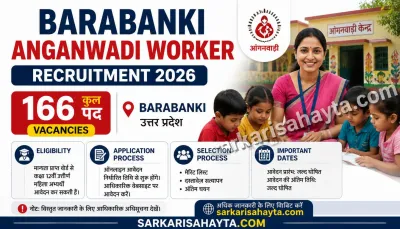
The Barabanki Anganwadi Worker recruitment notification specifies a total of 166 vacancies distributed across 16 projects in both rural and urban areas. This distribution reflects the diverse needs of the district, where some blocks require a larger workforce due to population density and socio‑economic conditions, while others have relatively fewer openings.
Among the projects, Banki block stands out with the highest number of vacancies at 23 posts. This indicates a significant demand for Anganwadi services in the area, likely due to its larger population and the need for expanded coverage. Other blocks with notable vacancies include Nindura (17 posts) and Deva (14 posts), both of which are key rural regions requiring strong Anganwadi networks to ensure effective delivery of child and maternal welfare schemes.
On the other hand, some blocks such as Barabanki City (2 posts) and Haidergarh (3 posts) show relatively fewer vacancies. This does not necessarily mean that the demand is lower, but rather that existing centres may already be staffed, or the population distribution requires fewer additional workers. The variation in numbers highlights the importance of tailoring recruitment to local needs rather than applying a uniform approach across the district.
Reservation plays a crucial role in this recruitment. Out of the 166 posts, 25 are reserved for Scheduled Castes (SC), 46 for Other Backward Classes (OBC), and 95 remain unreserved. This distribution ensures that opportunities are extended to marginalized communities while maintaining a balance for general category applicants. The reservation policy aligns with the broader objectives of social justice, ensuring that women from disadvantaged backgrounds have equitable access to government employment.
It is also important to note that the notification emphasizes preference for widows, divorced, and abandoned women, particularly from Below Poverty Line (BPL) families. This adds another layer of inclusivity to the recruitment process. By prioritizing women who may otherwise struggle to find stable employment, the scheme not only fills vacancies but also addresses social vulnerabilities directly at the community level.
Overall, the vacancy distribution in Barabanki reflects both demographic realities and policy priorities. Larger blocks with higher populations have more openings, while reservation ensures fair representation across categories. For candidates, understanding this distribution is crucial, as it helps them identify where opportunities are concentrated and how reservation policies may impact their chances of selection.
Eligibility Criteria
🛠️ Essential Tools
Eligibility is one of the most important aspects of any recruitment process, and the Barabanki Anganwadi Worker Recruitment 2026 has laid down clear rules to ensure fairness and transparency. The criteria are designed not only to maintain minimum standards of education and age but also to extend opportunities to women from vulnerable backgrounds. Below is a detailed breakdown of the eligibility requirements.
Gender Requirement
Only women candidates are eligible to apply for these posts. This is consistent with the nature of Anganwadi work, which involves close interaction with mothers and children. By restricting the posts to women, the government ensures that the workforce remains sensitive to the needs of families and communities.
Educational Qualification
The minimum educational qualification required is Intermediate (Class 12 pass). This ensures that candidates have a basic level of education to handle record‑keeping, communication, and coordination with government departments. However, the notification also specifies that merit will be prepared up to the postgraduate level. This means that candidates with higher qualifications will not be excluded; instead, their academic achievements will be considered in the merit list. For example, a candidate with a Master’s degree may have an advantage in terms of merit ranking compared to someone with only a 12th pass certificate.
Age Limit
The age limit is set between 18 and 35 years as of 1 July 2026. This range ensures that candidates are mature enough to handle responsibilities but still young enough to serve for several years. The lower limit of 18 years allows fresh school graduates to apply, while the upper limit of 35 years provides opportunities to women who may have completed higher education or are seeking employment after personal challenges.
Preference Categories
One of the most distinctive features of this recruitment is the preference given to certain categories of women. The notification specifies that widows, divorced, and abandoned women from Below Poverty Line (BPL) families of the same Gram Sabha or ward will be given priority. This policy serves two purposes:
- Social empowerment: Women who have faced personal hardships are provided with stable employment opportunities.
- Community relevance: By recruiting women from the same locality, the Anganwadi centre becomes more accessible and relatable to the community it serves.
If no eligible widow is available, preference will move to divorced or abandoned women. If none of these categories are found within BPL families, then women from Above Poverty Line (APL) families may be considered, following the same order of preference. This layered approach ensures that the most vulnerable candidates are prioritized without leaving vacancies unfilled.
Document Verification
Eligibility is not just about meeting the criteria; it must be proven through valid documents. Candidates must provide:
- Age proof: High school mark sheet or certificate showing date of birth.
- Educational certificates: Intermediate or higher qualification certificates.
- Residence certificate: Issued by the local authority, clearly mentioning Gram Sabha or ward.
- Income certificate: Digitally signed and verifiable online, as per UP government rules.
- Special category documents: Death certificate for widows, court orders for divorced women, etc.
Why These Criteria Matter
The eligibility rules are not arbitrary. They reflect the dual goals of the recruitment: ensuring that Anganwadi centres are staffed by capable women and empowering those who need support the most. By combining educational standards with social preference categories, the government balances efficiency with inclusivity. For candidates, understanding these criteria is essential, as meeting them is the first step toward securing a position in this highly impactful role.
Application Process
Applying for the Barabanki Anganwadi Worker Recruitment 2026 is designed to be simple, transparent, and entirely digital. The government has emphasized that applications will be accepted only through the official online portal, ensuring that the process remains accessible and verifiable. Below is a comprehensive guide to help candidates navigate the application process smoothly.
Step-by-Step Guide
- Visit the official website: Candidates must go to upanganwadibharti.in, the dedicated portal for Anganwadi recruitment in Uttar Pradesh.
- Locate the recruitment link: On the homepage, look for the notification titled “Barabanki Anganwadi Worker Recruitment 2026” and click on the application link.
- Register yourself: New users will need to create an account by providing basic details such as name, mobile number, and email ID. A one‑time password (OTP) may be sent for verification.
- Fill in personal details: Enter information such as date of birth, father’s/husband’s name, address, and Gram Sabha/Ward details. Accuracy here is critical, as residence plays a role in eligibility.
- Educational qualifications: Upload details of your Intermediate (Class 12) certificate and any higher qualifications. Ensure that marks, percentages, and year of passing are entered correctly.
- Upload documents: Candidates must upload scanned copies of required certificates, including caste, income, and residence certificates. These must be digitally signed and verifiable online. For widows, a death certificate is required; for divorced women, a court order must be provided.
- Review and submit: Before final submission, carefully review all details. Once submitted, changes may not be allowed. Download and save a copy of the application form for future reference.
Documents Required
- High school certificate (for age proof)
- Intermediate or higher qualification certificates
- Residence certificate mentioning Gram Sabha/Ward
- Income certificate (digitally signed, verifiable online)
- Caste certificate (if applicable)
- Special category documents (death certificate, court order, etc.)
Common Mistakes to Avoid
- Incorrect details: Entering wrong marks, percentages, or personal information can lead to rejection.
- Unclear documents: Uploading blurred or unreadable certificates may invalidate the application.
- Missing category declaration: Candidates claiming widow/divorced/abandoned status must mention it clearly in the form; failure to do so will nullify the claim.
- Late submission: Applications submitted after the deadline of 4 August 2026 will not be accepted under any circumstances.
Why the Online Process Matters
The exclusive use of the online portal ensures transparency and efficiency. It eliminates the possibility of middlemen or unofficial agents interfering in the process. Digital verification of certificates also reduces fraud and ensures that only genuine candidates are considered. For applicants, this means that the responsibility lies entirely with them to provide accurate information and valid documents.
Final Note
Candidates should treat the application process with utmost seriousness. Every detail entered and every document uploaded will be scrutinized by the selection committee. A well‑prepared application not only increases the chances of selection but also reflects the candidate’s commitment to the role. With the deadline approaching, applicants are advised to complete the process early to avoid last‑minute technical issues.
Selection Process
The selection of Anganwadi Workers in Barabanki district will follow a structured and transparent process as outlined in the government order dated 17 September 2025. The aim is to ensure that only eligible candidates are appointed, while giving fair preference to women from disadvantaged backgrounds. Below is a detailed explanation of how the selection process works.
Merit Preparation
Merit will be prepared based on educational qualifications. The minimum qualification required is Intermediate (Class 12), but candidates with higher qualifications such as graduation or post‑graduation will be ranked accordingly. Marks obtained in the qualifying examinations will be carefully considered, and candidates with stronger academic records will have an advantage. This system ensures that the most capable candidates are selected while still allowing women with basic qualifications to compete.
Preference Categories
In addition to academic merit, preference will be given to widows, divorced, and abandoned women, especially those from Below Poverty Line (BPL) families. This layered preference system means that if multiple candidates have similar qualifications, the one belonging to a vulnerable category will be prioritized. This approach integrates social justice into the recruitment process, ensuring that employment opportunities reach women who need them most.
Document Verification
Document verification is a critical stage of the selection process. Candidates must provide valid and verifiable certificates for age, residence, income, and caste. These documents must be digitally signed and capable of online verification. For special categories, widows must submit a death certificate issued by the Gram Panchayat or municipal authority, while divorced or abandoned women must provide a legal order from a competent court. Any discrepancies, forged documents, or unclear submissions will lead to rejection of the application.
Role of the Selection Committee
The district selection committee, chaired by senior officials such as the District Magistrate and District Programme Officer, will oversee the entire process. The committee is responsible for scrutinizing applications, verifying documents, and preparing the final merit list. Their decisions are considered final and binding, ensuring that the recruitment process remains free from external influence or bias.
Transparency and Accountability
To maintain transparency, the list of selected candidates will be published on the official recruitment portal and displayed on notice boards at the district headquarters, development blocks, and Anganwadi project offices. This public disclosure allows community members to review the results and ensures accountability at every stage. Candidates can also track their application status online, reducing uncertainty and increasing trust in the process.
Final Appointment
Once the merit list is finalized and published, selected candidates will be appointed to Anganwadi centres within their respective Gram Sabhas or wards. The appointment letters will specify the terms of engagement, including honorarium and responsibilities. By combining merit, preference categories, and strict verification, the selection process ensures that Anganwadi centres are staffed by capable, committed, and socially relevant women.
Important Dates & Timeline
Every recruitment process is governed by a strict timeline, and the Barabanki Anganwadi Worker Recruitment 2026 is no exception. Candidates must pay close attention to these dates, as missing a deadline could mean losing the opportunity to apply. The notification clearly outlines the schedule, ensuring that applicants have sufficient time to prepare and submit their applications.
Key Dates
- Notification issued: 5 July 2026
- Application Start: 15 July 2026
- Last date to apply online: 4 August 2026
This one‑month window provides candidates with ample time to gather documents, verify certificates, and complete the online application form. However, applicants are strongly advised not to wait until the last day, as technical issues or delays in uploading documents could result in rejection.
Expected Timeline After Application
While the notification specifies the application deadline, the subsequent stages typically follow a predictable pattern based on past recruitment cycles:
- Document verification: Usually begins within 2–3 weeks after the application deadline. Candidates may be called to submit original documents for verification at the block or district level.
- Merit list preparation: Once verification is complete, the district selection committee prepares the merit list. This process may take 4–6 weeks depending on the number of applicants.
- Publication of results: The final merit list is published on the official portal and displayed on notice boards at district headquarters, development blocks, and Anganwadi project offices. This ensures transparency and allows community members to review the results.
- Appointment letters: Selected candidates receive appointment letters specifying their posting location, honorarium, and responsibilities. This stage usually follows within 1–2 weeks of result publication.
- Training and orientation: Newly appointed Anganwadi Workers often undergo a short training program to familiarize them with ICDS schemes, record‑keeping, and community engagement practices.
Why the Timeline Matters
Understanding the timeline helps candidates plan effectively. From gathering documents to preparing for verification, each stage requires careful attention. The recruitment process is not just about applying; it is about staying prepared for every step until final appointment. By keeping track of these dates, candidates can avoid unnecessary stress and ensure a smooth journey through the selection process.
Frequently Asked Questions (FAQs)
1. Who can apply for the Barabanki Anganwadi Worker Recruitment 2026?
Only women candidates are eligible to apply. The recruitment is specifically designed to empower women and ensure that Anganwadi centres remain sensitive to the needs of mothers and children. Men are not eligible for these posts.
2. What is the minimum educational qualification required?
The minimum qualification is Intermediate (Class 12 pass). However, candidates with higher qualifications such as graduation or post‑graduation can also apply. Merit will be prepared considering higher qualifications, which means that better academic records can improve chances of selection.
3. Is there any maximum qualification limit?
No, there is no maximum qualification limit. Candidates up to the postgraduate level are eligible, and their merit will be considered accordingly. This ensures that women with advanced education are not excluded from the process.
4. What is the age limit for applicants?
Candidates must be between 18 and 35 years as of 1 July 2026. This age range ensures that applicants are mature enough to handle responsibilities while still being able to serve for several years.
5. Are widows, divorced, and abandoned women given preference?
Yes. The notification clearly states that widows, divorced, and abandoned women from Below Poverty Line (BPL) families of the same Gram Sabha or ward will be given priority. If no eligible widow is available, preference will move to divorced or abandoned women. If none are available in BPL families, Above Poverty Line (APL) women may be considered in the same order.
6. Can two women from the same family apply?
Yes, two women from the same family can apply. However, they cannot be appointed as Worker and Helper in the same Anganwadi centre. This rule prevents conflicts of interest and ensures fair distribution of opportunities.
7. What documents are required during application?
Candidates must upload the following documents:
- High school certificate (for age proof)
- Intermediate or higher qualification certificates
- Residence certificate mentioning Gram Sabha/Ward
- Income certificate (digitally signed and verifiable online)
- Caste certificate (if applicable)
- Special category documents (death certificate for widows, court order for divorced women, etc.)
8. How should widows or divorced women prove their status?
Widows must provide a death certificate issued by the Gram Panchayat or municipal authority along with a certified copy of the family register. Divorced or abandoned women must provide a legal order issued by a competent court. Without these documents, claims for preference will not be accepted.
9. What happens if incorrect information or forged documents are submitted?
If any information is found to be false or documents are forged, the application will be rejected. The selection committee has the authority to cancel such applications, and the candidate will be held responsible for the error. This strict rule ensures transparency and fairness in the recruitment process.
10. How can candidates apply?
Applications must be submitted online through the official portal upanganwadibharti.in. Offline or postal applications will not be accepted. Candidates must carefully fill in all details and upload clear, self‑attested copies of required documents.
11. What is the last date to apply?
The last date to submit online applications is 4 August 2026. Applications submitted after this date will not be considered under any circumstances.
12. How will the merit list be prepared?
The merit list will be prepared based on educational qualifications, with preference given to widows, divorced, and abandoned women from BPL families. Higher qualifications will be considered, and candidates with stronger academic records will rank higher.
13. Where will the results be published?
The final merit list will be published on the official recruitment portal and displayed on notice boards at the district headquarters, development blocks, and Anganwadi project offices. This ensures transparency and allows community members to review the results.
14. Can vacancy numbers change?
Yes, the notification specifies that vacancy numbers may increase or decrease depending on departmental requirements. Candidates should be prepared for minor changes in the final list.
15. Why is this recruitment important?
This recruitment is not just about filling posts. It is about empowering women, especially those from vulnerable backgrounds, and strengthening the ICDS framework in Barabanki. By appointing capable and socially relevant women, the government ensures that children and mothers receive essential services at the grassroots level.
Conclusion
The Barabanki Anganwadi Worker Recruitment 2026 represents more than just a hiring exercise. It is a vital initiative that strengthens the Integrated Child Development Services (ICDS) framework at the grassroots level. By opening 166 posts across rural and urban projects, the government is ensuring that essential services such as nutrition, preschool education, and maternal health reach families in every corner of the district.
What makes this recruitment particularly significant is its focus on inclusivity. By prioritizing widows, divorced, and abandoned women from Below Poverty Line (BPL) families, the scheme provides opportunities to those who often face the greatest challenges in securing stable employment. This approach not only fills vacancies but also empowers vulnerable women, enabling them to rebuild their lives while serving their communities.
The emphasis on transparency through an online application process further strengthens trust in the system. With digitally verifiable certificates and clear merit‑based selection, candidates can be assured that the process is fair and accountable. For applicants, this means that success depends entirely on meeting eligibility criteria, providing accurate documents, and demonstrating merit.
As the deadline of 4 August 2026 approaches, eligible women are encouraged to apply promptly and carefully. This recruitment is not just an opportunity for employment; it is a chance to contribute to the welfare of children and mothers, and to play a meaningful role in shaping healthier, stronger communities in Barabanki. In essence, the Anganwadi Worker Recruitment 2026 is a step forward in both social empowerment and community development.