
🙏 Welcome to Sarkari Sahayta
Sarkari Sahaytais your trusted platform for government recruitment updates, examination guidance, eligibility information, career planning, and useful online tools. Our aim is to explain complex government notifications in simple and practical English so that candidates can understand important rules before submitting an application.
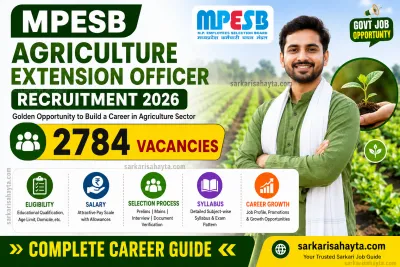
This detailed article has been prepared after carefully studying the official rulebook of the Madhya Pradesh Employees Selection Board (MPESB), Bhopal for the Group-2 Sub Group-1 Agriculture Extension Officer Recruitment Examination 2026. The official rulebook contains examination rules, vacancy distribution, reservation details, educational qualification, age conditions, examination pattern, and the agriculture syllabus. The official vacancy table shows 2,784 Agriculture Extension Officer posts, while the syllabus section provides a single 200-mark paper divided between general subjects and agriculture-related subjects.
Important Note: Sarkari Sahayta manually researches and simplifies recruitment information for educational and informational purposes. Candidates should always read the complete official rulebook and verify their personal eligibility before paying the application fee or submitting the final application form.
🛠️ Essential Tools
🤖 AI Summary
The MPESB Agriculture Extension Officer Recruitment 2026 is a major government employment opportunity for agriculture and horticulture graduates. Madhya Pradesh Employees Selection Board is conducting the Group-2 Sub Group-1 Agriculture Extension Officer Recruitment Examination 2026 for direct recruitment to Agriculture Extension Officer posts under the Directorate of Farmer Welfare and Agriculture Development, Madhya Pradesh, Bhopal.
A total of 2,784 vacancies have been listed for Agriculture Extension Officer. According to the department-wise vacancy table, the category distribution is 1,126 UR posts, 444 EWS posts, 316 SC posts, 122 ST posts, and 776 OBC posts. The post is classified as an executive post. The prescribed pay scale mentioned in the rulebook is ₹25,300 to ₹80,500.
🛠️ Essential Tools
The online application process begins on 03 July 2026 and closes on 17 July 2026. Candidates can make permitted corrections in the application from 03 July 2026 to 22 July 2026. The examination is scheduled to begin from 02 August 2026, Sunday.
The examination will contain one question paper carrying 200 marks. The first 100 marks cover General Knowledge, General Hindi, General English, General Mathematics, General Logical Ability, General Science, and General Computer Knowledge. The remaining 100 marks are based on the relevant agriculture subject. The official agriculture syllabus includes General Agriculture, Agronomy, Soil Science, Soil and Water Conservation, Plant Physiology, Crop Improvement, Horticulture, Plant Protection, Agricultural Economics, and Agricultural Extension Education.
🛠️ Essential Tools
For the Agriculture Extension Officer post, the specific educational qualification mentioned in the vacancy section is a Bachelor's Degree in Agriculture or Horticulture. The general age framework is 18 to 40 years for open competitive direct recruitment, while eligible Madhya Pradesh reserved categories, specified government or institutional employees, Home Guards, persons with disabilities, and women may receive the applicable upper-age benefit up to 45 years under the prescribed rules. Age is calculated with reference to 01 January 2026.
AI Career View: Candidates with a genuine interest in agriculture, farmer advisory services, crop production, rural development, agricultural extension, and field-level government work should seriously consider this recruitment. With 2,784 notified posts and a clearly agriculture-oriented syllabus, this examination offers a strong opportunity to eligible graduates who begin focused preparation immediately.
📌 General Information
| Recruitment Authority | Madhya Pradesh Employees Selection Board, Bhopal |
|---|---|
| Exam Name | Group-2 Sub Group-1 Agriculture Extension Officer Recruitment Examination 2026 |
| Post Name | Agriculture Extension Officer |
| Department | Directorate of Farmer Welfare and Agriculture Development, Madhya Pradesh |
| Post Code | 01 |
| Recruitment Type | Direct Recruitment |
| Total Vacancies | 2,784 Posts |
| Post Nature | Executive |
| Pay Scale | ₹25,300 – ₹80,500 |
| Application Start Date | 03 July 2026 |
| Last Date to Apply | 17 July 2026 |
| Correction Last Date | 22 July 2026 |
| Exam Start Date | 02 August 2026 |
| Exam Mode | Online / Computer-Based Examination |
| Total Marks | 200 Marks |
| Educational Qualification | Bachelor's Degree in Agriculture or Horticulture |
The recruitment is especially significant because it is connected with the agriculture development administration of Madhya Pradesh. Agriculture Extension Officers can play an important field-level role in the communication of agricultural knowledge, farmer awareness, extension programmes, and implementation support for agricultural development activities.
📖 Recruitment Overview
The Agriculture Extension Officer Recruitment Examination 2026 is being conducted under Group-2 Sub Group-1. The recruitment is intended to fill vacancies in the Directorate of Farmer Welfare and Agriculture Development, Madhya Pradesh. The official department-wise vacancy statement lists all 2,784 vacancies against post code 01 for Agriculture Extension Officer.
An Agriculture Extension Officer generally works as an important communication link between agricultural administration and the farming community. Agricultural science is constantly changing. New crop varieties, nutrient-management practices, pest-control strategies, farm technologies, market initiatives, and government programmes must reach farmers in a practical form. Extension services are designed to reduce the gap between scientific agricultural knowledge and field-level adoption.
This is why the official syllabus does not focus only on theoretical agriculture. It covers agronomy, soil science, crop improvement, horticulture, plant protection, agricultural economics, and extension education. A successful candidate is expected to understand both crop science and the practical communication of agricultural knowledge.
The examination is competitive. Merely submitting the application does not guarantee selection or appointment. Eligibility during the computer-based examination process is provisional. Certificates and eligibility conditions may be examined by the concerned department during the appointment process. Candidates must therefore enter correct information and possess the required qualification and valid supporting documents.
The official rules also require candidates for the advertised posts to have a valid registration with an employment office in Madhya Pradesh, subject to the provisions stated in the rulebook. Candidates claiming reservation or age relaxation should possess valid certificates issued by the competent authority and acceptable under Madhya Pradesh Government rules.
📅 Important Dates
| Event | Official Date |
|---|---|
| Online Application Start Date | 03 July 2026 |
| Last Date for Online Application | 17 July 2026 |
| Application Correction Start Date | 03 July 2026 |
| Last Date for Application Correction | 22 July 2026 |
| Examination Start Date | 02 August 2026, Sunday |
Candidates should not wait until 17 July 2026 to complete the application. Government recruitment portals may experience increased traffic near the deadline. Aadhaar-related verification, payment issues, photograph problems, qualification details, or category-certificate confusion can also delay submission.
A practical approach is to complete the application during the first week of the application period. After submission, download or save the application form and carefully compare the entered name, date of birth, category, qualification, contact information, and other important fields with the original documents.
The correction facility should be treated as a safety mechanism rather than an excuse for careless form filling. Some information may be controlled by portal rules or official conditions. Candidates should therefore enter all details accurately during the initial application itself.
⏰ Examination Shift Timings
The official rulebook states that the examination will begin from 02 August 2026 and provides two examination shifts.
| Shift | Reporting Time | Instruction Reading Time | Answering Time |
|---|---|---|---|
| First Shift | 07:00 AM to 08:00 AM | 08:50 AM to 09:00 AM | 09:00 AM to 12:00 Noon |
| Second Shift | 12:30 PM to 01:30 PM | 02:20 PM to 02:30 PM | 02:30 PM to 05:30 PM |
Candidates should follow the reporting time printed on their admit card. The rulebook clearly warns that candidates arriving after the permitted reporting time may not be allowed to enter the examination centre.
💰 Application Fee
| Candidate Category | Examination Fee |
|---|---|
| Unreserved Candidates | ₹500 |
| SC / ST / OBC / EWS / Divyang Candidates who are Madhya Pradesh Domiciles | ₹250 |
| Direct Recruitment Backlog Posts | No Examination Fee |
In addition to the examination fee, portal charges may apply. The rulebook states that candidates applying through an MP Online kiosk are required to pay a portal fee of ₹60. Candidates filling the form by logging in through a registered citizen user are required to pay a portal fee of ₹20.
Applicants should confirm the payable amount displayed by the application portal before completing payment. After successful payment, keep the payment receipt, transaction details, and submitted application copy safely. Do not assume that money deducted from a bank account automatically means the application has been successfully submitted. Check the final application status.
🎓 Eligibility
The specific educational qualification stated for Post Code 01 – Agriculture Extension Officer is:
Bachelor's Degree in Agriculture or Horticulture.
This is an important eligibility condition. Candidates should not interpret the general graduation wording of the examination rules as automatic eligibility for the Agriculture Extension Officer vacancy. The post-specific vacancy section clearly prescribes graduation in Agriculture or Horticulture.
Candidates should possess the required qualification in accordance with the recruitment conditions applicable on the relevant application date. The qualification should be supported by valid degree, marksheets, or other acceptable educational records issued by the concerned university or institution.
🌱 Who Should Apply?
The recruitment is particularly suitable for candidates who have completed programmes such as a recognized Bachelor's Degree in Agriculture or a Bachelor's Degree in Horticulture and satisfy all other official eligibility conditions.
Candidates should verify the exact title and recognition status of their degree if there is any difference in nomenclature. If a candidate possesses a related but differently titled qualification, the safest approach is to verify its acceptability under the departmental recruitment rules instead of assuming equivalence.
Eligibility is not limited to educational qualification. Candidates must also satisfy age requirements, applicable employment registration rules, category conditions, certificate requirements, and other appointment-related provisions.
The rulebook also contains important appointment eligibility conditions. For example, it states conditions concerning the number of children where one child was born on or after the prescribed date of 26 January 2001, marriage below the government-prescribed age, and conviction for offences against women. Candidates affected by any such condition should read the original rules carefully before applying.
🎂 Age Limit
Age is calculated as on 01 January 2026. The general age framework provided in the rulebook for direct recruitment through open competition is as follows:
| Category / Recruitment Condition | Age Limit |
|---|---|
| Open Competitive Direct Recruitment | 18 to 40 Years |
| Eligible MP Domicile SC / ST / OBC Candidates | 18 to 45 Years, subject to rules |
| Eligible Government / Corporation / Board / Autonomous Institution Employees | 18 to 45 Years, subject to rules |
| Home Guard / Nagar Sainik and Eligible Divyang Candidates | 18 to 45 Years, subject to rules |
| Women Candidates under Applicable Rules | 18 to 45 Years, subject to rules |
The rulebook specifically states that EWS candidates do not receive age relaxation merely on the basis of EWS status. Candidates should distinguish between fee concession, qualifying-mark provisions, reservation, and age relaxation because these are separate recruitment benefits governed by different rules.
Additional age-related provisions exist for certain eligible categories, including ex-servicemen and other specified candidates. The rules also refer to benefits for certain award-winning sportspersons and participants covered under specified government incentive provisions. However, the overall maximum age generally cannot exceed 45 years after including relaxations, except for categories specifically excluded from this general ceiling under the rules.
Age relaxation should never be claimed without valid documentary evidence. The candidate must be able to produce the prescribed certificate or proof issued by the competent authority whenever required during verification or appointment.
🏦 Vacancy Details
The official recruitment rulebook lists a total of 2,784 Agriculture Extension Officer vacancies under the Directorate of Farmer Welfare and Agriculture Development, Madhya Pradesh.
| Category | Total Vacancies |
|---|---|
| Unreserved – UR | 1,126 |
| Economically Weaker Section – EWS | 444 |
| Scheduled Caste – SC | 316 |
| Scheduled Tribe – ST | 122 |
| Other Backward Class – OBC | 776 |
| Total | 2,784 |
The detailed reservation table further distributes vacancies among open, women, ex-servicemen, and contractual employee components. The rulebook also mentions 168 vacancies for persons with disabilities, distributed as 42 VH, 42 EH, 42 LD, and 42 MD positions within the prescribed reservation structure.
The official rulebook additionally presents the OBC reservation position through an 87 percent main reservation table and a separate provisional or hypothetical table for the remaining 13 percent posts. Candidates should rely on the final official and legally applicable reservation position used by MPESB and the department during the recruitment process.
Vacancy numbers are important for competition analysis, but candidates should not select a category simply by looking at the number of posts. Category claims must be legally correct and supported by valid certificates.
📝 Selection Process
The recruitment process is primarily based on the computer-based recruitment examination and subsequent departmental eligibility verification and appointment procedures.
- Online Application: Eligible candidates submit the MPESB application form with correct personal, category, and educational information.
- Computer-Based Examination: Candidates appear in the Group-2 Sub Group-1 Agriculture Extension Officer examination.
- Qualification and Merit Processing: Examination performance is considered according to MPESB rules, qualifying standards, reservation provisions, and merit requirements.
- Recommendation / Candidate List: Eligible candidates may be included in the appropriate selection or recommendation process.
- Document and Eligibility Verification: The concerned department examines qualification, age, category, and other eligibility records.
- Appointment Process: Appointment is subject to fulfilment of all prescribed conditions and issuance of an appointment order by the competent department.
The official rules prescribe minimum qualifying marks of 50 percent for unreserved candidates. SC, ST, OBC, and Divyang candidates receive relaxation of up to 10 percent, resulting in a minimum qualifying benchmark of 40 percent under the stated provision. The rulebook also refers to a 10 percent relaxation in minimum qualifying marks for EWS candidates under the cited Madhya Pradesh Government provision.
Minimum qualifying marks are not the same as the final selection cutoff. In a recruitment with thousands of serious candidates, actual competitive merit can be substantially higher. Candidates should therefore prepare for the highest possible score rather than targeting only the qualifying percentage.
Passing the examination also does not create an automatic legal right to appointment. The candidate must satisfy all recruitment and departmental eligibility conditions, and an appointment order must be issued by the competent authority.
💼 Salary & Benefits
The official vacancy section specifies the Agriculture Extension Officer pay scale as:
₹25,300 – ₹80,500
This pay scale makes the Agriculture Extension Officer post an attractive state government career opportunity for eligible agriculture and horticulture graduates. Actual monthly salary and take-home amount can depend on government pay rules, admissible allowances, deductions, posting conditions, and service-related provisions applicable at the time of appointment.
💵 Possible Salary Components
Depending on applicable Madhya Pradesh Government service rules, an employee's salary structure may include basic pay and admissible allowances. Government employees may also be covered by leave, retirement contribution, and other service benefits according to the rules applicable to their appointment.
Candidates should avoid relying on unofficial claims that promise a fixed “in-hand salary” without considering deductions and applicable government orders. The reliable official figure in the recruitment rulebook is the ₹25,300–₹80,500 pay scale.
🌾 Nature of the Career
An Agriculture Extension Officer career may involve a combination of field responsibilities, farmer communication, agricultural programme support, reporting, and coordination. Candidates who prefer a purely desk-based career should understand the practical nature of agricultural extension before choosing this path.
📈 Career Growth
Agriculture Extension Officer is not merely an examination title. It represents a professional career in the public agricultural development system. Experience in agricultural extension can develop strong knowledge of crop production, farmer behaviour, rural communication, local agricultural problems, and implementation of development programmes.
During service, officers can improve their professional capability by studying crop production trends, soil and nutrient management, integrated pest management, horticulture, agricultural economics, digital agriculture, and rural extension methods. Practical field exposure can be particularly valuable because agricultural conditions differ by region, climate, soil, irrigation availability, and cropping system.
Career progression depends on the departmental service rules, seniority, available promotional channels, qualifications, performance, and government policies. Candidates should treat the first appointment as the beginning of a long-term professional journey rather than only a salary opportunity.
A strong Agriculture Extension Officer develops three types of expertise: technical agriculture knowledge, field problem-solving ability, and communication skills. Technical knowledge helps identify agricultural issues. Field understanding helps recommend practical approaches. Communication skills help explain scientific recommendations in a form that farmers can understand and adopt.
📝 How to Apply
Candidates should complete the application process carefully through the official MPESB online application system. The following step-by-step approach can reduce application errors:
- Read the Rulebook: Study the Agriculture Extension Officer Recruitment Examination 2026 rules before registration.
- Check Educational Eligibility: Confirm that you possess the required Bachelor's Degree in Agriculture or Horticulture.
- Check Age: Calculate your age as on 01 January 2026 and verify applicable relaxation provisions.
- Prepare Aadhaar Details: Aadhaar registration is mandatory under the examination instructions.
- Prepare Personal Details: Keep your correct name, date of birth, parents' details, address, mobile number, and email information ready.
- Prepare Category Documents: Candidates claiming reservation or relaxation should keep valid certificates ready.
- Complete Registration: Open the official application facility and complete the required registration process.
- Fill the Application Form: Enter personal, educational, category, and other required information exactly as supported by documents.
- Upload Required Files: Upload the prescribed photograph, signature, and other documents in the required format and size.
- Review Every Field: Check spelling, qualification, category, date of birth, and contact information.
- Pay the Fee: Complete the applicable examination fee and portal fee payment.
- Submit the Form: Complete final submission only after checking all information.
- Save Application Number: The application form number is essential for downloading the examination admit card.
- Download the Submitted Form: Keep a digital and printed copy of the application.
- Use Correction Facility if Required: Correct permitted mistakes before 22 July 2026.
The application number should be preserved carefully. The rulebook states that candidates can obtain their online examination admit card through the application form number. Losing important application records can create unnecessary difficulty before the examination.
📂 Documents Required
Candidates should prepare an organized document folder before applying. The exact documents required at different recruitment stages may depend on the candidate's category and eligibility claim.
- Recent passport-size photograph in the prescribed format.
- Scanned signature in the required format.
- Aadhaar Card or Aadhaar-related information required by the application and examination rules.
- Class 10 marksheet or certificate for date-of-birth verification, where applicable.
- Class 12 marksheet and certificate.
- Bachelor's Degree in Agriculture or Horticulture.
- Graduation semester or year-wise marksheets.
- Valid caste certificate for SC, ST, or OBC candidates, where applicable.
- Valid EWS certificate for candidates claiming EWS benefits.
- Madhya Pradesh domicile or residence-related proof where required for a specific benefit.
- Disability certificate for eligible Divyang candidates.
- Ex-serviceman certificate or service documents for candidates claiming applicable benefits.
- Government or departmental service certificate, where applicable.
- Employment office registration details as required under the recruitment rules.
- Valid photo identity document.
- Submitted online application form.
- Application fee payment receipt or transaction record.
- Admit card for the examination stage.
On the examination day, an original photo identity document is mandatory. The rulebook lists Voter ID, PAN Card, Aadhaar Card, Driving Licence, and Passport among acceptable original photo identity options. E-Aadhaar is accepted only when verified through UIDAI as prescribed.
Candidates must also carry Aadhaar-related information in accordance with the rulebook. Multi-level biometric verification is mandatory at examination entry and during the examination process. Aadhaar should be unlocked at the time of biometric verification.
📌 Important Instructions
The examination instructions are strict. Candidates should read them before travelling to the examination centre.
- Aadhaar registration is mandatory.
- Carry an original valid photo identity document to the examination centre.
- Carry Aadhaar Card, E-Aadhaar, Aadhaar copy, Aadhaar number, or Aadhaar VID information as prescribed.
- Aadhaar should be unlocked during biometric verification.
- Multi-level biometric verification is mandatory.
- Reach the examination centre within the official reporting time.
- Late candidates may not be permitted to enter.
- Carry the admit card downloaded from the MPESB system.
- Carry a black ballpoint pen.
- Mobile phones are prohibited in the examination room.
- Calculators and log tables are prohibited.
- Digital watches and unauthorized electronic devices are prohibited.
- Cheating material or unauthorized notes are strictly prohibited.
- Candidates may not be permitted to leave the examination room after the examination begins and before completion of the examination period.
- Keep the application form number safe for admit card access.
- Eligibility at the online examination stage is provisional.
- Certificates may be verified by the concerned department during the appointment process.
- Valid Madhya Pradesh employment office registration is required according to the stated recruitment provision.
The advertised post is executive in nature. The rulebook specifically states that candidates belonging to the specified primitive tribal communities such as Baiga, Sahariya/Saharia, and Bharia do not receive direct appointment exemption for these executive posts. Such candidates must submit the online application and appear in the examination as Scheduled Tribe candidates under the prescribed procedure.
❌ Common Mistakes
1. Assuming Any Graduation is Eligible: The post-specific qualification is a Bachelor's Degree in Agriculture or Horticulture. Candidates from unrelated graduation streams should not assume eligibility.
2. Waiting for the Last Date: Applying on 17 July 2026 can be risky because technical, payment, or document-upload problems may occur.
3. Selecting the Wrong Category: A category claim should match valid documentary evidence. Incorrect reservation claims can create serious problems during verification.
4. Ignoring the Age Calculation Date: Age should be checked with reference to 01 January 2026 under the official rules.
5. Assuming EWS Gives Age Relaxation: The rulebook specifically states that EWS candidates do not receive age relaxation solely on the basis of EWS status.
6. Preparing Only Agriculture: Agriculture carries 100 marks, but general subjects also carry 100 marks. Ignoring General Knowledge, Hindi, English, Mathematics, Reasoning, Science, or Computer Knowledge can damage the final score.
7. Studying Agriculture Without the Official Syllabus: Random preparation wastes time. The official syllabus clearly identifies ten agriculture areas.
8. Targeting Only Minimum Qualifying Marks: Qualification and final competitive selection are different. A higher score improves merit competitiveness.
9. Losing the Application Number: The application number is important for downloading the admit card.
10. Carrying Electronic Devices: Mobile phones, calculators, digital watches, and other prohibited devices should not be taken into the examination room.
11. Arriving Late: Reporting time is not a suggestion. Candidates arriving after the permitted time may be denied entry.
12. Ignoring Biometric Requirements: Aadhaar and biometric verification instructions should be followed carefully, including the Aadhaar unlock requirement.
📊 Competition Level Analysis
The recruitment has 2,784 vacancies, which is a substantial vacancy count. However, agriculture-related government recruitment usually attracts a focused pool of graduates who have studied many of the official syllabus topics during their degree programmes.
The competition can be described as moderate to high. The vacancy count is positive, but candidates should expect serious competition from B.Sc. Agriculture and horticulture graduates with strong academic foundations.
The examination structure creates an interesting competitive balance. Half of the marks come from general subjects and half from agriculture. A technically strong agriculture graduate may lose rank because of weak mathematics, reasoning, computer knowledge, or language performance. Similarly, a candidate strong in general aptitude cannot compensate completely for poor agriculture knowledge.
The most competitive candidates will be those who maintain balance. A candidate who scores consistently across both 100-mark components has a stronger merit position than a candidate who depends entirely on one section.
Competition Rating: 8/10. The large vacancy count provides opportunity, but the short application-to-examination timeline and agriculture-specific candidate pool make disciplined preparation essential.
📚 Preparation Strategy
The official paper carries 200 marks. Candidates should divide preparation into two major tracks: General Section Preparation and Agriculture Subject Preparation.
📘 Strategy for General Subjects
General Knowledge: Build knowledge of Madhya Pradesh, Indian polity, geography, history, economy, current developments, and important government programmes. Give special attention to agriculture-related developments and Madhya Pradesh-specific facts.
General Hindi: Revise grammar, vocabulary, sentence correction, synonyms, antonyms, idioms, and comprehension-based questions.
General English: Focus on basic grammar, vocabulary, articles, prepositions, tenses, voice, narration, error detection, and reading comprehension.
General Mathematics: Practice percentages, ratio and proportion, averages, profit and loss, simple and compound interest, time and work, time and distance, and basic numerical problems.
Logical Ability: Solve analogy, series, coding-decoding, classification, direction, blood relation, ranking, statement-based reasoning, and basic analytical questions.
General Science: Revise school-level physics, chemistry, biology, environment, and science in daily life.
Computer Knowledge: Prepare computer fundamentals, hardware and software, operating systems, MS Office concepts, internet, networking basics, cyber awareness, and common computer terminology.
🌾 Strategy for Agriculture Subjects
General Agriculture: Understand the importance of agriculture in the national economy. Connect agriculture with employment, rural development, food security, and economic growth.
Agronomy: This should be a major preparation area. Study major crops of Madhya Pradesh and their production techniques. Revise farming systems, sustainable agriculture, introductory agrometeorology, agro-climatic zones, and agro-ecological zones.
Soil Science: Prepare soil composition, physical properties, chemical properties, biological properties, essential plant nutrients, nutrient functions, nutrient dynamics, integrated nutrient management, and problem-soil management.
Soil and Water Conservation: Study soil erosion, conservation approaches, water conservation, and watershed management.
Plant Physiology: Focus on nutrient absorption, translocation, metabolism, photosynthesis, respiration, plant growth, development, and growth regulators.
Crop Improvement: Revise genetics and plant breeding principles used in crop improvement. Understand basic inheritance and breeding concepts.
Horticulture: Study production practices of important fruits, vegetables, spices, and economically important flowering plants. Prepare nursery management, propagation methods, unfruitfulness, alternate bearing, fruit drop, physiological disorders, post-harvest management, and value addition.
Plant Protection: Prepare important crop pests and diseases, management methods, integrated pest and disease management, spray equipment, rodent management, and pesticide safety precautions.
Agricultural Economics: Study basic economic principles in agriculture, farm planning, resource management, farming systems, agricultural marketing, regulated markets in Madhya Pradesh, initiatives such as e-Choupal, and the role of agricultural prices.
Agricultural Extension Education: Focus on extension philosophy, objectives, principles, extension organizations at state, district, and block levels, communication methods, farmer organizations, training, and important rural development programmes.
📖 Best Books
Candidates do not need dozens of books. The objective should be to select a limited set of reliable resources and revise them repeatedly.
- Agriculture at a Glance by R.K. Sharma: Useful for broad agriculture revision and objective preparation.
- Objective Agriculture by S.R. Kantwa: Helpful for practising agriculture-based multiple-choice questions.
- Principles of Agronomy by T.Y. Reddy and G.H.S. Reddi: Useful for strengthening agronomy concepts.
- Introductory Soil Science Textbooks: Use a standard agricultural university-level resource covering soil properties, nutrients, and soil management.
- Fundamentals of Plant Physiology: Select a graduation-level book covering photosynthesis, respiration, growth, and plant hormones.
- Plant Breeding and Genetics Notes: Graduation notes can be highly effective for basic genetics and crop improvement revision.
- Horticulture Objective Notes: Prepare fruit, vegetable, spice, nursery, propagation, disorders, and post-harvest topics.
- Agricultural Extension Education Textbook: Choose a standard ICAR or agricultural university-oriented book.
- Lucent's General Knowledge: Useful for basic general awareness revision.
- Quantitative Aptitude by R.S. Aggarwal: Useful for mathematics practice.
- Verbal and Non-Verbal Reasoning by R.S. Aggarwal: Useful for logical ability practice.
- Objective General English by S.P. Bakshi: Helpful for grammar and objective English.
- General Hindi Objective Book: Select a competitive examination-oriented Hindi grammar resource.
- Computer Awareness Objective Book: Use a basic competitive examination computer awareness guide.
Book Selection Rule: Use one main book, your graduation notes, an objective question source, and mock tests for each major agriculture area. Do not keep changing resources every week.
🗓️ 90-Day Study Plan
The following 90-day plan is a model preparation framework. Candidates should compress or modify it according to the actual time available before their examination shift.
📅 Days 1–15: Build the Foundation
Study General Agriculture, major crops of Madhya Pradesh, and basic agronomy. Begin mathematics and reasoning practice for at least one hour daily. Revise General Hindi and General English grammar on alternate days. Create a syllabus tracker and mark every official topic.
📅 Days 16–30: Soil and Crop Science
Complete Soil Science, essential nutrients, integrated nutrient management, problem soils, soil conservation, water conservation, and watershed management. Start General Science and Computer Knowledge. Solve at least 50 agriculture MCQs every day.
📅 Days 31–45: Physiology and Crop Improvement
Study plant absorption, nutrient movement, metabolism, photosynthesis, respiration, growth, development, and plant growth regulators. Complete basic genetics and plant breeding. Revise the first 30 days of agriculture topics every Sunday.
📅 Days 46–60: Horticulture and Plant Protection
Prepare fruits, vegetables, spices, flowering plants, nursery management, propagation, horticultural disorders, and post-harvest management. Study important crop insects, diseases, integrated management, spray equipment, rodent management, and pesticide safety.
📅 Days 61–70: Economics and Extension
Complete agricultural economics, farm planning, resource management, marketing, regulated markets, e-Choupal, and agricultural prices. Study agricultural extension philosophy, objectives, organization structure, communication, farmer organizations, training, and rural development programmes.
📅 Days 71–80: Full Syllabus Revision
Revise all ten agriculture units. Prepare short notes for crops, nutrients, pests, diseases, plant hormones, horticultural disorders, extension principles, and agricultural economics. Solve mixed general section tests daily.
📅 Days 81–85: Mock Test Phase
Attempt full-length mock examinations in a three-hour environment. Analyse every wrong answer. Divide mistakes into knowledge errors, calculation errors, confusion errors, and time-management errors.
📅 Days 86–90: Final Revision
Do not start large new books. Revise short notes, factual tables, crop practices, nutrients, diseases, pests, extension structures, mathematics formulas, computer terminology, and language rules. Maintain a stable sleep schedule according to your likely examination shift.
⏱️ Recommended Daily Schedule
| Study Area | Suggested Daily Time |
|---|---|
| Agriculture Core Subject | 3 Hours |
| General Subjects | 2 Hours |
| MCQ Practice | 1.5 Hours |
| Revision | 1 Hour |
| Error Notebook | 30 Minutes |
🤖 AI Career Advice
If you are a B.Sc. Agriculture or eligible horticulture graduate, do not treat this examination as another random government form. The recruitment directly matches your academic background. Your degree subjects already provide a foundation for a large part of the 100-mark agriculture section.
Your biggest strategic question should be: Where can I gain marks faster? If agriculture is already strong, improving general mathematics, reasoning, computer knowledge, and language accuracy may rapidly increase your total score. If the general section is strong but graduation concepts are weak, your priority should be the ten official agriculture syllabus units.
AI-based study tools can be useful for generating practice questions, simplifying difficult agricultural concepts, comparing nutrient deficiencies, creating crop revision tables, and testing recall. However, AI should be used as a study assistant, not as a replacement for the official syllabus and reliable agriculture textbooks.
Create a digital error log. Every time you answer a question incorrectly, record the topic and reason. After 500 to 1,000 practice questions, this error log becomes more valuable than random new study material because it reveals your personal weakness pattern.
From a career perspective, choose Agriculture Extension Officer if you are comfortable with public interaction, agricultural field realities, farmer communication, and government service responsibilities. Candidates interested in rural development and practical agriculture may find this career professionally meaningful.
🧠 Expert Tips
Tip 1 – Follow the 100+100 Rule: Every week, evaluate your performance separately in the general 100-mark portion and agriculture 100-mark portion.
Tip 2 – Prioritize Madhya Pradesh Agriculture: The agronomy syllabus specifically mentions major crops of Madhya Pradesh. Prepare state cropping patterns and important field crops carefully.
Tip 3 – Create Nutrient Flashcards: Write each essential nutrient, major function, and common deficiency concept on compact revision cards.
Tip 4 – Link Pests with Crops: Do not study insect names randomly. Create crop-wise pest and disease tables with management concepts.
Tip 5 – Master Extension Terminology: Agricultural extension questions can be scoring when definitions, objectives, principles, communication methods, and organizational structures are revised repeatedly.
Tip 6 – Practice Timed Tests: The answering period is three hours. Train yourself under examination-like conditions.
Tip 7 – Maintain an Agriculture Fact Notebook: Record difficult facts, confusing terms, and frequently forgotten concepts in one notebook.
Tip 8 – Revise More Than You Read: Three revisions of one reliable source are usually more useful than reading three books once.
Tip 9 – Protect the Final Week: Avoid social media debates about expected cutoffs and paper difficulty. Focus on your revision plan.
Tip 10 – Prepare Examination Documents Early: Keep the admit card, original photo ID, Aadhaar information, and black ballpoint pen ready before examination day.
❓ FAQs
- ❓ Q1. What is MPESB Agriculture Extension Officer Recruitment 2026?
- It is the Group-2 Sub Group-1 Agriculture Extension Officer Recruitment Examination 2026 conducted by the Madhya Pradesh Employees Selection Board for Agriculture Extension Officer vacancies under the Directorate of Farmer Welfare and Agriculture Development, Madhya Pradesh.
- ❓ Q2. How many vacancies are available?
- The official rulebook lists a total of 2,784 Agriculture Extension Officer vacancies.
- ❓ Q3. What is the last date to apply?
- The last date for submitting the online application is 17 July 2026.
- ❓ Q4. When does the application process begin?
- The online application process begins on 03 July 2026.
- ❓ Q5. What is the correction last date?
- The last date for permitted application corrections is 22 July 2026.
- ❓ Q6. When will the examination begin?
- The examination is scheduled to begin from 02 August 2026, Sunday.
- ❓ Q7. What is the educational qualification?
- The post-specific qualification is a Bachelor's Degree in Agriculture or Horticulture.
- ❓ Q8. Can a general graduate apply?
- Candidates should follow the post-specific qualification. The Agriculture Extension Officer vacancy section prescribes a Bachelor's Degree in Agriculture or Horticulture.
- ❓ Q9. What is the age limit?
- The general direct recruitment age framework is 18 to 40 years. Eligible specified categories may receive relaxation up to 45 years according to the official rules.
- ❓ Q10. What is the age calculation date?
- Age is calculated with reference to 01 January 2026.
- ❓ Q11. Does EWS status provide age relaxation?
- The rulebook states that EWS candidates do not receive age relaxation merely on the basis of EWS status.
- ❓ Q12. What is the application fee for unreserved candidates?
- The examination fee for unreserved candidates is ₹500, excluding applicable portal charges.
- ❓ Q13. What is the fee for eligible MP reserved-category candidates?
- The examination fee is ₹250 for eligible Madhya Pradesh domicile SC, ST, OBC, EWS, and Divyang candidates, subject to the official conditions.
- ❓ Q14. What is the salary of an Agriculture Extension Officer?
- The official rulebook mentions a pay scale of ₹25,300 to ₹80,500.
- ❓ Q15. How many marks are in the examination?
- The examination carries a total of 200 marks.
- ❓ Q16. How many question papers are there?
- The official syllabus states that there will be only one question paper.
- ❓ Q17. What subjects are included in the general section?
- The general section includes General Knowledge, General Hindi, General English, General Mathematics, General Logical Ability, General Science, and General Computer Knowledge.
- ❓ Q18. How many marks are allocated to agriculture subjects?
- The relevant subject-based agriculture portion carries 100 marks.
- ❓ Q19. What is the agriculture syllabus?
- The syllabus includes General Agriculture, Agronomy, Soil Science, Soil and Water Conservation, Plant Physiology, Crop Improvement, Horticulture, Plant Protection, Agricultural Economics, and Agricultural Extension Education.
- ❓ Q20. Is Aadhaar required?
- Yes. The official examination instructions state that Aadhaar registration is mandatory and contain specific Aadhaar and biometric verification requirements.
- ❓ Q21. Is biometric verification compulsory?
- Yes. Multi-level biometric verification is mandatory at examination entry and during the examination process.
- ❓ Q22. Should Aadhaar be unlocked?
- Yes. The rulebook states that Aadhaar should be unlocked at the time of biometric verification.
- ❓ Q23. What photo ID can be carried to the examination centre?
- Candidates may carry an acceptable original photo identity document such as Voter ID, PAN Card, Aadhaar Card, Driving Licence, or Passport as specified in the rulebook.
- ❓ Q24. Can I carry a mobile phone to the examination room?
- No. Mobile phones and other prohibited electronic devices are not permitted in the examination room.
- ❓ Q25. What should I carry to the examination centre?
- Candidates should carry the downloaded admit card, prescribed original photo identity document, required Aadhaar information, and a black ballpoint pen, along with any other item specifically required in the admit card instructions.
- ❓ Q26. What are the minimum qualifying marks?
- The rulebook prescribes 50 percent minimum qualifying marks for unreserved candidates and provides the stated relaxation in minimum qualifying marks for eligible categories according to the recruitment rules.
- ❓ Q27. Does obtaining minimum qualifying marks guarantee selection?
- No. Minimum qualification does not guarantee final selection or appointment. Merit, vacancies, reservation, eligibility verification, and departmental appointment conditions apply.
- ❓ Q28. Is Madhya Pradesh employment registration required?
- The rulebook states that candidates for the advertised posts must have valid registration with an employment office in Madhya Pradesh according to the prescribed provision.
- ❓ Q29. Is Agriculture Extension Officer an executive post?
- Yes. The official vacancy table classifies the Agriculture Extension Officer post as executive.
- ❓ Q30. What is the best preparation strategy?
- Prepare the general and agriculture portions equally, follow the official syllabus, practise objective questions, attempt timed mock tests, and repeatedly revise weak topics identified through an error notebook.
🏁 Final Verdict
The MPESB Agriculture Extension Officer Recruitment 2026 is one of the most important opportunities for eligible Agriculture and Horticulture graduates seeking a government career in Madhya Pradesh. The recruitment offers 2,784 Agriculture Extension Officer vacancies and a pay scale of ₹25,300 to ₹80,500.
The online application window is short, from 03 July 2026 to 17 July 2026, while the examination is scheduled to begin from 02 August 2026. Candidates should therefore combine application accuracy with immediate examination preparation.
The 200-mark examination rewards balanced candidates. General Knowledge, Hindi, English, Mathematics, Logical Ability, Science, and Computer Knowledge together carry 100 marks. Agriculture-related subjects carry another 100 marks. Ignoring either half of the paper can significantly reduce merit performance.
For agriculture preparation, candidates should strictly follow the official ten-area syllabus: General Agriculture, Agronomy, Soil Science, Soil and Water Conservation, Plant Physiology, Crop Improvement, Horticulture, Plant Protection, Agricultural Economics, and Agricultural Extension Education. Graduation notes, reliable objective agriculture books, repeated revision, and full-length mock tests should form the core preparation strategy.
Before applying, verify your Bachelor's Degree in Agriculture or Horticulture, age as on 01 January 2026, category documents, employment registration requirement, and all other eligibility conditions. Do not provide incorrect information simply to complete the form because final eligibility is subject to departmental verification.
Final Sarkari Sahayta Advice: If you are eligible, complete your application early, preserve your application number, prepare all documents, and begin a syllabus-based study schedule immediately. With 2,784 vacancies, this recruitment provides a strong opportunity, but success will depend on balanced preparation, revision discipline, question practice, and examination-day accuracy.
🌾 Study agriculture conceptually, practise questions consistently, and prepare to serve the farming community professionally. Best wishes from Sarkari Sahayta for the MPESB Agriculture Extension Officer Recruitment Examination 2026.