
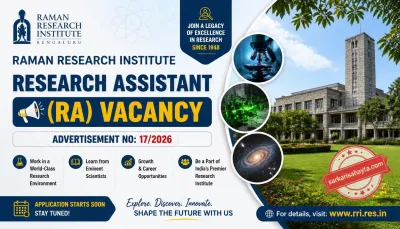
This comprehensive guide explains the Research Assistant (RA) positions advertised by Raman Research Institute (RRI) on 15 June 2026. It covers eligibility, role details, step-by-step application guidance, document checklists, CV and Statement of Purpose (SOP) writing tips, interview preparation, pay and terms, and practical advice for candidates based in or moving to Bengaluru. The article aims to give prospective applicants everything needed to prepare a strong application and perform well in selection.
Vacancy Snapshot — Key Facts
- Position: Research Assistant (RA), Temporary.
- No. of posts: 2 (Two).
- Project group: Quantum Network and Sensing, led by Dr Tanmoy Chakraborty (Light and Matter Physics theme).
- Appointment duration: Initially one year; possible extension for another year based on performance.
- Remuneration: Consolidated Rs. 31,000 per month plus HRA as applicable.
- Upper age limit: 26 years as on the closing date (15 July 2026), with age relaxations per Govt. of India rules for reserved categories.
- How to apply: Online via the institute’s application portal.
- Last date: 15 July 2026 (applications received after this date will not be considered).
Full advertisement (condensed)
The Raman Research Institute (RRI), an autonomous institute funded by the Government of India and dedicated to basic-science research, has invited applications for two Research Assistant positions to work on experimental and applied aspects of quantum photonics. Candidates with strong academic backgrounds and aptitude for experimental optics are encouraged to apply. Essential qualification is M.Sc. (Physics / Photonics / Optoelectronics / related fields) or B.E./B.Tech/M.Tech (Engineering Physics / Electronics / related fields) with minimum 60% marks (candidates who have appeared for final examinations may apply but must submit provisional degree certificate at joining). Desirable skills include hands-on experimental optics experience (integrated photonics design/fabrication/characterisation, free-space optical alignment, fibre optics and detectors, instrument interfacing and programming in Python/MATLAB/LabVIEW). Selected candidates will work on generation, manipulation and detection of single photons, and on simulations for photonic platforms, collaborating with scientists and PhD scholars.
Incomplete applications, particularly those without the Statement of Purpose (SOP), will not be considered. For queries contact recruitment@rri.res.in. Apply via the application portal (see links section below for the official site).
Eligibility and Qualifications — What the institute requires
- Essential qualification: M.Sc. (Physics/Photonics/Optoelectronics/related fields) OR B.E./B.Tech/M.Tech (Engineering Physics/Electronics/related fields) with at least 60% marks or equivalent. Final-year students may apply but must submit provisional degree certificate on joining.
- Upper age limit: 26 years as on 15 July 2026. Age relaxation as per Government of India rules for SC/ST/OBC/PwD categories.
- Desirable: Strong experimental optics experience and familiarity with photonics laboratory workflows; experience with fabrication/characterisation of integrated photonic circuits, free-space beam alignment, fibre handling, single-photon detectors, and instrument control using Python/MATLAB/LabVIEW.
- Soft skills: Teamwork, communication, record-keeping, disciplined lab practice, ability to follow and write SOPs for experiments, and scientific curiosity.
Role and Responsibilities — What you will do
The RA will be embedded in the Quantum Network and Sensing group and is expected to carry out practical experimental work and simulations related to quantum photonics. Typical responsibilities include:
- Design, assemble and align optical setups for single-photon generation, manipulation and detection, including both free-space and fibre-based configurations.
- Assist in design, fabrication and characterisation of integrated photonic circuits (on-chip platforms), coordinate with fabrication facilities or vendors when needed.
- Handle sensitive optical components, fibre splicing/termination, detectors (SPADs, SNSPDs if applicable), and precision opto-mechanical equipment.
- Operate and interface lab instruments: lasers, power meters, oscilloscopes, spectrum analysers, photon-counting modules, and use programming tools such as Python, MATLAB or LabVIEW for instrument control, data acquisition and analysis.
- Develop scripts for automation, data analysis pipelines, and simulation models for photonic platforms.
- Maintain laboratory notebooks, prepare progress reports and contribute to group meetings and collaborative tasks with scientists and PhD students.
Why this role is valuable — Career perspective
Working as an RA at RRI in quantum photonics offers:
- Direct experimental experience with quantum optics and photonics hardware — valuable for both academic (PhD) and industry careers (quantum technology startups, photonics companies).
- Opportunity to work with experienced researchers and develop publication-quality work or project reports that strengthen future PhD applications.
- Hands-on exposure to instrument control, data analysis and simulation tools widely used in optics labs across the world.
- Networking with researchers in India’s quantum science community.
Application Requirements — Documents to upload
Prepare scanned, legible copies of the following before starting the online form. Incomplete applications—especially those missing the Statement of Purpose—will not be considered.
- Educational certificates and mark-sheets from Class X onwards (scanned PDFs or high-quality images).
- Proof of date of birth (10th certificate or equivalent).
- Curriculum Vitae (CV) detailing academic background and past experimental projects (PDF).
- Statement of Purpose (1–2 pages) explaining motivation and suitability (PDF).
- Recent passport-sized photograph signed by the applicant (scanned image).
- Contact information for two referees (email and phone). These should be instructors or supervisors familiar with your work and willing to provide references when contacted by RRI.
How to Apply — Step-by-step process
- Gather documents listed above and convert to clear PDFs or PNG/JPEG images (prefer PDFs for certificates and CV; use 300 DPI for photos).
- Write and polish your CV and Statement of Purpose (guidance below). Keep file names simple and descriptive (e.g., Surname_CV.pdf, Surname_SOP.pdf).
- Visit the RRI application portal and create an account or log in. (Refer to the official RRI website for the portal link; external links in this article use target="_blank" rel="noopener".)
- Complete the online form accurately. Provide contact details for two referees and ensure referees are aware they might be contacted.
- Upload scanned documents and the signed photograph. Double-check dates, percentage marks and scanned file clarity.
- Review the form, then submit before the last date: 15 July 2026. Save or print the acknowledgement/receipt if provided.
- Monitor your email (and spam folder) for communications from RRI regarding tests, shortlisting or interviews.
Writing an Effective CV — What to emphasise
Your CV should be concise (2–3 pages), emphasise experimental skills, and make it easy for reviewers to spot relevant experience. Structure and content suggestions:
- Header: Full name, email, phone, location (city, state), and a link to a GitHub or personal webpage if relevant.
- Profile summary: One or two sentences highlighting your academic background and experimental experience in optics/photonic systems.
- Education: Degree titles, institutions, years, and percentage/CGPA. Mention project titles and supervisors for major projects (B.Sc./B.Tech/M.Sc/M.Tech thesis).
- Research & Laboratory Experience: Describe experimental projects with specific contributions (design, alignment, data acquisition, simulation, fabrication coordination). Quantify when possible — e.g., “built and aligned free-space entanglement setup; reduced coupling losses by X%.”
- Technical skills: List optics skills (alignment, fibre handling, detectors), instruments (oscilloscope, source, power meter), programming (Python, MATLAB, LabVIEW), and simulation tools (COMSOL, Lumerical, etc.).
- Publications and presentations: Include preprints, conference posters or talks. If none, list significant project reports or major lab contributions.
- Honours, awards, relevant coursework and workshops (photonics, optics, quantum information, cleanroom training).
- References: Provide two referees with position, institution, email and phone number (only provide referees who have consented).
Statement of Purpose (SOP) — Structure and sample guidance
The SOP is mandatory and often decisive. Keep it 1–2 pages, focused, and specific to the role. Use Indian English. Suggested structure:
- Opening: Brief introduction — your name, highest degree and a one-line summary of your career objective.
- Motivation: Why quantum photonics? Mention specific interests (single-photon experiments, integrated photonics, quantum sensing) and any inspiring experiences.
- Relevant experience: Summarise your most relevant experimental projects, emphasising your role, techniques used, and outcomes (data, reports, improvements). Keep concrete technical details clear but concise.
- Skills and fit: Explain how your technical skills (optical alignment, fibre handling, programming) and soft skills (teamwork, documentation) match the RA responsibilities.
- Career goals: How this RA position fits into your medium-term goals (PhD, R&D in quantum tech) and what you plan to contribute to RRI.
- Closing: A short statement reiterating interest and readiness to join, with contact details.
Sample SOP paragraph (use as inspiration, not verbatim):
During my M.Sc. project on “Integrated waveguide sources for quantum light”, I designed and characterised a silicon-nitride waveguide source and performed coupling experiments that reduced insertion loss by 20%. I developed Python notebooks for automated data capture from an APD-based photon-counting module and analysed coincidence data to estimate source brightness and heralding efficiency. This project gave me hands-on experience in photonic fabrication workflows, free-space alignment and detector interfacing — skills I am eager to apply and expand in the Quantum Network and Sensing group at RRI.
Practical tips for document preparation
- Scan certificates at 300 DPI. Make sure scanned pages are not clipped and text is readable.
- Name files clearly: Surname_Degree_Year.pdf (e.g., Sood_MSc_2024.pdf).
- Compress large PDFs if necessary but avoid degrading legibility of text or images.
- Use a clean, readable CV template; avoid over-design. PDF is preferred for CV and SOP.
- Ensure your signed passport photo is a clear headshot; sign near the bottom edge of the image.
- Keep referee contact details accurate and inform referees about the vacancy so they can respond promptly if contacted.
Sample CV checklist (one-line items)
- Contact details and short profile sentence.
- Education with marks/CGPA and year.
- Project experience with specific tasks and outcomes.
- Technical skills (optics, instruments, programming, simulation tools).
- Publications, presentations, workshops and certifications.
- References with prior consent.
Preparing for Shortlisting and Interview
RRI may short-list candidates based on higher qualifications or experience than the minimum. If short-listed, you may face a written test and/or interview focusing on experimental optics, photonics concepts and hands-on skills.
- Brush up fundamentals: optics (Gaussian beams, lenses, coupling, waveguides), photonics (modes, loss, coupling efficiency), quantum optics basics (single photons, coherence, detectors) and electronics basics relevant to instrumentation.
- Review your projects thoroughly: be ready to explain experimental setups, measurement procedures, error sources and analysis techniques.
- Practice instrument-related questions: How to align a laser into a single-mode fibre, troubleshoot coupling loss, characterise detector dead-time and dark counts, or synchronise detection electronics.
- Be ready to demonstrate coding familiarity: basic Python scripts for data acquisition, plotting and simple analysis (fitting histograms, coincidence counting logic).
- Expect behavioural questions: teamwork examples, problem-solving under time constraints, and how you document and report results.
Common technical questions to prepare for
- Explain how you would couple a free-space laser beam into a single-mode fibre and how you would measure and improve coupling efficiency.
- What are common sources of loss in integrated photonic circuits and how can you mitigate them?
- Describe how a single-photon avalanche diode (SPAD) works and how you would measure its dead time and dark count rate.
- How do you characterise the brightness and heralding efficiency of a photon-pair source?
- Write a simple Python pseudocode for counting coincidences between two detectors given time-tagged event lists.
Pay, Terms and Conditions — What to expect
- Consolidated remuneration: Rs. 31,000 per month plus HRA as applicable (as per Institute norms).
- Appointment is temporary for one year initially, with the possibility of extension for a further year based on performance.
- Age relaxation and other reservation rules follow Government of India norms.
- The Institute reserves rights to restrict number of candidates for test/interview and to relax requirements or not fill the post.
Living and Working in Bengaluru — Practical notes for applicants
- Location: RRI is located in Sadashivanagar, near Mekhri Circle — a central, well-connected area of Bengaluru.
- Cost of living: Bengaluru is relatively affordable compared with many other tech hubs but expect rental variance depending on neighbourhood (Sadashivanagar/Indiranagar/Malleswaram ranges vary considerably).
- Transport: Good public transport, app-based taxis and local buses; plan commute times to the lab (peak hours can be congested).
- Accommodation: If relocating, consider short-term stays while you search for longer-term rental. Institutes sometimes share noticeboards or advise on nearby housing.
- Local amenities: Hospitals, markets, grocery stores and eateries are generally accessible near central neighbourhoods.
Accessibility, reservations and other policies
Age relaxation applies per Government of India rules for SC/ST/OBC/PwD. The Institute may restrict shortlist size and reserves the right to relax requirements or not fill the post. Canvassing will disqualify the candidate. Keep identification and reservation certificates ready if applying under reserved categories.
Useful checklist before submission (quick)
- CV and SOP finalised (SOP compulsory).
- Scanned educational certificates from Class X onwards uploaded.
- Proof of date of birth uploaded.
- Signed passport photo scanned.
- Two referees informed and their contact details added.
- All uploaded files legible; final review of form answers done.
- Submit before 15 July 2026 and save acknowledgement.
Official contact and application portal
Apply through the RRI application portal. For queries, use the recruitment email provided in the advertisement (recruitment@rri.res.in). External links in this article open in a new tab for convenience and safety.
Authoritative sources to check (open in new tab):
FAQ — Frequently Asked Questions
- Who is eligible to apply for the RA positions?
- What documents must I upload with the application?
- Is the Statement of Purpose (SOP) really mandatory?
- How will RRI select candidates?
- What programming skills are expected?
- Can final-year students apply?
- What is the salary and duration of the appointment?
- Who should I contact for queries about the advertisement?