
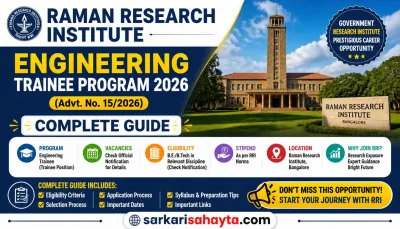
Raman Research Institute (RRI), Bengaluru, has issued Advertisement No. 15/2026 dated 29 May 2026 calling for applications to its Engineering Trainee Program for fresh engineering graduates in Electronics, Electronics & Communication Engineering and Computer Science. The programme offers one‑year trainee positions, extendable to a second year, with hands‑on work on advanced electronics, digital signal processing and software systems. This article explains eligibility, roles, selection process, application steps, documentation, and preparation tips so that candidates can submit a complete and strong application before the last date, 30 June 2026.
Institute overview and purpose of the Engineering Trainee Program
RRI is a premier research institute funded by the Government of India, focusing on research in basic sciences, and more details about its activities are available on its official website. The Institute develops state‑of‑the‑art, in‑house instrumentation for its science and technology projects and is launching the Engineering Trainee Program to involve fresh graduates in designing, simulating and testing modern electronic and computing systems.
The programme is designed to give trainees hands‑on exposure to electromagnetics simulation, advanced radio‑frequency (RF) circuits, high‑speed analogue‑to‑digital converters (ADCs), FPGA‑based digital signal processing and algorithms, as well as software development in high‑speed networking environments. By working alongside scientists and engineers, trainees gain practical experience that bridges the gap between academic learning and real‑world R&D work.
Programme snapshot — Key facts
- Advertisement: Advt. No. 15/2026 dated 29/05/2026.
- Programme: Engineering Trainee Program at Raman Research Institute.
- Positions: Six (6) trainee engineer positions are available.
- Duration: Initial appointment for 1 year, extendable to a second year based on satisfactory performance.
- Probation: Initial probationary period of 3 months.
- Work areas: RF analog and digital signal processing hardware, FPGAs, electromagnetics simulation, ADCs, DSP algorithms, and software development for high‑speed networks.
- Location: Primarily at the RRI campus, Bengaluru, with possible field trips for testing, validation and deployment.
- Remuneration: Rs. 31,000 per month in both the first and second year.
- Last date to apply: 30 June 2026; applications received after this date will not be considered.
Positions and duration — What the trainees will do
The institute has six open positions for trainee engineers under this programme. The initial appointment period is one year, with the possibility of extension for a second year subject to satisfactory performance and institutional needs. During the appointment, trainees are required to assist scientists and engineers in developing cutting‑edge electronic hardware and software systems.
Specifically, trainees will work on radio‑frequency analog and digital signal processing modules, using state‑of‑the‑art Field‑Programmable Gate Arrays (FPGAs) for implementing high‑speed DSP functions and control logic. They may also participate in developing algorithms, integrating hardware subsystems, characterising performance, validating complete receiver chains and working within the institute’s computer group on software development, testing and installation for high‑speed network connectivity.
There is an initial probationary period of three months, during which the institute can closely evaluate the trainee’s technical competence, learning ability, professionalism and teamwork. Successful continuation beyond probation is typically contingent on adequate performance and adherence to institutional discipline and standards.
Eligibility criteria — Age and qualification
RRI has defined clear eligibility criteria to ensure that the programme targets recent graduates with strong academic foundations and a serious interest in electronics and computing. These criteria include a strict age limit and minimum academic performance thresholds in specific disciplines.
- Age limit: Candidates must be 23 years of age or younger as of the closing date for submission of completed online applications. This means that on 30 June 2026, the candidate’s age should not exceed 23 years.
- Educational qualification: Applicants must hold a B.E. or B.Tech. degree in one of the following:
- Electronics
- Electronics & Communication Engineering
- Computer Science
- Minimum marks: At least 70% marks or 7.5 CGPA in the qualifying examination (B.E./B.Tech.).
- Teamwork and field work: The ability to work in teams and at field stations is explicitly stated as essential, reflecting the collaborative and occasionally on‑site nature of the work.
Although the primary workplace is the RRI campus in Bengaluru, the advertisement notes that field trips with team members may be necessary for testing, validation and deployment of integrated receivers, system tests and measurements. Applicants must therefore be prepared for occasional travel and work at field stations as part of team deployments.
Desirable qualifications — Skills that strengthen your profile
In addition to essential criteria, the advertisement lists a set of desirable qualifications that highlight the skills and knowledge areas particularly valuable for the programme. Candidates who can demonstrate these competencies in their CV, projects or SOP will be at an advantage during shortlisting and interviews.
- Aptitude for laboratory work: Comfort in handling lab instruments, setting up experiments, following protocols and maintaining lab records.
- Basic knowledge of analogue electronics: Understanding of circuits, amplifiers, filters, oscillators, biasing, signal conditioning and noise considerations.
- Basic knowledge of digital electronics: Logic gates, combinational and sequential circuits, counters, registers, digital timing, and familiarity with digital design concepts.
- Basic understanding of programmable microcontrollers: Experience or knowledge related to microcontroller programming, interfacing and embedded systems principles.
- Basic/advanced knowledge of computer programming: Proficiency in programming languages (such as C/C++, Python or similar) and understanding of algorithms, data structures and software development practices.
While not mandatory, these desirable skills map directly onto the tasks involved in developing and validating RF front‑ends, digital back‑ends, FPGA pipelines and software tools. Candidates with relevant projects or internships should explicitly highlight them in their CV and Statement of Purpose to demonstrate suitability.
Work profile — What Engineering Trainees actually do
The advertisement paints a picture of a technically rich environment where trainees are exposed to several aspects of modern electronics and computing systems. Trainees will join lab teams working on electromagnetics simulations, where antenna and RF structures are modelled and optimised using specialised tools.
On the hardware side, they will participate in the design and development of state‑of‑the‑art RF circuits and high‑speed ADC‑based systems, including front‑end electronics for receivers and intermediate‑frequency or baseband processing blocks. Integration, characterisation and validation of these modules under real‑world conditions is a key part of their role.
Digital signal processing forms another central pillar, with trainees contributing to FPGA‑based digital signal processing systems and associated algorithms. This may involve working on RTL design, high‑level synthesis, FPGA toolchains, verification and implementation of filters, channelisers or correlators.
On the software and networking side, trainees working with the institute’s computer group may help develop, test and install software to support high‑speed network connectivity, data acquisition pipelines and control systems. This integration of hardware and software responsibilities reflects the modern R&D need for versatile engineering skills spanning multiple layers of the system stack.
Why this programme is valuable for fresh graduates
For fresh engineering graduates, the RRI Engineering Trainee Program offers a unique bridge between academic learning and high‑end research and development. Unlike purely academic or purely corporate roles, this programme situates trainees in a research institute environment where long‑term scientific goals drive technological innovation.
Trainees gain exposure to the complete lifecycle of instrumentation development—from design and simulation, through prototyping and lab testing, to field deployment and integration into real experiments. This holistic experience is particularly attractive for those considering future careers in R&D, advanced electronics, embedded systems, signal processing or scientific computing, and it also enhances their profile for higher studies or specialised industry roles.
The emphasis on teamwork and field work further helps trainees develop soft skills such as communication, collaboration, problem‑solving under real‑world constraints and adaptability to dynamic project requirements. These capabilities are increasingly valued across sectors and can significantly strengthen one’s long‑term career prospects.
Remuneration and terms — Pay, period and probation
The Engineering Trainee positions come with a consolidated remuneration of Rs. 31,000 per month. This stipend is the same for both the first and second year, offering clarity in financial planning for the trainees over the entire potential duration of the programme.
The appointment is initially for one year, with the explicit possibility of extension by one more year, subject to satisfactory performance. This means that continued engagement beyond the first year is not automatic, but depends on periodic evaluations and the candidate’s contributions to projects and team activities.
An initial probationary period of three months allows the institute to assess foundational skills, work ethic, attitude and fit within lab teams. During this period, trainees are expected to demonstrate learning agility, reliability, and adherence to institutional norms and guidelines, which will influence confirmation for the remainder of the year and any potential extension.
General information and shortlisting policy
The advertisement clearly states that fresh graduates are encouraged to apply, signalling that prior industry experience is not mandatory and that the programme is geared towards early‑career engineers. At the same time, the institute reserves the right to limit the number of candidates selected for interviews based on how closely applications match the essential and desirable qualifications.
Mere fulfilment of the essential and desired qualifications does not automatically entitle a candidate to be called for an interview. Shortlisting is competitive and will take into account the alignment of academic performance, skills and stated interests with the specific work areas mentioned in the advertisement, such as RF circuits, FPGAs and programming.
Shortlisted candidates will be requested to appear for a personal written test and/or interview at the Raman Research Institute in Bengaluru. No TA/DA will be paid for attending these selection processes, so applicants should plan their travel and stay arrangements independently if they are shortlisted.
The Institute also notes that it reserves the right to relax the stated requirements in exceptional cases and may choose not to fill the advertised positions if necessary. Additionally, canvassing in any form may lead to disqualification, so candidates must avoid any attempt to influence the selection process through non‑merit channels.
Age relaxation and reservation considerations
While the eligibility criterion includes a strict age limit of 23 years or younger as on the closing date, the advertisement mentions that age relaxation will be applicable as per Government of India rules for candidates belonging to SC, ST, OBC categories and for candidates with disabilities.
This implies that candidates from reserved categories may receive relaxation in the upper age limit according to standard central government norms, subject to submission of valid category certificates and any specific instructions provided by the institute. Candidates who believe they are eligible for such relaxations should carefully check the RRI careers page and any detailed instructions in the online application portal for exact extents and documentation requirements.
As always, claims for reservation or age relaxation must be supported by genuine, valid and appropriately issued certificates. Any discrepancy or non‑genuine documentation can lead to rejection at the application stage or cancellation of selection at a later stage.
How to apply — Online application process
Applications for the Engineering Trainee Program must be submitted by filling out an online form and uploading all required documents and images. The advertisement provides a specific application link: https://careers.rri.res.in/trainee_eng/job_listing.php. Candidates should access this link, read any instructions on the portal and then proceed with registration and form filling.
Before starting the online application, candidates should prepare scanned colour copies of their educational certificates and mark sheets, a concise CV, a well‑written Statement of Purpose (SOP), and digital copies of a recent passport‑size photograph and signature. This preparation ensures a smooth application experience without repeated interruptions to search for documents.
The last date for receipt of online applications is 30 June 2026, and the institute will not consider applications received after this date. It is prudent to submit well before the deadline to avoid last‑minute technical issues or network delays, and to have enough time to correct any inadvertent errors discovered during final review.
Documents to upload — Complete checklist
The advertisement lists the documents and images that must be uploaded along with the online application. Incomplete applications, especially those missing the Statement of Purpose, will not be considered, so every applicant should ensure that their file set is complete and compliant.
- Scanned colour copies of educational certificates and mark sheets: This includes B.E./B.Tech. degree certificate (or provisional if applicable), semester mark sheets and any other relevant academic credentials.
- Curriculum Vitae (CV): Ideally 1–2 pages, summarising academic background, projects, internships, technical skills and any relevant achievements. The CV should emphasise electronics, digital systems, programming and lab experience.
- Statement of Purpose (SOP): A document limited to 1500 words, explaining what motivates the applicant to apply for the Engineering Trainee Program and why they consider themselves an appropriate choice for the opening.
- Recent passport‑size photograph: A clear, recent colour photograph suitable for official records.
- Signature image: A scanned or digitally captured signature that will be used for authentication within the application process.
Each applicant must additionally provide references of two individuals whom the Institute could contact for referral letters. These referees should typically be academic supervisors, project guides or employers familiar with the applicant’s technical abilities and work ethic, and applicants should obtain their consent before listing them in the application.
Since incomplete applications will not be considered, candidates must double‑check that all listed documents are uploaded and clearly legible. In particular, applications without a Statement of Purpose are explicitly mentioned as being unacceptable and will be summarily rejected.
Writing an effective Curriculum Vitae (CV)
The CV serves as a concise technical and academic summary for the selection committee. For an engineering trainee role, it should highlight not just academic performance but also hands‑on projects that demonstrate readiness to work in labs and on real systems.
- Header and contact details: Include full name, email address, mobile number and current city. Ensure that the email and phone are active and monitored regularly.
- Academic summary: Provide details of the B.E./B.Tech. programme, including branch, institute, university, graduation year and overall percentage or CGPA. Mention performance in core electronics and computer science subjects if particularly strong.
- Projects and internships: Describe key projects related to electronics, digital design, microcontrollers, FPGA, signal processing or programming. For each project, briefly note objectives, tools used, your specific contribution and outcomes.
- Technical skills: List relevant skills such as circuit design tools, simulation software, FPGA platforms, programming languages, version control tools and lab instruments you are familiar with.
- Achievements and activities: Mention any hackathons, technical competitions, workshops, training programmes or certifications that relate to electronics and computing.
- Referees (if not asked separately): Sometimes CVs include referees; in this case, ensure they match those mentioned in the application form.
Maintain clarity and brevity: a 1–2 page CV is sufficient if it highlights the most relevant information. Use consistent formatting, bullet points and simple fonts to improve readability and make key skills easy to spot at a glance.
Statement of Purpose (SOP) — Structure and content
The Statement of Purpose is a critical component of the application and must not exceed 1500 words. It must explain what motivates the applicant to apply for the Engineering Trainee Program and why they believe they are an appropriate choice for the position.
A well‑structured SOP could follow these sections:
- Introduction: Briefly introduce yourself, your degree and your career interests, particularly in electronics, embedded systems, signal processing and scientific computing.
- Motivation: Explain why you are interested in RRI and this specific trainee programme. You may refer to your interest in RF systems, FPGAs, electromagnetics, scientific instrumentation or research‑oriented engineering roles.
- Academic and project background: Highlight key courses, labs and projects that prepared you for the programme. Emphasise hands‑on experiences where you designed circuits, wrote code, debugged hardware or participated in team‑based engineering tasks.
- Fit with programme work areas: Connect your skills to the advertisement’s focus: RF analog and digital modules, high‑speed ADCs, FPGA‑based DSP, microcontrollers and networked systems. Show how your knowledge of analogue/digital electronics, microcontrollers and programming aligns with these domains.
- Teamwork and field readiness: Provide examples of working in teams, handling responsibilities, and any experiences in on‑site or field activities, showing that you can adapt to lab and field station environments.
- Career goals: Describe how this trainee programme fits into your medium‑term goals, such as pursuing advanced R&D roles, higher studies (M.Tech./Ph.D.) or careers in advanced electronics or scientific instrumentation.
- Conclusion: Summarise your motivation, reiterate your enthusiasm for contributing to RRI projects and express readiness for the challenges of the role.
Keep the tone professional yet personal, avoid generic statements and ground your claims in specific experiences. Since incomplete applications, particularly those without an SOP, will not be considered, treat this document with the seriousness of a formal, targeted essay rather than a generic motivation letter.
References — Choosing and informing your referees
Each applicant must provide references of two individuals whom the Institute could contact for referral letters. Effective selection of referees can significantly strengthen the application, as their feedback gives the selection committee an independent assessment of your abilities.
Suitable referees typically include:
- Academic advisors or project guides: Faculty members who supervised your major project, final‑year project or important lab work and can comment on your technical skills and work ethic.
- Internship supervisors: Professionals who oversaw your work during internships, especially in electronics, embedded systems, programming or instrumentation roles.
- Department heads or course instructors: If they are well acquainted with your academic performance and participation in departmental activities.
Before listing them, always inform your referees and seek their consent. Share a brief summary of the programme and your CV so they can write informed, specific comments if contacted by RRI. Ensure that their email addresses and phone numbers are accurate and remain active throughout the selection process.
Selection process — Written test and interview
The advertisement states that shortlisted candidates will be requested to appear for a personal written test and/or interview at RRI. While detailed exam pattern and syllabus are not specified, candidates can reasonably expect a focus on core electronics, digital systems, programming fundamentals and problem‑solving relevant to RF and DSP work.
To prepare, applicants should revise:
- Analogue electronics basics: Operational amplifiers, filters, biasing, small‑signal models and noise concepts.
- Digital electronics: Logic design, finite‑state machines, timing diagrams and fundamentals of digital communication.
- Microcontrollers and embedded systems: Basic architecture, GPIO, timers, communication interfaces and simple firmware coding.
- Programming: C/C++ or Python fundamentals, data structures, simple algorithms and debugging techniques.
- Signals and systems / DSP: Sampling, discrete‑time signals, basic transforms and filtering concepts, especially if they have studied such courses.
During the interview, candidates may be asked to explain their projects, demonstrate understanding of circuits or code they have written, and answer conceptual questions about teamwork, problem‑solving and field work readiness. Since no TA/DA is provided, candidates should plan to attend at their own expense if they accept the invitation to the test/interview.
Communication and queries — Official contact channel
For any queries or help related to the Engineering Trainee Program 2026, the advertisement provides a dedicated email: etp2026@rrimail.rri.res.in. Candidates should use this address for clarifications, quoting the advertisement number and their name, and should frame queries clearly and concisely.
As the official application link is https://careers.rri.res.in/trainee_eng/job_listing.php, applicants should also regularly check this page and the main RRI careers section for any updates, corrections, or notices during the application and shortlisting period.
Application checklist — Avoiding rejection
To ensure that their application is considered, candidates should carefully follow this checklist before clicking “Submit” on the online form. Since incomplete applications, especially those lacking a Statement of Purpose, will not be entertained, attention to detail is critical.
- Verify that you meet the age limit (23 years or younger as of 30 June 2026) and essential academic criteria.
- Confirm you have B.E./B.Tech. in Electronics, Electronics & Communication Engineering or Computer Science with at least 70% or 7.5 CGPA.
- Scan colour copies of all required educational certificates and mark sheets and ensure they are clear and readable.
- Prepare a 1–2 page CV highlighting relevant projects, skills and interests aligned with the programme.
- Draft a Statement of Purpose (≤1500 words) that explicitly addresses your motivation and suitability for the role.
- Keep digital copies of your passport‑size photograph and signature ready in the formats and sizes accepted by the portal.
- Identify and confirm two referees and collect their email IDs and phone numbers accurately.
- Fill all fields in the online form, upload documents and review all entries for correctness.
- Submit the form well before the 30 June 2026 deadline and save any confirmation or application ID provided by the portal.
Frequently Asked Questions (FAQ)
- What is the Raman Research Institute Engineering Trainee Program 2026?
- How many trainee positions are available and for how long?
- What are the essential eligibility criteria for applicants?
- What desirable skills can improve my chances of selection?
- What is the monthly remuneration for Engineering Trainees?
- Will there be any written test or interview?
- How do I apply for the Engineering Trainee Program?
- Is the Statement of Purpose mandatory?
- Is there any age relaxation for reserved categories or persons with disabilities?
- Whom should I contact if I have queries about the programme or application?